

 Back to Blogs
The Difference Between Ranking on Google and Being Recommended by AI
Two brands sell roughly the same skincare product. Both have well-built websites, SEO teams, and rank reasonably well on Google.
Ask ChatGPT to recommend a skincare brand for combination skin.
💬 Only one comes up.
Ask Perplexity the same question.
💬 Same brand.
Ask Claude.
💬 Same brand again.
The other one, equally good, equally optimised for Google, doesn’t appear in any of the AI responses.
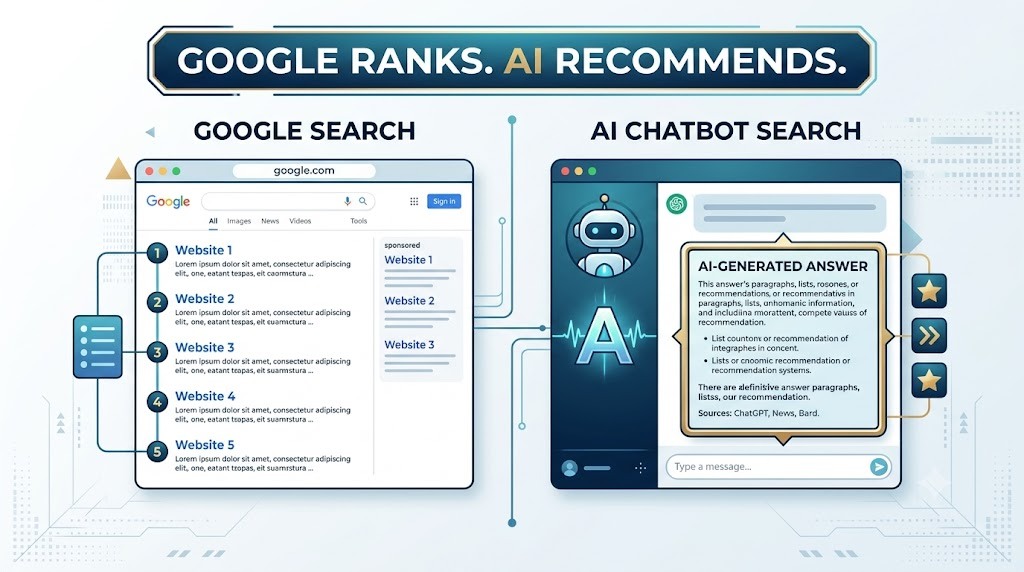
What’s going on? The two systems are not measuring the same thing, and most marketing teams still don’t fully understand how different they actually are.
- Ranking on Google is a popularity contest with an algorithm.
- Being recommended by AI is a credibility test with a synthesis engine.
These are completely different games, and the brands that haven’t figured that out are about to spend the next five years confused about why their SEO investment is producing diminishing returns.
Here’s how the two systems actually work.
Google ranks pages based on signals that have been gamed for two decades.
- Keyword usage.
- Backlinks.
- Page authority.
- User engagement.
- Page speed.
- Schema markup.
- Time on page.
- Click-through rate.
Each is measurable, which means the SEO industry has spent 20 years optimising for them.
The ranked page is the one that played the optimisation game best, not necessarily the page with the most accurate or useful information. Which is why the top result for any commercial query is usually a thinly-disguised product page wearing a blog post costume.
AI systems work differently. When ChatGPT, Claude, or Perplexity gets asked a question, the system doesn’t pull up a list of ranked pages.
- It synthesises an answer from many sources,
- weighted by how often each source is cited, referenced, and
- corroborated across the broader web.
The system is optimising for credibility, defined as the breadth and consistency with which a brand or expert is being talked about across high-trust sources. Popularity, as Google understands it, barely matters.
This produces very different winners.
- A brand can rank well on Google with a strong SEO budget and a thin product page.
- The same brand will not be recommended by AI if other authoritative sources aren’t referencing it independently.
- The AI is looking for a pattern of mentions across the web that suggests the brand actually matters in its category.
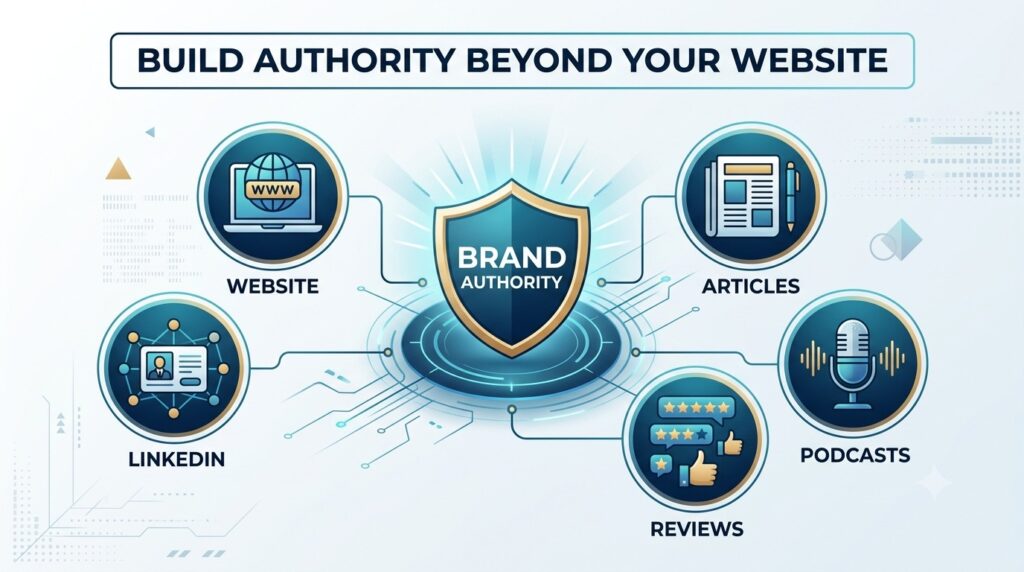
If the only place the brand gets talked about is its own website, the AI has nothing to corroborate against, and the brand goes unmentioned even when it ranks first on Google.
A brand can also be relatively weak on traditional SEO and still get recommended by AI,
- if it’s being discussed in expert communities,
- cited in independent articles,
- mentioned in podcasts,
- reviewed on third-party sites.
The AI sees the pattern of credible mentions and surfaces the brand as a likely good answer, even when its own website isn’t winning the Google rankings.
There’s a third layer worth understanding. Being ranked on Google still gets clicks. Being recommended by AI gets citations. Citations are the new top-of-funnel. When ChatGPT mentions a brand in response to a user’s question, the user often doesn’t click through. They take the recommendation and move on. The brand has been recommended without ever delivering traffic to its own website. This is going to feel uncomfortable for marketing teams still measuring success in page views. The new metric is recommendation share, and most brands aren’t tracking it yet.
What does all this mean practically?
1️⃣ Build authority beyond your website
First, the brand needs to stop treating its own website as the only place that matters.
The brands that get cited by AI are the ones whose ideas, products, and expertise appear in many places across the web.
- Guest posts.
- Podcast appearances.
- Newsletter mentions.
- Industry round-ups.
- Reviews on third-party sites.
- Wikipedia mentions, where appropriate.
The brand’s authority is built outside the brand’s own website, not inside it.
2️⃣ Create original expertise
Second, the brand needs to develop genuine expertise that other sources will reference. Generic content gets ignored by AI synthesis engines.
- Original frameworks,
- distinctive opinions, and
- useful research get cited.
The brand that publishes an original study on skincare ingredient interactions across Indian climates will get referenced by AI when users ask about Indian skincare.
The brand that publishes a generic “top 10 skincare ingredients” listicle will be ignored, even when it ranks well on Google.
3️⃣ Invest in the founder’s voice
Third, the founder voice matters more in the AI era.
AI systems pick up on consistent, recognisable expertise more reliably than faceless brand websites.
A founder who shows up on LinkedIn, podcasts, and YouTube becomes part of the AI’s understanding of the category. The brand whose founder is invisible is harder for the AI to model.
At Mirra Digital, our work for clients has shifted significantly. We still build SEO into the content strategy. The bigger investment is in building distributed credibility across the broader web. The brands following this approach are starting to get recommended in AI responses, which is the new prize.
Google ranking is still useful. Being recommended by AI is becoming more useful.
The brands that figure out the difference are the ones that get found in 2027, no matter what happens to traditional search.