

 Back to Blogs
The Trend Cycle Is Broken. Stop Trying to Keep Up.
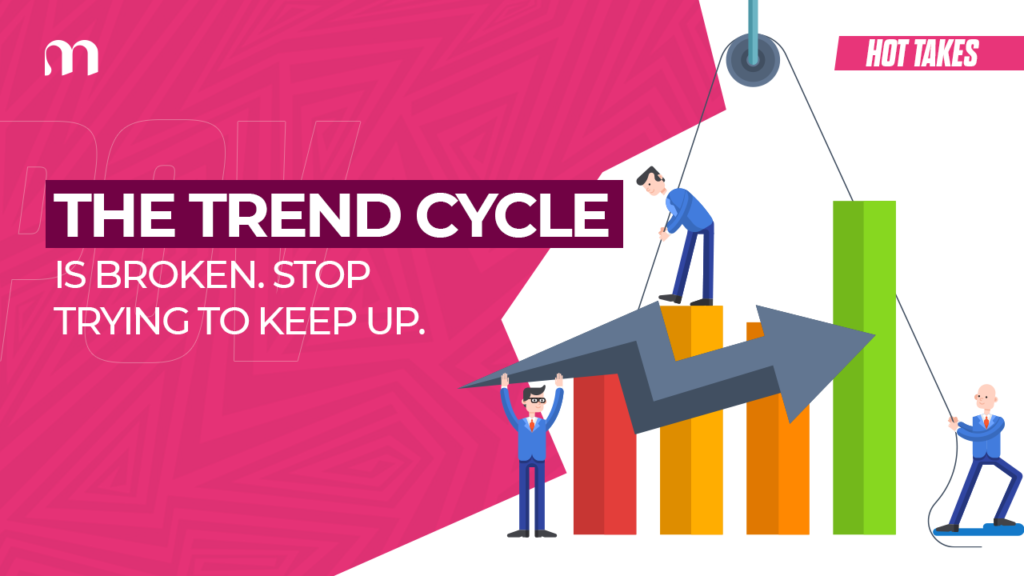
The trend cycle as we knew it, is broken, and most of us are still running on a treadmill that stopped working a while ago.
The whole machinery of “jump on the trend, ride it for reach, move to the next one” used to make sense. Trends had a shelf life of a few weeks. Audiences genuinely got excited when a brand showed up doing something culturally current. Trending audio actually trended.
There was a window, you used the window, you moved on. It worked, and it was fun.
Now the whole thing feels hollow.
⇥ Part of it is speed.
A trend lands on Friday and is over by Sunday lunchtime. By the time a brand has
- briefed a creator,
- filmed,
- edited,
- approved, and
- posted,
the audio has been used by twelve thousand other accounts, the joke has stopped being funny, and the algorithm has moved on to whatever’s next. Most brands aren’t fast enough for the current cycle, and the ones that are fast enough are usually sacrificing quality to make it happen.
⇥ Part of it is volume.
AI-generated trend content has flooded every platform, and the result is a feed where every reel looks like every other reel.
- same audio,
- same format,
- same caption structure,
- same hook.
Audiences have started scrolling past these without registering them, because there’s nothing distinctive to register.
When a hundred brands all use the same trending sound in the same week, it stops being a trend and starts being noise pollution.
⇥ And part of it is audience fatigue.
People have caught on. They can tell when a brand is jumping on a trend purely for reach, and they’ve stopped rewarding it the way they used to. Unless a brand puts a genuinely original spin on the trend, something that makes the trend look like the brand instead of the other way around, audiences are skipping it. Going viral is harder, and the few things that do break through tend to be the ones that aren’t really chasing the trend at all.
The recent penguin video. 🐧
The baby monkey “punch” thing. 🐒
They worked because they were genuinely surprising and weirdly specific. Trying to manufacture that on a content calendar is mostly impossible.
⇥ Here’s where I’ll admit something.
Even I, who runs a marketing agency and writes posts arguing for slower, more intentional content, sometimes feel that low-grade pressure to use a trending audio because surely it’ll help, right? Surely if everyone else is doing it, ignoring it costs me something. I’ll be honest, I’m not even sure it does help. I keep doing it sometimes anyway. The pull of the trend cycle is genuinely difficult to opt out of, even for people who professionally know better, which is part of why this whole thing is a trap. Acknowledging that feels more useful than pretending I’m above it.
⇥ So if the trend cycle is broken, what should brands actually do?
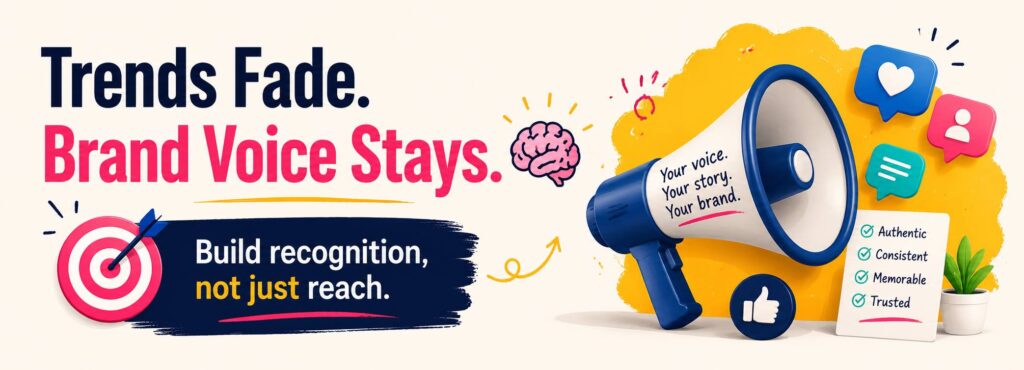
Lead with point of view. Always. The brand should be the constant, and trends should be opportunistic.
- The brands without a clear voice are the ones that get whiplash, because every trend pulls them in a different direction, and over time their audience can’t actually remember what the brand stands for between viral moments.
- When a trend genuinely aligns with what your brand stands for, jump in, do it well, put a real spin on it. When it doesn’t, ignore it and don’t apologise.
- The brands that have a clear, distinctive voice are the ones that can engage with trends without being swallowed by them.
This is the difference between a brand using culture and a brand being used by it.
Building a recognisable voice is slower, less exciting, and harder to measure week to week than chasing reach. It’s also the thing that compounds. A year of consistent point of view will outperform a year of trend-chasing, because the audience gathered through trend-chasing churns out fast and the audience built through real voice tends to stay.
There’s also the practical cost no one talks about. Chasing every trend is exhausting and expensive.
- Briefs,
- edits,
- last-minute filming,
- pulling team members off other work because something’s gone viral and you have to react now.
The energy that goes into reacting to twenty trends in a quarter would be better spent making three pieces of content that actually say something the brand believes.
The cycle isn’t going to fix itself. Audiences have moved on faster than brands have, and the ones willing to admit that and shift accordingly will end up with something the trend-chasers can’t actually buy. Which is memory.