

 Back to Blogs
The Psychology of Micro-Commitments in Online Buying
Every founder asks themselves the same question about their checkout flow. Why are so many people getting to the buy button and then disappearing? The cart is full. The intent is clear. At the final moment, something breaks. The customer hesitates and leaves. 🛒
The answer lies in one of the most reliable findings in behavioural psychology, and it’s a concept most marketing teams have heard of but underuse. Micro-commitments. 🧠
How Micro-Commitments Work
Humans are far more likely to take a big step if they’ve already taken several small ones in the same direction. The principle was first documented in the 1960s, when researchers showed that households who agreed to put a small sign in their window supporting a campaign were much more likely, weeks later, to agree to a much larger sign on their lawn. The small commitment changed how the person saw themselves. They had become “the kind of person who supports this campaign.” The larger ask felt consistent with that identity.
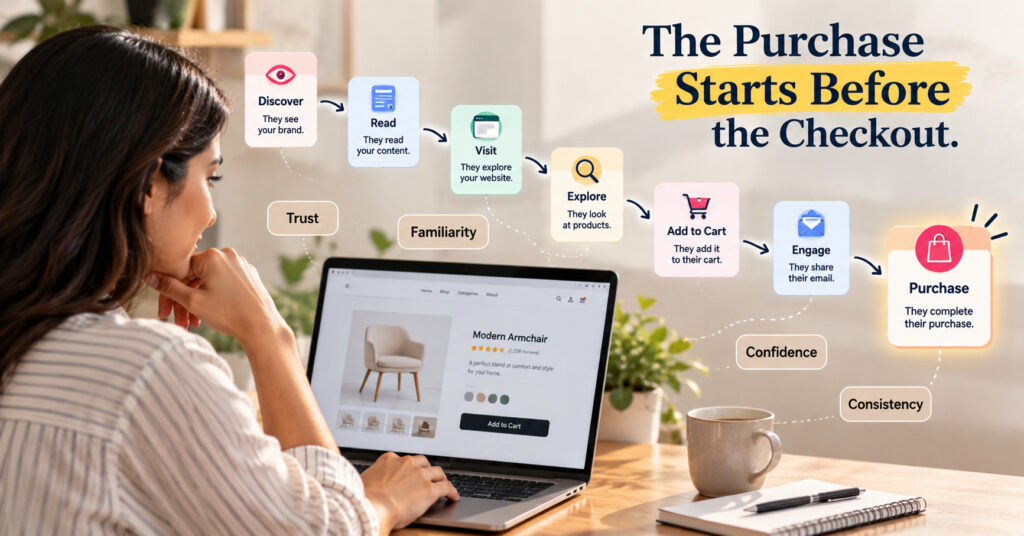
By the time a customer is asked to spend 1,800 rupees on a moisturiser, they’ve already made about seven smaller commitments.
- They followed the brand.
- They read a few captions.
- They opened the website.
- They clicked into a product page.
- They added it to cart.
- They started typing their email.
Each of these is a tiny yes that makes the next yes easier.
The brands losing the most sales at checkout are usually the ones asking the customer to make the entire commitment at once, with no smaller commitments built into the path. The customer arrives via an ad, lands on a product page, sees the price, and has to decide right there whether to commit. That’s a big ask. Most people defer it. Most people don’t come back.
Brands that win at conversion build a series of small invitations into the customer journey, each of which feels low-risk on its own, and which collectively walk the customer toward the larger commitment without it ever feeling like a leap.
What does this actually look like?
It starts with the first interaction.
- The ad asks the customer to click through to a piece of content.
- The content asks them to subscribe to a newsletter for a related guide.
- The newsletter nurtures them with three useful emails.
- Only on the fourth email does the sales pitch arrive, and by then the customer has made five small commitments.
- The pitch lands as a natural next step. 📩
Inside the website, the same logic applies.
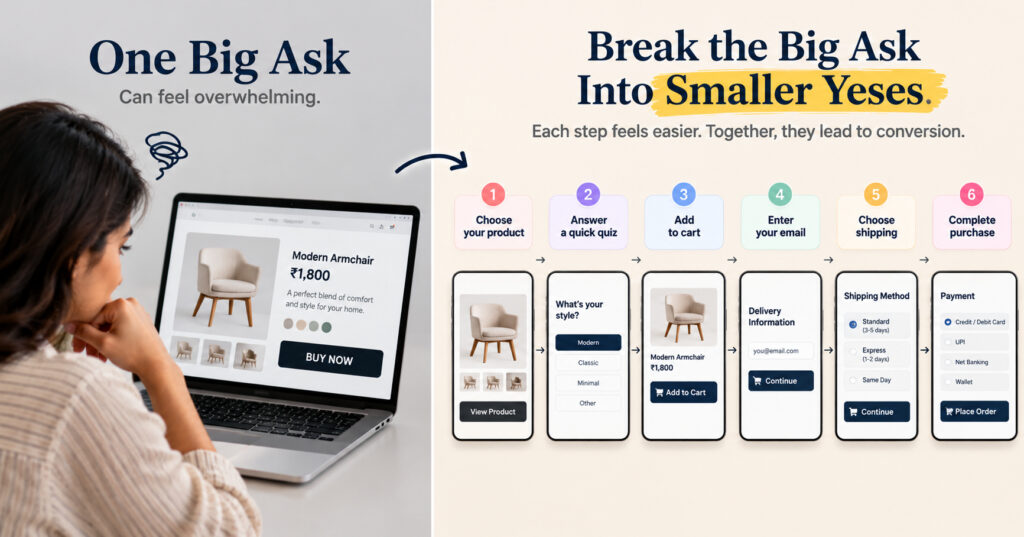
- A product page asking for immediate payment is one big commitment.
- A product page that first invites a variant choice, then a quick quiz, then add-to-cart, then email-for-discount, then payment is asking for a series of small commitments. Each step feels easy. 🛍️
There’s psychology behind why this works. Once a customer has made a small commitment, their brain treats the next request as consistent with who they’ve already shown themselves to be. They followed the brand, they read the content, they took the quiz, they added to cart. They’ve already become the kind of person who buys from this brand. The purchase stops feeling like a decision and starts feeling like a continuation of who they already are. 🧠
The opposite is also true. Customers who haven’t been walked through small yeses treat the purchase as a much bigger decision than it actually is. The brain finds the comparison unfavourable and defers. The brand never gets the customer back.
Practical Ways to Apply This
There are a few practical ways to apply this for any online business.
1. Map out the customer journey from first impression to purchase.
Count the number of yeses required between awareness and conversion. If the answer is fewer than five, the journey is asking for too much commitment too fast.
Add lower-stakes invitations earlier.
- 📝 A quiz.
- 📘 A guide download.
- 📂 A free template.
- 📩 A newsletter signup.
Each one is a small yes that increases the probability of a later, larger yes.
2. Restructure the checkout to break the ask into smaller steps.
Collect the email first. The shipping address second. Payment third. Each step on its own page. Conversion rates routinely improve when this is done well, because each step feels small even when the cumulative effort is the same.
3. Use commitment-style microcopy.
- “Show me the right products for my skin type” is a smaller commitment than “buy now.”
- “Save this for later” is smaller than “add to cart.”
- “See if it’s right for me” is smaller than “start free trial.”
The language on the button matters as much as what it does.
At Mirra Digital, we’ve increasingly built funnel structures around micro-commitment frameworks, with direct ad-to-product page paths reserved only for very specific use cases. The early-stage assets get more clients in the door. The conversion improves at every subsequent step. The math compounds.
Big decisions are made up of small ones. The brands that respect this build sales journeys customers walk through willingly. The brands that ignore it keep wondering why the cart abandonment rate is so high. 🛒