

 Back to Blogs
The Founder’s Biggest Job Isn’t Growth. It’s Focus.
Ask any founder what their biggest job is, and you’ll get the same answer in slightly different words.
- Growth.
- Scaling.
- Revenue.
- Hiring.
- The 10x trajectory.
- Fundraising.
- The hockey-stick chart on a slide.
Almost nobody says focus. Which is funny, because focus is the actual job, and the founders who get it right tend to be the ones whose growth charts everyone else is trying to copy.
💡 Here’s the inconvenient truth nobody wants to put on a LinkedIn carousel.
Most founders die from too many opportunities, well before they die from too few.
The pitch decks are full of options. The customer requests pile up. The advisors all have ideas. The team brings five new initiatives to every quarterly meeting. The market keeps surfacing adjacent verticals the brand could expand into.
✅ Saying yes feels productive.
❌ Saying no feels like leaving money on the table.
So the founder keeps saying yes.
And six months in, the team is burnt out, the strategy is incoherent, and growth has stalled in three places at once.
Focus is the founder’s actual job.
Everything else, the hiring, the marketing, the sales, the operations, can be delegated to people who are often better at it than the founder.
The one thing that can’t be delegated is the decision about what not to do.

The founder is the only person in the room who can credibly:
- Kill a project
- Decline an opportunity
- Shut down a debate by saying “that’s not what we’re focused on.”
The rest of the team can suggest it. Nobody else can enforce it.
Why is focus so hard?
1️⃣ The first is that saying no feels expensive in the moment.
The customer requesting a feature might churn.
The opportunity declined might be the one that took off.
The new market segment ignored might be the one that defined the next decade.
The founder can’t see the counterfactual where they said yes to everything and went broke, because that counterfactual hasn’t happened to them.
They can see the cost of saying no in vivid detail, and the cost of losing focus only in abstract.
2️⃣ The second is that founders are usually high-energy people who genuinely enjoy new ideas.
- The dopamine hit of a fresh opportunity is real.
- The slog of executing on an existing one is real.
Most founders unconsciously chase the first feeling, while the second is where actual businesses are built.
3️⃣ The third is social pressure.
The founder community talks constantly about growth, expansion, scaling, new markets.
The founder who privately executes on one thing for three years can feel like they’re falling behind, even when they’re actually pulling ahead.
Comparison is the thief of focus.
So what does focused founding actually look like, in practice?
1) Pick one customer.
Not one industry.
One customer profile.
The specific, named, painfully detailed version of the person the brand serves best.
Make every decision through this lens.
- If the new feature doesn’t help this customer, it doesn’t get built.
- If the new channel doesn’t reach this customer, it doesn’t get used.
- If the new hire doesn’t understand this customer, they don’t get the offer.
Focus starts with knowing exactly who the work is for.
2) Kill the strategy meeting that adds.
Run the one that subtracts.
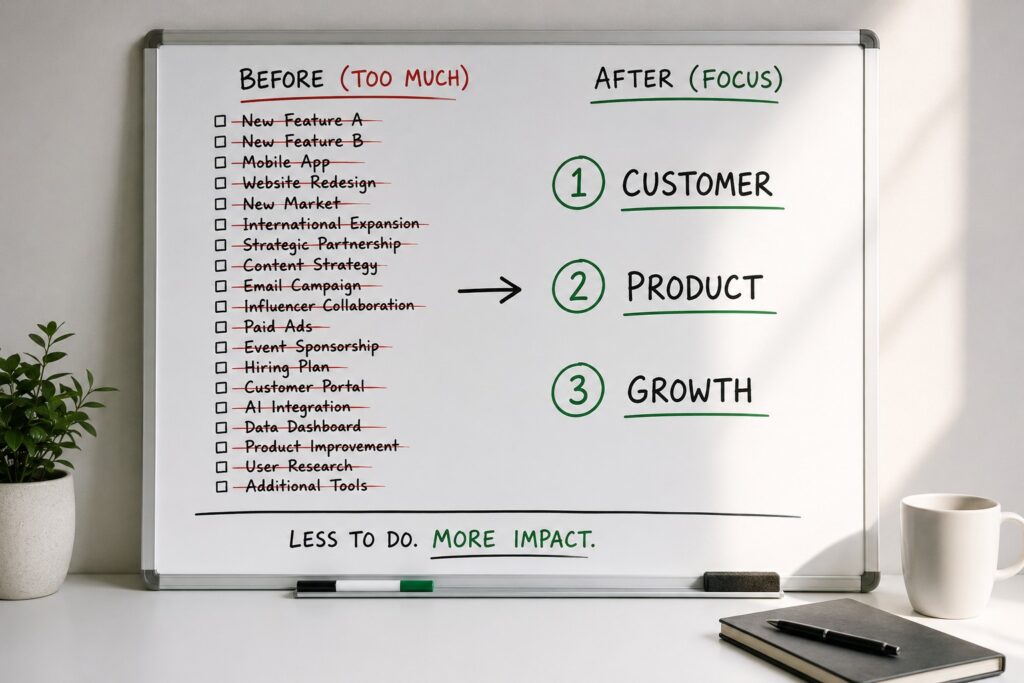
Most strategy meetings end with more to do.
The founder’s job is to run meetings that end with less to do.
Look at the current roadmap, ask which three things matter most, and shelve the rest.
📅 Do this monthly.
Watch the team get faster.
3) Set a “no” budget.
Some founders find it useful to commit to a number of opportunities they will say no to each week.
Five no’s is a healthy target for a small business.
If a founder hasn’t said no to anything in a week, they probably haven’t been paying attention.
Choose what to be bad at.
Every focused business is also, by definition, intentionally bad at some things.
The skincare brand that focuses on combination skin is bad at being relevant to oily-skin customers.
The agency that focuses on early-stage brands is bad at serving enterprise.
Being bad at things on purpose is how being great at one thing happens.
The founders building the strongest businesses in 2026 are doing the least amount of the wrong things.
Their teams are not stressed about prioritisation.
✅ Their content is not all over the place.
✅ Their product is sharply defined.
✅ Their marketing is consistent.
And underneath all of it is a founder who has accepted that focus is the job, with growth as the outcome.
If your team is currently working on more than three priorities, it’s probably worth a Monday morning conversation about which one you’d shelve if you had to.
At Mirra Digital, half of what we do for founders is help them figure out what to stop doing so the rest can finally start working.
❤️ Sometimes the bravest thing a founder can do is close five tabs and finish one.