

 Back to Blogs
ChatGPT Ads vs Google Ads: What Marketers Should Know
You’re the founder of a small SaaS company in Bengaluru. You’ve spent four years pouring money into Google Ads. Your average CPC is now 42 rupees. Your conversion rate has flatlined. Your team is asking whether ChatGPT ads, now available in India, might be a better spend for the same money.
The answer is more complicated than a clean “yes, switch” or “no, stay put.”
Here’s the opinion most marketers on LinkedIn are not saying clearly.
ChatGPT Ads and Google Ads are not replacements for each other. They serve two different stages of consumer intent, and any brand that tries to move entirely from one to the other is going to leak revenue somewhere.
Let’s break down the differences.
1. The mechanism is different.
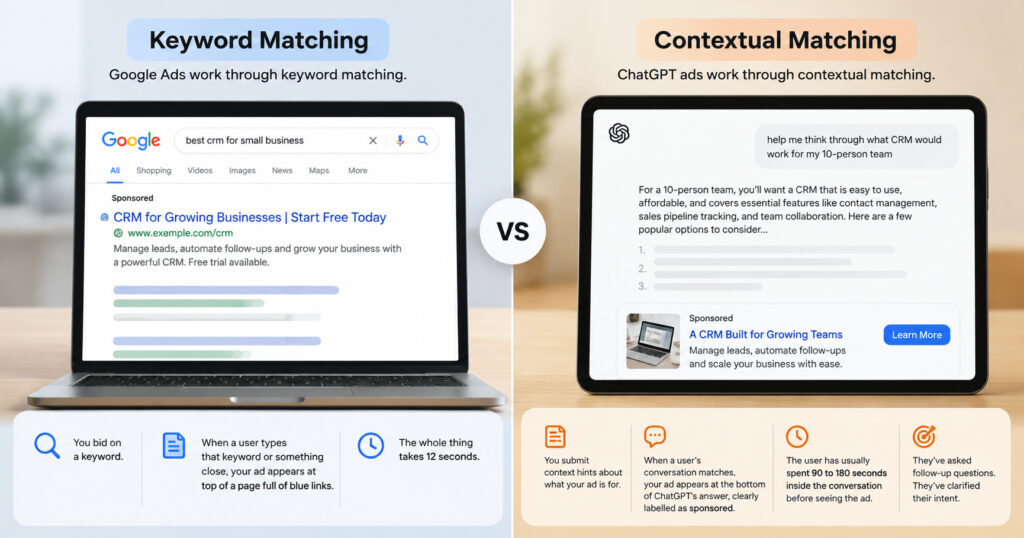
Google Ads work through keyword matching.
- You bid on a keyword.
- When a user types that keyword or something close, your ad appears at the top of a page full of blue links.
- The whole thing takes 12 seconds.
ChatGPT ads work through contextual matching.
- You submit context hints about what your ad is for.
- When a user’s conversation matches, your ad appears at the bottom of ChatGPT’s answer, clearly labelled as sponsored.
- The user has usually spent 90 to 180 seconds inside the conversation before seeing the ad.
- They’ve asked follow-up questions.
- They’ve clarified their intent.
By the time your ad appears, they’ve done more thinking about what they need than a Google user ever does.
2. The format is different.
A Google Ad is a headline and two lines of description fighting for attention against ten other links.
A ChatGPT ad is a small card with a short line of copy sitting directly below an authoritative-looking AI answer.
- Google: Multiple search results competing for attention.
- ChatGPT: Sponsored card positioned below the AI-generated answer.
- There’s no other competing ad in view.
3. The intent stage is different.
This is the piece most marketers are underestimating.
Google Ads is often bottom-funnel.
Someone typing “best CRM for 10-person team pricing“ is very close to a buying decision.
ChatGPT ads is often mid-funnel.
Someone asking ChatGPT “help me think through what CRM would work for my 10-person team“ is earlier in the journey.
They’re comparing, considering, still open to being influenced.
Where Google Ads still wins.
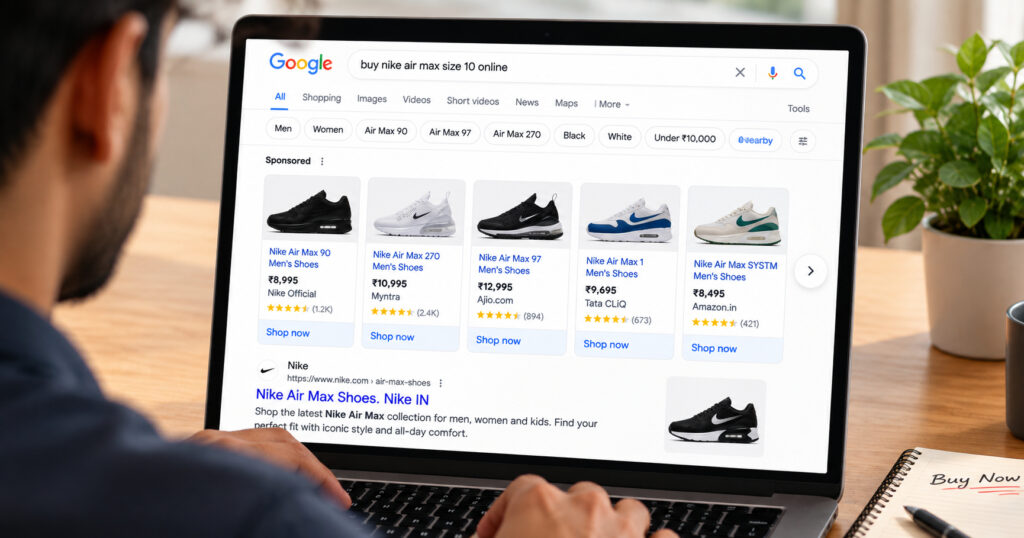
High-intent transactional queries.
“Buy Nike Air Max size 10 online“ is a Google query.
Nobody asks ChatGPT to help them buy shoes they’ve already decided on.
Google still owns this and probably will for years.
Where Google Ads is losing ground.
Complex research queries.
“What’s the best way to structure my agency’s pricing model“ used to go to Google, which returned a list of blogs.
Now it goes to ChatGPT, which returns a full custom answer.
Traffic that used to hit your blog is now hitting ChatGPT’s answer, and the only way for your brand to show up in that moment is through the sponsored slot or by appearing in the organic answer.
Where ChatGPT Ads is starting to win.
Mid-funnel research and consideration.
Early Indian data shows conversion rates on ChatGPT ads closer to search than to social, at CPCs significantly lower than either.
The auction is still young, competition is still light, and the intent is real.
🚨 This is the honeymoon window that will not last past mid-2027.
Will ChatGPT Ads replace Google Ads?
No, at least not soon.
The two platforms are catching different customers at different moments.
What we’re seeing is a rebalancing.
Marketers who were spending 100% of paid budget on Google and Meta will start moving 10 to 20% of that budget to ChatGPT for testing.
The brands that get their learning in early will have an unfair advantage when ChatGPT prices go up.
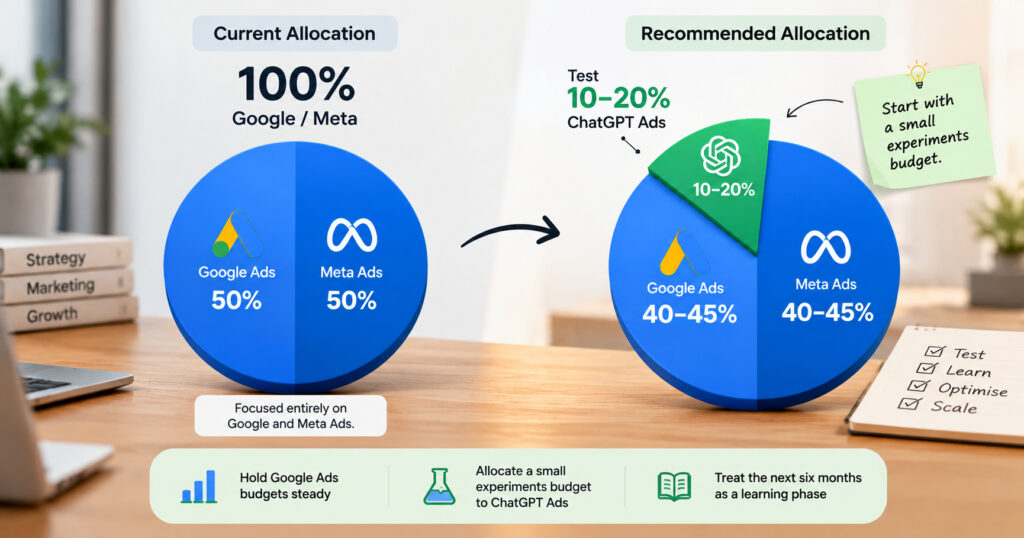
We’re telling clients to:
- Hold Google Ads budgets steady
- Allocate a small experiments budget to ChatGPT Ads
- Treat the next six months as a learning phase
Brands that come out of 2026 knowing how to use both channels will have a real advantage over the ones still deciding whether ChatGPT is worth the trouble.
Stop framing this as ChatGPT vs Google.
The real question is:
how do I use both, in what ratio, for what type of query.
Choose neither. Use both. Learn now.