


 Back to Blogs
The New Etiquette of Replying to Voice Notes

There’s a new social pressure that didn’t exist five years ago, and almost nobody is talking about it. It arrives in the form of a small grey bar on WhatsApp, Instagram, or iMessage. Someone has sent you a voice note. The bar shows the length. 2:34. Sometimes 4:18. Once, memorably, 11:47. You stare at it. You feel something between mild dread and mild guilt. Then you don’t open it for three days.
The voice note has become the most polarising form of digital communication of the last few years. And the etiquette around it is still being made up in real time, by everyone, badly, all at once.
Let’s talk about it. Because it matters more than it sounds, especially for anyone in business, working remotely, or just trying to navigate modern friendships without losing their mind.
🎧 First, the obvious question. Why did voice notes take over in the first place?
Because they are convenient for the sender. Voice notes are the fastest way to get a long thought out of one’s head. No typing. No editing. No proofreading. The sender records, hits send, moves on. From a sender’s point of view, voice notes are wonderful. From a receiver’s point of view, they are a small commitment shaped like a grey rectangle.
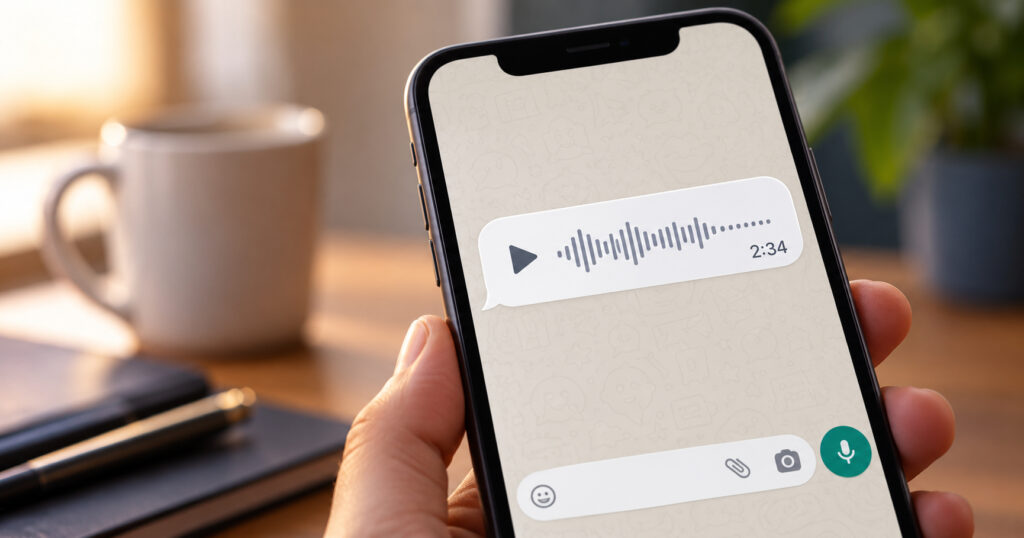
And there lies the problem. Voice notes shift the labour of communication from the sender to the receiver. Reading a text takes seconds. Listening to a voice note takes the entire length of the voice note, plus the social pressure of paying attention. The receiver has to find the time, hold the phone in a way that doesn’t broadcast the audio to a coffee shop full of strangers, and concentrate. Often while the sender has already moved on to their next thought.
There’s also no skimming option.
A text can be read in a glance. A voice note has to be listened to in full, or scrubbed through awkwardly with constant pauses. The receiver can’t easily tell which 30 seconds of the 4-minute voice note actually contained the information they needed. This is why voice notes get ignored. They demand too much from the receiver, often for too little payoff.
- Across India, the Middle East, and Australia, the cultural texture of voice note usage is genuinely different.
- In India, voice notes have become the default in family WhatsApp groups, with parents and grandparents using them as the closest digital equivalent to a phone call.
- In the Middle East, voice notes are used in professional contexts too, with colleagues sending 5-minute notes mid-workday as a faster alternative to typing long messages.
- In Australia, voice notes are more common in close friendships and rarer in work settings, where they’re often considered slightly imposing.
All of which means a thoughtful sender now has to ask a few questions before recording.
- Who is the receiver, and what’s their relationship to voice notes?
- Will this be received as a warm gesture or as a small imposition?
- Could the same content be communicated in a 30-second written message?
Some new etiquette is starting to settle. Here’s what’s emerging.
📌 Voice notes longer than 90 seconds need a justification.
Either the content is genuinely complex, or the receiver has explicitly opted in to long-form audio from this sender. A 4-minute voice note sent without warning is a small social tax most receivers resent paying.
Send a one-line text before the voice note.
A quick “sending you a voice note about the campaign feedback, no rush” gives the receiver context, a sense of urgency, and a chance to mentally prepare. This is the difference between feeling addressed and feeling ambushed.
Don’t follow up if the voice note hasn’t been heard.
The grey-bar-of-shame already does the work. Adding “did you get my voice note” the next day intensifies the social pressure that made the receiver avoid it in the first place.
Transcripts are no longer optional.
WhatsApp, Instagram, and iMessage all offer automatic transcription. Senders who care about being respectful of the receiver’s time should consider whether the voice note is necessary at all. If the answer is yes, the transcript option will get used far more often than the audio.
Reading the voice note transcript is not rude. It’s just the modern equivalent of skimming an email.
Don’t send voice notes to people whose work involves being on calls all day.
Doctors, founders, journalists, recruiters, customer support teams. By the time they have a moment to listen, your point will have lost its context and they will have lost their patience.
Don’t record voice notes in noisy environments.
The chai shop background, the car horn, the wind on the beach. It’s charming for ten seconds and exhausting for two minutes.
Take phone calls.
If a topic genuinely requires three minutes of explanation, a five-minute conversation with the receiver actually present is better for everyone.
The deeper truth about voice notes is that they reveal how much we secretly miss talking to each other in real time.
The grey rectangle is a workaround for the conversation we couldn’t quite schedule.

Maybe sometimes it’s just easier to call.