

 Back to Blogs
How to Turn Customer Questions Into a 3-Month Content Strategy

Quick question. 🤔 When was the last time you stared at a blank Google doc trying to plan content? If the answer is this week, this is for you.
Here’s the thing most founders and small marketing teams don’t realise.
- The content strategy you’ve been agonising over already exists.
- It’s sitting in your DMs, your inbox, your support tickets, your sales calls, and your comment sections. 📩
- 💬 Every question a customer has ever asked is a free, validated content idea.
The only question is whether anyone’s been listening. 👂
Most brands aren’t listening. 🚫 They write content based on what they think their audience should care about, which is usually some version of “why our product is amazing.” Then they wonder why nobody engages. 🤷 Meanwhile, the audience is sending the same six questions to support every week, and nobody on the team is connecting the dots. 🔍
Here’s how to do it differently. 👇 A three-month content strategy, built entirely on real customer questions, that you can sit down and write in about ninety minutes. ⏱️
Start with the question archive.
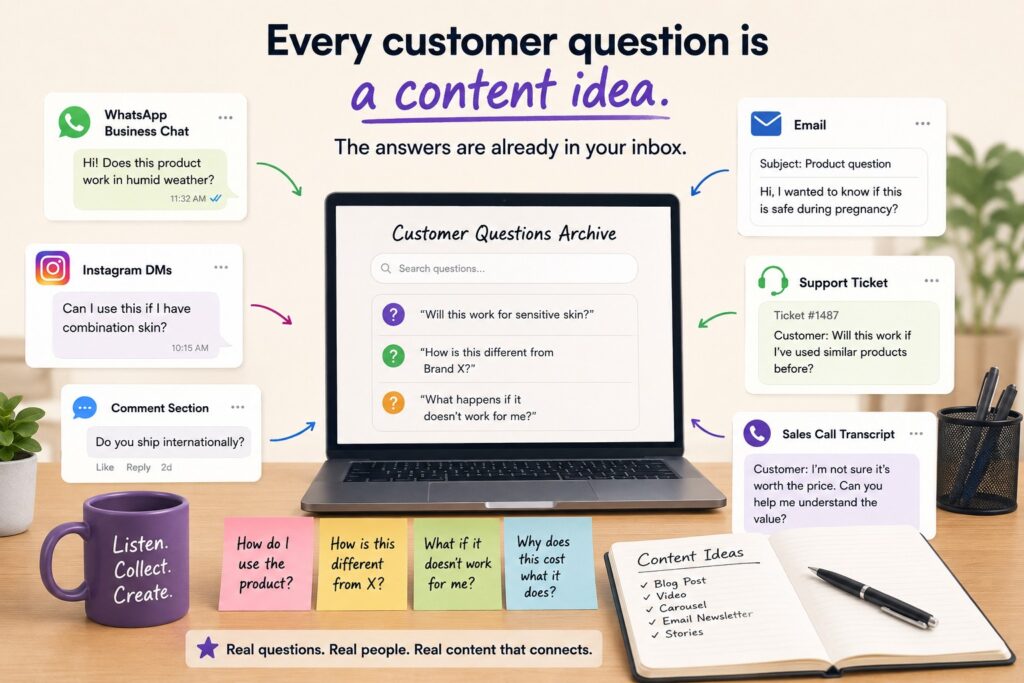
Open every channel where customers talk to your brand:
- WhatsApp business chats
- Instagram DMs
- Comment sections
- Support tickets
- Sales call transcripts
Go back two months. Pull every question a real human has asked. Don’t filter. Just collect. 📝
You’ll be surprised how much material is already there. 😮 A small brand can easily pull together fifty to a hundred questions in an afternoon. Bigger ones, two or three hundred. None are guesses about what your audience wants. They’re things actual humans typed because they actually wanted to know. 💬
Now group them.
Don’t overthink it. Sort the questions into rough buckets:
• “How do I use the product.”
• “How is this different from X.”
• “What if it doesn’t work for me.”
• “Why does this cost what it does.”
Clusters appear naturally. Some questions come up ten times. Those are gold. 🥇 Some come up once. Hold on to those too, they often hide the most interesting angles.
Here’s the part nobody talks about. The same question, asked by twenty people, almost always means there’s a piece of content missing. 🚨 If you keep getting asked whether your skincare works for combination skin, the issue is that nobody’s written the piece that addresses combination skin. That’s a free content brief, handed to you by actual customers.
Once you have the buckets, build the calendar.
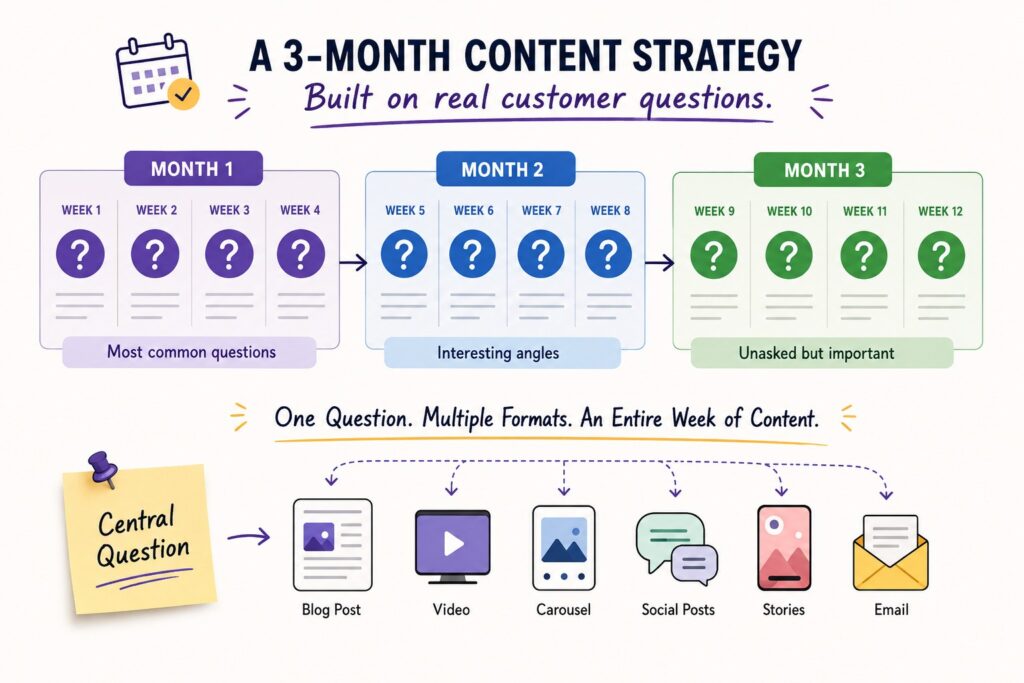
Twelve weeks. One central question per week, with smaller related pieces flowing out of it.
1️⃣ For the first month
Take the four questions that come up most often. These are your strongest opportunities because the demand is already proven.
Build a main piece of content around each one. A blog post, video, long-form Instagram carousel, or newsletter. Then break each main piece into smaller social posts, story arcs, and email content. 🔄
One question, multiple formats, an entire week of content from a single insight.
2️⃣ For the second month
Go to the questions that came up less often but raised the most interesting angles. The questions that surprised you. 😯 The ones that suggested customers were thinking about your product in ways you hadn’t anticipated.
These pieces often outperform the obvious topics, because they signal that the brand is paying attention. 👀
3️⃣ For the third month
Look at the questions that didn’t get asked but should have. The hesitations and objections that come up in sales calls but never in DMs.
Harder to write, often the highest-converting, because they pre-empt the friction sitting between an interested customer and a confident one. 🎯
Three months. Twelve weeks. Twelve central questions. Sixty to a hundred individual pieces of content, depending on how aggressively you repurpose.
All of it built on real demand from real people, with zero guesswork. 🙌
A few things that make this actually work in practice.
📌 Write in plain language.
The customer who asked the question used everyday words. The answer should too. If the original DM said “will this work for oily skin in the monsoon,” the blog post shouldn’t open with “In today’s increasingly humid climate.” Match the energy of the question. 🗣️
📌 Credit the source.
Open the piece with the actual question, sometimes verbatim. “A customer asked us last week…” frames the content as a genuine response, which builds trust and signals that the brand is listening. 🤝 People love being heard. ❤️
📌 Keep collecting.
The question archive isn’t a one-time exercise. Set up a simple spreadsheet, a Notion page, or a WhatsApp group with the team where new customer questions get dropped throughout the month. 📥
After a year, you’ll have a content engine that runs on its own.
Here’s the bigger shift. 🔄 Once a brand treats customer questions as the strategy, the relationship with the audience changes. People start feeling like the brand is listening, which is a strange thing for marketing to make a customer feel.
📈 Engagement goes up.
📈 Conversion goes up.
Both because the content is answering things real people actually had on their minds. 💬
So…. what’s the most common question customers asked you this month? 🤔 Have you written about it yet?
If not, you already know what next week’s content should be. 👀
Sometimes the strategy is right there in the inbox. 📩