Back to Blogs
The Best Marketing Advice I Ever Got Was from My Grandmother, Who Has Never Heard the Word “Marketing”
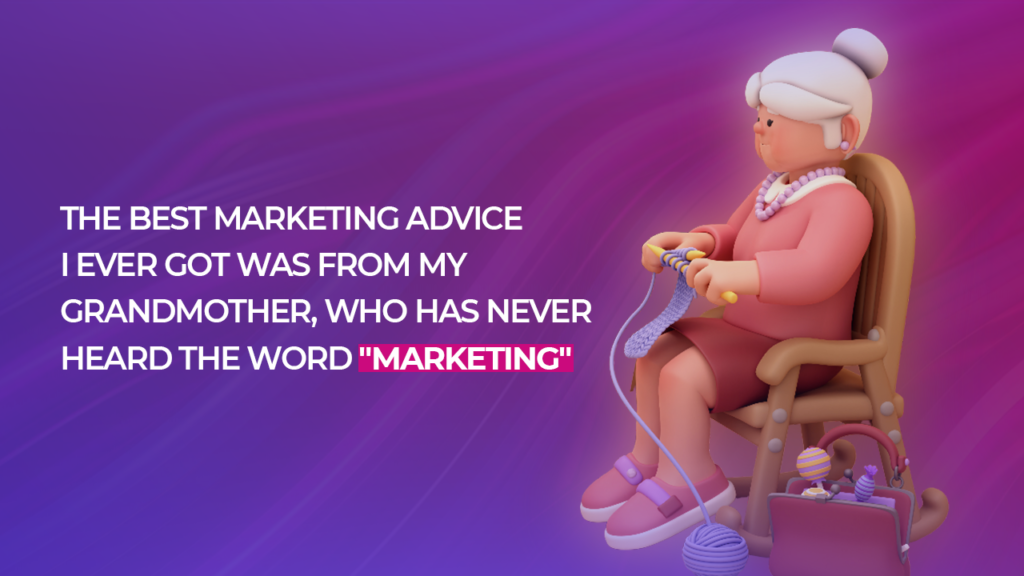
Every Indian household has, or once had, a grandmother who ran the most important marketing meetings of the family without ever calling them that.
- She decided which brand of atta the house ate.
- She decided which shop the sarees came from.
- She decided which pressure cooker had earned its place in the kitchen for the next fifteen years.
She had never heard the word marketing. She could barely operate the TV remote. And she was, without exaggeration, better at consumer decision-making than most people currently drawing marketing salaries in India.
Here’s the opinion I’ve arrived at slowly, working with founders across India who spend crores optimising acquisition funnels. The best marketing advice most of us will ever get was given to us by someone who has never used the word. It came from watching older women make consumer decisions with a rigour Silicon Valley has spent forty years trying to build machine-learning models to replicate.
Let me explain what I mean.
Four Rules Grandmothers Followed Before Modern Marketing Existed
Grandmothers had a set of rules for how to evaluate a product, and every single rule was more sophisticated than what most brands are doing today. Let’s walk through them.
1️⃣ Trust Before Trying
Rule one. Never buy a new brand until at least three trusted people have used it for at least six months. This is roughly the exact framework modern brands try to reverse-engineer through influencer marketing, review aggregation, and social proof. Grandmothers did it with a phone call to their sister-in-law and one visit to the neighbour. The evaluation window was longer. The trust ratio was tighter. The conversion, once it happened, was permanent.
2️⃣ Packaging Is a Signal
Rule two. The packaging is a signal about the price, and any brand overinvesting in packaging is probably overcharging inside. Modern D2C brands spend enormous amounts on packaging. Grandmothers would look at the packaging, do the mental math, and decline the product on the basis of what they suspected the margin was. Every brand launching in India today has forgotten how well-tuned this instinct is in older consumers.

3️⃣ Consistency Over Discounts
Rule three. If it’s genuinely good, the price stays stable. If it goes on discount every three months, something is wrong. This is exactly the insight modern brand theory has been trying to articulate for a decade. Discount frequency is a signal of margin desperation. Grandmothers knew this thirty years ago. They punished discount-heavy brands by refusing to buy them at any price, on the grounds that a brand willing to discount had been overpriced to begin with.
4️⃣ Value You Can Explain
Rule four. Never buy something you can’t explain the value of to somebody else. If you couldn’t explain to your daughter-in-law why this specific vessel was worth the price, you didn’t buy it. This is the ultimate consumer discipline. Modern brands are constantly selling to customers who buy things they can’t justify to anyone, which produces the guilt-heavy buying culture we’ve been writing about elsewhere. Grandmothers refused to enter that culture in the first place.
What These Rules Tell Us About Consumer Behaviour
Put those rules together.
- Long evaluation windows.
- Suspicion of packaging.
- Suspicion of discounts.
- Refusal to buy things you can’t justify to anyone.
This is a better consumer research framework than most Indian D2C brands are currently using. It also produces significantly better consumer decisions than most modern marketing systems produce, which is one reason grandmothers rarely regretted a household purchase and modern consumers regret them all the time.
The Marketing Lesson Is Structural, Not Sentimental
The marketing lesson from grandmothers is not sentimental. It’s structural. The framework Indian households used for generations was, in every important sense, more rigorous than what digital marketing has replaced it with. We’ve traded a slow, careful, socially-verified consumer culture for a fast, algorithmic, reach-optimised one. The trade has produced more revenue for brands and much less confidence for consumers.
What Can Indian Brands Actually Do With This Insight?
Slow down the conversion timeline.
Stop pretending customers should buy on the first visit. Build touchpoints that let a customer evaluate the brand over three or six months, the way a grandmother would evaluate a new atta before switching.
Underinvest in packaging. Overinvest in the product itself.
The grandmother test still works. If your product looks 40% more premium than it actually is, an entire generation of Indian consumers will write you off.
Discount rarely, and only for real reasons.
Every discount trains the customer to distrust the base price. The grandmother rule of “never buy a discounted brand full price again” is still active in the Indian consumer psyche. Ignore it at your revenue’s expense.
Build reputation locally before nationally.
Get 500 households in one neighbourhood to love your product before spending a rupee on national ads. The grandmother network is still the most reliable distribution system in India. It just doesn’t run on Meta.
At Mirra Digital, we tell clients that Indian marketing sophistication didn’t start with Instagram. It started with the women running households in Mysore, Lucknow, and Coimbatore, who were doing consumer research three decades before McKinsey opened a Bangalore office.
A Thought Worth Remembering
The best marketing advice most of us will ever get came from someone who has never heard the word. Worth remembering, before the next round of budget briefings.