

 Back to Blogs
Why Structured Expertise Is Becoming More Valuable Than Content Volume

Imagine two consultants pitching the same client.
Both have similar credentials.
📚 One has published 200 blog posts in the last two years, plus a weekly newsletter, plus a steady drumbeat of LinkedIn content.
📄 The other has published 14 pieces in the same time. Just 14.
🤔 Guess which one gets hired?
The 14-piece consultant. Almost always.
📌 Here’s what’s happening across knowledge industries right now, and most marketers haven’t noticed yet.
Volume used to be a signal of expertise.
“This person publishes a lot, they must know what they’re talking about.”
That signal has been broken.
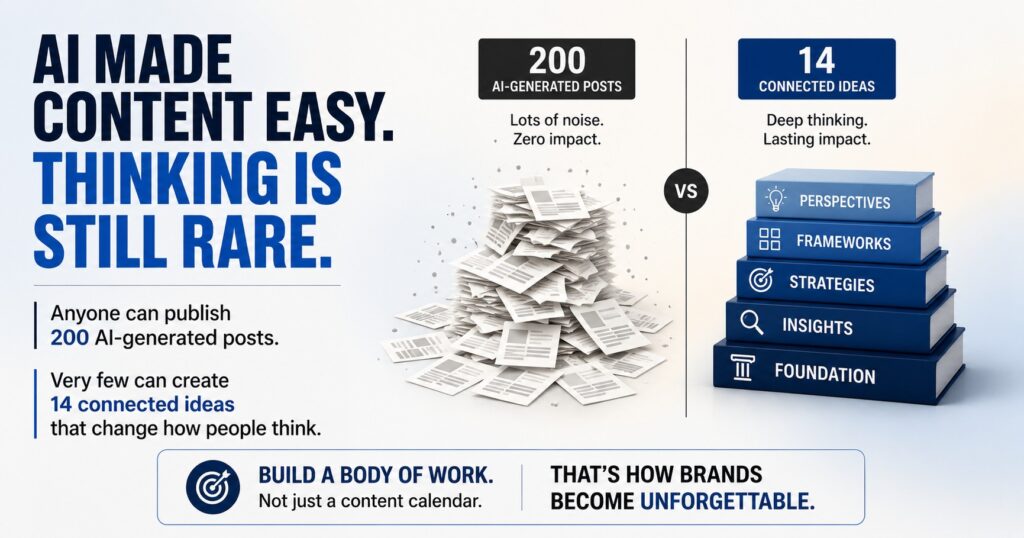
AI can produce 200 blog posts in a weekend.
Publishing volume now signals one of two things to a discerning buyer.
- Either the brand is paying a content factory to churn it out,
- Or the brand is using AI to generate the bulk of it.
Both are interpreted as low-effort, regardless of the actual quality.
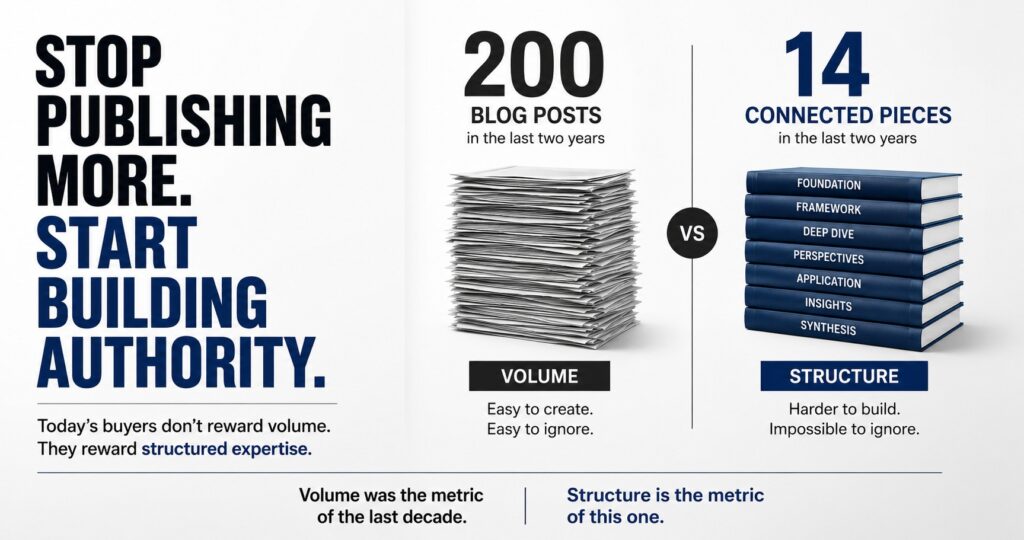
What’s working in its place is structured expertise.
The 14 pieces from the second consultant are connected.
- Each one builds on the previous.
- They demonstrate a coherent way of thinking about the problem.
- They reference each other.
- They form, collectively, a body of work that signals the consultant has actually thought through this domain for years.
That’s what expertise looks like now.
- Volume has stopped functioning as the credibility signal.
- Structure has taken its place.
Why has this shift happened ?
1️⃣ First, AI flooded the volume game.
Every brand can now publish 50 blog posts a month if they’re willing to copy-paste from ChatGPT.
Volume used to require either talent or money.
Now it requires neither.
Anything that gets cheap and abundant stops being a credibility signal.
This is true of every market in history.
2️⃣ Second, buyers have gotten weirdly good at spotting the volume game.
The reader who scrolls a content-heavy LinkedIn profile and sees 200 nearly-identical posts in the last year doesn’t think:
“Prolific expert.”
They think:
“Automated, probably AI-assisted, hard to tell what this person actually believes.”
The signal flipped from “impressive” to “suspicious” in about 18 months.
3️⃣ Third, AI search has changed what content actually does for a brand.
When ChatGPT or Perplexity gets asked a question, it cites the source that demonstrated the deepest understanding.
A single excellent piece can be cited thousands of times.
A hundred mediocre pieces on the same topic get cited zero times.
The math has flipped.
So what does structured expertise actually look like in practice?
It looks like a body of work.
❌ Not a content calendar.
✅ A body of work.
The difference matters.
A content calendar fills slots.
A body of work answers a single question across multiple angles, with each new piece adding a layer that wasn’t there before.
If you read the first piece, you should be primed for the second.
If you read all 14, you should come away understanding the domain at a depth no single piece could provide.
It looks like distinctive frameworks.
Brands building structured expertise tend to develop named ways of thinking about problems.
- The 5-step framework.
- The decision matrix.
- The diagnostic question.
These frameworks function as transmission tools for the underlying expertise.
A reader who has internalised a brand’s framework starts thinking about their own work through that framework, which is the deepest form of brand-building that exists.
It looks like long-term consistency on a narrow topic.
The structured expert writes about the same handful of things, from different angles, for years.
The content factory writes about whatever’s trending this week.
- One builds compounding authority.
- The other builds noise.
It looks like clear opinions and clear repudiations.
Structured expertise requires saying what to do and what to stop doing, with equal clarity.
The brands building real authority publish content that names the bad ideas in their industry by name.
- This is uncomfortable.
- It’s also what makes the expertise visible.
- Vague experts are forgettable.
- Sharp ones get cited.
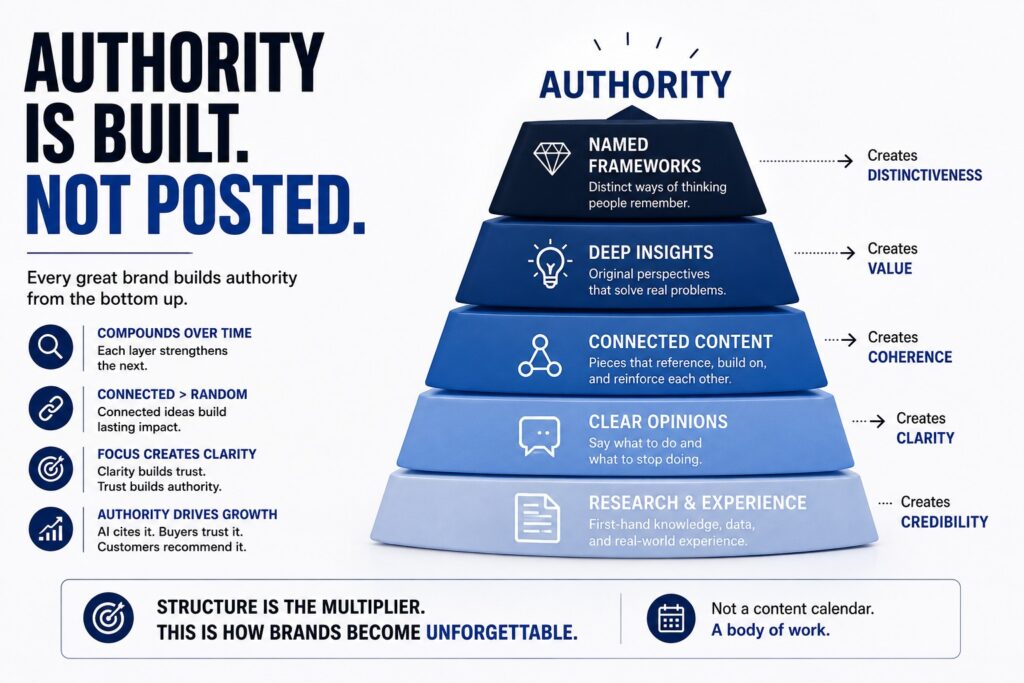
Practically, here’s what this means for any brand still publishing a lot of mediocre content.
📌 Cut your output by 70 percent and improve what’s left.
The brand publishing 50 blog posts a month would be better served by publishing 15 deeply considered ones with real depth.
The freed editorial bandwidth gets spent on research, editing, and connecting the pieces into a coherent body of work.
📌 Pick three to five questions you want to be known for.
Then commit to answering them across multiple pieces, formats, and angles for the next two years.
This is how authority builds.
Most brands abandon their thesis after six months because the topic doesn’t trend that month.
📌 Audit your existing content for coherence.
Most brand blogs are random collections of posts written at different times for different reasons.
A reader can’t tell what the brand actually stands for after reading 30 of them.
This is fixable.
Pick the strongest pieces, build a structure around them, retire the rest.
At Mirra Digital, we have stopped helping clients fill content calendars.
We help them build bodies of work.
The brands choosing the second path are the ones AI will keep citing, buyers will keep trusting, and customers will keep recommending.
📢 Volume was the metric of the last decade.Structure is the metric of this one.