

 Back to Blogs
Why Founder-Led Marketing Works Better Than Corporate Marketing
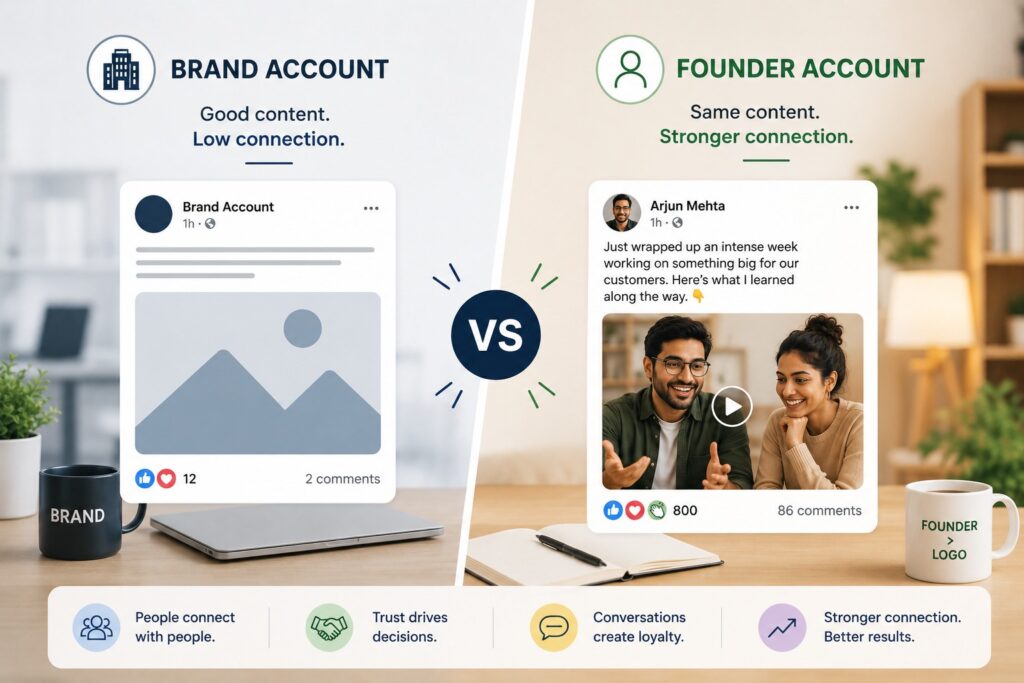
Two LinkedIn posts go up on the same day, in the same industry, about the same topic.
One is written by a faceless brand account.
The other is written by the founder, using their own name and a photo of their actual face. 👤
Same words, more or less.
One gets 12 likes. 👍
The other gets 800. 🔥
If you’ve spent any time on LinkedIn or Instagram lately, you already know which one was which.
It’s the same pattern every time.
The founder wins. Always.
Here’s what’s actually happening, and why it matters for any small business that’s still hiding behind a logo.
People Trust People
People trust people.
Not in a hand-wavy, vibes-based way.
In a measurable, repeatable, hammered-into-the-data way.
Edelman’s Trust Barometer has been running this study for over two decades, and every year the trend is the same.
- Trust in CEOs and founders has gone up.
- Trust in corporate brand accounts has stayed roughly the same or gone down.
The gap is widening, and it’s significant.
Why Does This Happen ?
Because brand accounts can’t:
- Apologise convincingly.
- Admit doubt.
- Have a bad day.
- Post a half-formed thought at 11pm and revise it the next morning.
A brand account is locked into a posture.
A founder is allowed to be a person.
The audience can feel the difference within three seconds of reading.
📱 The Algorithm Is Also Choosing People
There’s also the algorithmic angle, which most brands are still ignoring.
Every major platform now favours individual creator content over brand-page content.
- LinkedIn rewards personal profiles with three to five times the organic reach of company pages.
- Instagram throttles brand accounts unless they’re paying for distribution.
- Twitter (or whatever it’s called this week) basically doesn’t show company tweets to non-followers.
The platforms have decided the future is personal, and they’re voting with their algorithms.
So if founder-led marketing works this well, why are so few founders actually doing it?
1️⃣ Founders are scared of saying the wrong thing publicly.
The brand account feels safer because it speaks in corporate-approved phrases.
The founder account requires the founder to have actual opinions, which can be wrong, which can age badly, which can offend the wrong investor.
The fear is real.
It’s also mostly unjustified.
Most founder posts that go wrong are the ones trying too hard to be controversial.
The ones grounded in genuine experience almost never blow up in damaging ways.
2️⃣ Founders think they don’t have anything interesting to say.
This is almost always wrong.
Every founder is doing something most of the world doesn’t know about.
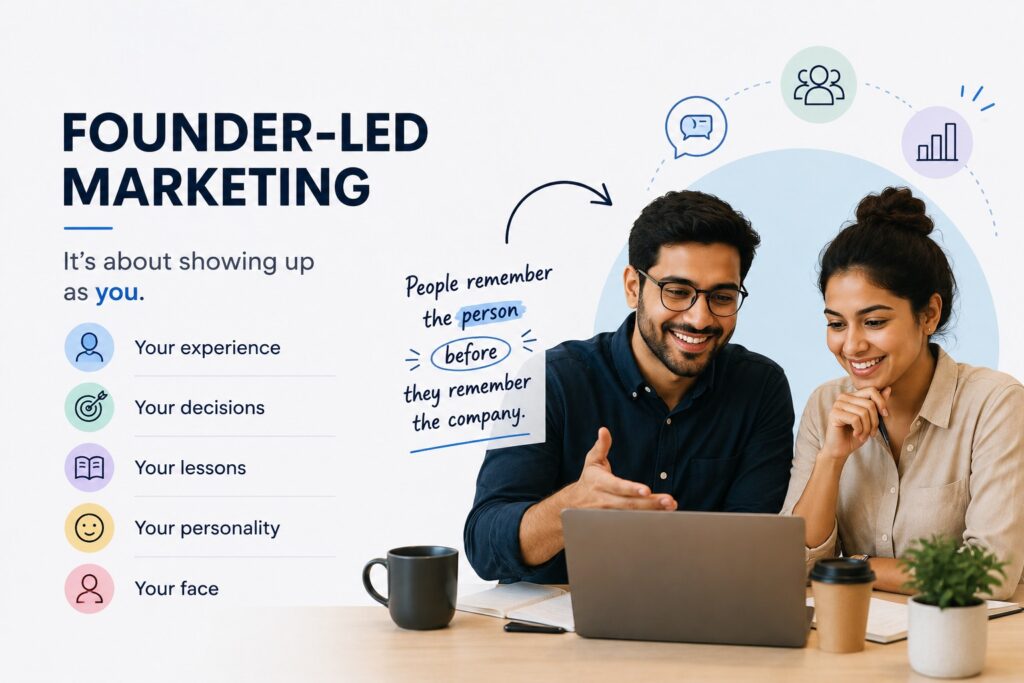
- The decisions they make every day.
- The things they’ve learned the hard way.
- The customers they’ve helped.
- The mistakes they’ve made.
- The things they’ve changed their minds about.
All of it is content.
The founder usually thinks it’s not interesting because it’s familiar to them.
To everyone outside, it’s gold.
3️⃣ Founders don’t think they have time.
This is mostly wrong, with one caveat.
Founder-led marketing doesn’t require daily posting or a content team.
It requires twenty minutes, two or three times a week, of the founder writing what’s actually on their mind.
That’s it.
Founders who do this consistently for six months end up with stronger personal brands than anyone running a six-figure brand marketing budget.
What does it actually look like in practice?
🗣️ Talk about the work.
The actual work.
- The campaign that didn’t go to plan.
- The customer who taught you something.
- The pivot you made last month.
- The hiring decision you got wrong.
- The pricing change you’re nervous about.
Specific, real, lived.
Not abstract leadership philosophy.
Not “5 lessons from building my first 10 lakh business.“
Real moments, real decisions, real reflections.
Show your face.
Even if it’s awkward.
Even if you don’t think the camera likes you.
The founder on video, doing 60 seconds of actual thinking, outperforms the founder hiding behind well-designed graphics every single time.
The market is starved for real people.
Be one.
Reply to comments yourself.
Founders who personally engage with comments build deeper trust than those who outsource it.
Even if the team helps draft the posts, the comment replies should sound like the founder.
Audiences can tell, and they reward the realness.
Pick one platform and commit.
Trying to be on LinkedIn, Instagram, Twitter, and YouTube simultaneously dilutes everything.
Pick the platform where your audience actually spends time and go deep on it for six months.
Then expand if it makes sense.
The Bottom Line
The brands building real trust in 2026 are the ones whose founders are visible, opinionated, and human in public.
The corporate brand voice still has a role, but the founder voice is the one customers actually remember and recommend to friends.
At Mirra Digital, half the work we do for founders involves helping them get out of their own way and start showing up online as themselves.
The hardest part is rarely the posting.
It’s the first week of not knowing what to say.
Start anyway.
Your audience is waiting for the version of your brand that has a face.