


 Back to Blogs
The One-Page Messaging Framework Every Startup Should Create Before Running Ads
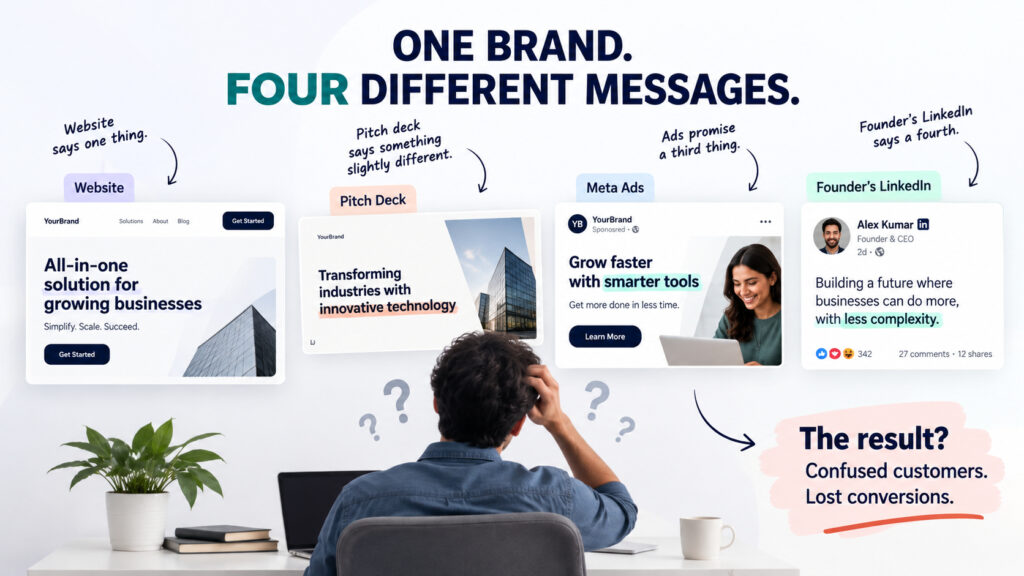
Every startup we work with has, on average, four versions of their core messaging floating around.
- The website says one thing.
- The pitch deck says something slightly different.
- The Meta ads say a third thing.
- The founder’s LinkedIn bio says a fourth.
Each was written by a different person, at a different time, for a different audience. Nobody on the team has ever sat down to align them.
Then the team launches ads and wonders why the campaigns aren’t converting.
Here’s the truth most agencies dance around.
The most common reason ad campaigns fail is fragmented messaging. The customer hits a different version at every touchpoint. They see an ad with one promise, click through to a landing page with a slightly different one, scroll down to an FAQ written in yet another voice, and close the tab because nothing quite holds together.
Most agencies brief new ad copy on top of this mess. The fix is upstream. Before any ads run, the brand needs one page that defines the messaging every touchpoint will use. Not a brand book. Not a 30-page strategy document. One page. Five sections. Stuck to the wall, shared with the team, used as the source of truth for everything the brand says publicly.
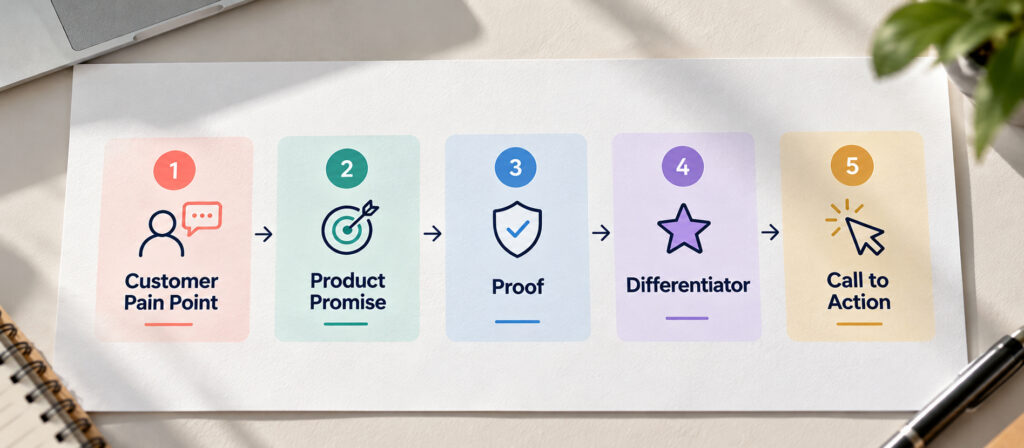
Here’s the framework we use with every new client at Mirra Digital before approving a single ad campaign.
1. Customer pain point.
Write the sharpest version of the problem the customer has, in the customer’s own words. “My skin feels tight every morning and the moisturisers I’ve tried either leave residue or stop working after two weeks.” Not “customers face dehydration issues.” The pain point should be so specific that the right customer reads it and thinks, that’s me. The wrong customer self-deselects. Both outcomes are useful.
If the brand can’t write the customer pain point in one or two sentences in the customer’s own language, the brand doesn’t understand its customer yet. Stop everything and go talk to ten customers before doing anything else.
2. Product promise.
Write the single biggest outcome the product delivers, from the customer’s point of view, in plain language. “By week three, your skin will feel hydrated all day without residue.” Not “clinically proven advanced hydration technology.” The promise should be specific, time-bound where possible, and written in the language of the customer’s life.
3. Proof.
List the three strongest pieces of evidence that the promise will be delivered. Not 14. Three. Testimonials with real names and outcomes.
- Clinical studies.
- Specific numbers.
- Before and after stories.
- Verified credentials.
Proof has to be specific enough to be challengeable. “Trusted by 10,000 customers” is a slogan. “240 chartered accountants across Mumbai and Bengaluru renewed in 2025” is proof.
If the brand can’t list three strong pieces of proof, the brand hasn’t been collecting them. Set up a system today.
Customer interviews. Outcome tracking. Testimonial requests.
Without proof, the messaging is just claims, and customers stopped believing claims years ago.
4. Differentiator.
Write the sharpest sentence about why this brand and not the alternative. The differentiator should be honest about what the brand is genuinely better at, and equally honest about what the brand isn’t right for. “We’re not the cheapest option. We’re the one that lasts twice as long.” Or “we’re not for customers looking for one-time sessions. We’re for ones building a long-term routine.”
Most brands struggle here. The bad differentiators say “better quality.” The good ones say something specific competitors can’t claim. If the differentiator can be copied to a competitor’s website without changing its meaning, it has stopped functioning as a differentiator. Generic claims hurt brand positioning over time.
5. Call to action.
Write the single, specific action you want the customer to take. Not three. One. “Start your free trial.” “Book a consultation.” “Find your skin type in 60 seconds.” Specific, easy to act on, consistent across every channel. The customer should encounter the same CTA in the ad, the landing page, the email, the social caption. Different CTAs in different places confuse people. Confused people don’t convert.
That’s the whole framework. One page. Five sections. Pain point. Promise. Proof. Differentiator. CTA.
What changes when a brand actually does this?
The website, ads, social posts, emails, and sales scripts all start sounding like they came from the same brand, because they did. The customer hits a consistent message across every touchpoint, which builds belief. Conversion rates routinely improve by 20 to 40 percent, with no other changes.
The team also gets faster. Every new piece of content, every new ad, every new email gets tested against the one-page document. If it fits, it ships. The endless internal debates about brand voice get replaced by a simple test.
At Mirra Digital, we refuse to run paid campaigns for clients who don’t have this document. The campaigns underperform too consistently when the upstream messaging is fragmented. Fixing it takes a week. Skipping it costs lakhs.
One page. Five sections. Stick it on the wall. Build everything on top of it. The brand finally sounds like one brand.