Back to Blogs
Why Every Indian Household Has a Drawer of “Good” Plastic Bags (And What It Reveals About How We Buy)
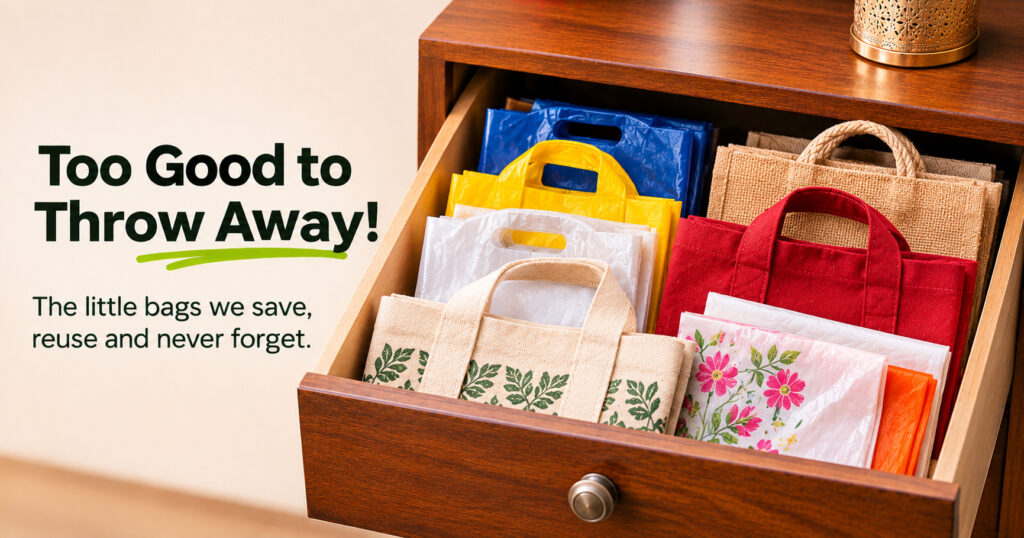
Open any drawer in an Indian household of a certain generation, and there’s a good chance you’ll find it. The drawer of good plastic bags.
- The ones from Fab India.
- The ones from Nykaa.
- The ones from the sweet shop with a nice paper handle.
- The heavy black one from the wine shop.
- The Amazon bag that’s slightly better quality than the others.
Sorted, folded, stacked, kept.
Every home has one of these drawers. Nobody organised a national movement around it. Nobody wrote a policy. It just happens. Across income levels, across cities, across families. Indian consumers save packaging. 🛍️
Here’s the opinion most Indian brands, and almost every foreign brand entering India, have missed entirely. Indian consumers assign real, measurable, monetary value to packaging in a way most Western consumers do not. This changes the entire economics of how packaging should be designed for the Indian market, and most brands are still using packaging strategies designed for markets where the packaging goes into the bin the moment the product comes out of it.
Let’s break down what’s actually happening in that drawer of good plastic bags.
The Hidden Value Behind Every Reusable Bag
The bag is not being kept because the consumer is frugal. The consumer is often middle-class or upper-middle-class. They can absolutely afford to throw it away. They keep it because the bag has secondary value that continues after the primary transaction.
Think about how these bags get reused:
- To pack lunch.
- To send fruit to a neighbour.
- To carry gifts to a wedding.
- To organise something in a cupboard.
- To take clothes to the dry cleaner.
- To hold shoes when travelling.
The bag has become a small unpaid brand ambassador. Every time it gets reused, it walks the brand’s name around a household, a lift, a bus stop, a wedding, a school. Nobody at the brand ever pays for it, and yet the brand collects it, over and over, for years.
The consumer knows this instinctively. The consumer is not just evaluating the price of the product they bought. They are evaluating the total value received, which includes the ongoing utility of the packaging. When a brand delivers a product in a badly-made single-use bag, the Indian consumer feels that they have been slightly cheated on a dimension the brand didn’t even know existed.
🌍 India vs The West: Two Different Packaging Mindsets
Compare this to the average American consumer, for whom packaging is disposable friction. The Amazon Prime box goes into recycling the day it arrives. The Whole Foods paper bag becomes a bin-liner within 24 hours. In the West, packaging is a wrapper. In India, packaging is a small durable object that has to earn its keep.
This changes the entire packaging equation in ways most brands are still not thinking about.
Packaging Is More Than Just Packaging
Brands designing packaging in India for Indian consumers should be treating the bag, box, or container as a secondary product.
What should good packaging deliver?
- Durability: It should be strong enough to survive at least 20 reuses.
- Presentation: It should look presentable enough that the consumer feels comfortable using it in public, at weddings, at a friend’s house.
- Brand visibility: It should carry the brand’s name in a way that reads well after the product itself is long gone.
The packaging is not the delivery mechanism. It is a small, ambient, ongoing brand advertisement that the consumer has voluntarily agreed to carry around for years.The brands that get this right compound brand exposure at almost no cost.
- The heavy Fab India bag has done more brand-building over 20 years than any Meta campaign.
- The Nykaa pink bag has done the same at a fraction of the influencer marketing budget.
- The Blue Tokai coffee bag becomes a container in half the middle-class kitchens in Bengaluru.
Each is worth enormous ongoing brand impression that never appears in any marketing dashboard.
The Packaging Sweet Spot for Indian Consumers
The sweet spot for Indian packaging is durable, reusable, presentable, and clearly not-overengineered. Indian consumers are also suspicious of packaging that looks like it cost more than it needed to. The tissue-paper wrapping inside a paper bag inside a plastic bag inside a shipping box signals, correctly, that the consumer is paying for packaging they don’t want. Most Indian brands are still copying Western unboxing aesthetics, which produces the wrong packaging for the wrong consumer.

What Can Indian Brands Practically Do?
First, audit your current packaging with a specific question.
If the consumer keeps this bag or box, will they be proud to use it in public again? If no, you’re leaking brand value every time you ship an order. Packaging that survives 20 reuses is worth much more than cheaper packaging that gets thrown out the same day. The math works out in the brand’s favour.
Third, stop copying Western unboxing playbooks.
Indian consumers don’t care about the theatrical reveal. They care about whether the packaging will earn its keep after the reveal is over.
The Drawer of Good Bags Is a Marketing Opportunity
At Mirra Digital, we now factor packaging into every Indian brand strategy we write. The drawer of good plastic bags is one of the most under-appreciated marketing signals in Indian consumer research. The brand that ends up in the drawer wins the next twenty impressions for free. The brand that ends up in the bin starts from scratch every time.