


The Wedding Economy: India’s Biggest Influencer Marketing Machine
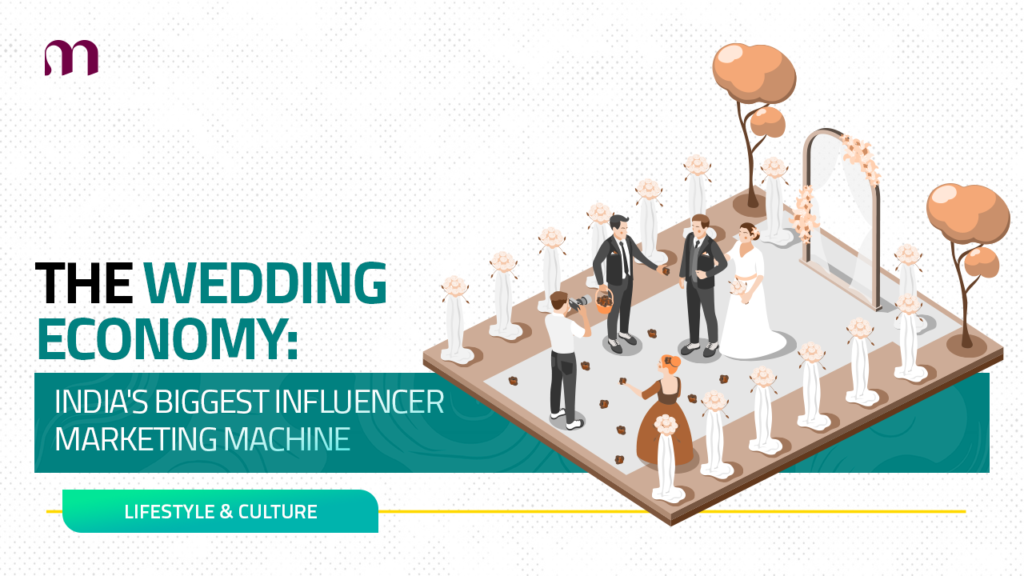
Walk into any Indian wedding of 500 people. Sixty-percent of the guests are silently running product reviews you have no idea are happening. The Indian wedding is not a celebration. It is a live-audit environment where roughly 30 brands, sometimes more, are being publicly judged, ranked, saved, and either recommended or warned against. And most of the brands being audited have no idea it’s happening. Here’s the opinion most Indian D2C brands don’t want to hear. The Indian wedding is the single most powerful influencer marketing platform in the country. It is also the single most ignored one. Brands spend crores chasing Instagram influencers with 200K followers when the aunty at the second table on the left is about to determine whether her entire extended family, roughly 40 households, will buy their next diamond set from you or from your competitor. Let’s break down what’s being evaluated at any Indian wedding. What’s Being Evaluated at Every Indian Wedding? 💎The jewellery. Being evaluated for design, weight, verification stamps, and whether it looks real from three feet away. Vendors that pass this test at one wedding get called into six more within the following year. 👗 The lehenga and outfits. Being cross-referenced against every designer the aunties have followed on Instagram over the last six months. Brands like Sabyasachi built empires almost entirely on this circuit before Instagram existed. The circuit still matters more than Instagram does today. 🍽️ The catering. Being ranked against every wedding the same guests have attended in the last two years. The paneer dish alone is a marketing exercise. The dessert counter is a launch event. 📸 The photography. Being noticed by every couple in the audience currently planning their own wedding. A photographer who does one great wedding gets booked for the next twelve. 🌸 The decor. Being evaluated for scale, colour palette, and how it will photograph. Decor vendors who understand this are booked out a year in advance. The ones who don’t understand it are ranking on Google ads and losing anyway. 💌 The invite. Being photographed before the wedding even begins. The invite is often the first brand touchpoint of the entire event, and it sets the tone for how every subsequent brand at the wedding is judged. 💄 The makeup artist. Being messaged by four bridesmaids within 48 hours of the ceremony. The good ones don’t run ads. They don’t need to. 🤵 The wedding planner. Being evaluated silently for months afterward, as every guest slowly discovers whether their referral held up in practice. This is influencer marketing on a scale no digital campaign in India can match. The audience is captive, emotionally primed, and spending 48 hours with 30 brand impressions from every direction. Unlike an Instagram feed, they are not scrolling. They are looking, comparing, discussing, photographing, saving contacts. A specific type of Indian brand has figured this out. The jewellery brand that pays for placement in a specific circuit of Delhi weddings. The catering brand focused on the top 40 wedding planners in Mumbai. The bridalwear designer that treats every wedding as a live campaign. These brands compound over years and become close to unkillable by competitors who don’t understand the circuit. The brands losing this game share one common trait. They treat the wedding as a moment for a discount campaign around the season. Instagram carousels about “wedding-ready looks.” Google ads targeting “best photographer near me.” Reels featuring brides they’ve never actually dressed. All of it optimised for a digital funnel that doesn’t touch the actual audit environment where their brand is being judged. What Should Indian Brands Actually Do? 1. First, understand which weddings your brand is being evaluated at. If you’re a jewellery brand, get a list of the top 100 weddings in your city this quarter. Find a way to be present at three of them. Even if you’re not paid for it. The compounding is worth more than the invoice. 2. Second, build relationships with wedding planners, decorators, and photographers who work the circuit you want to be in. The path to a bride’s jewellery choice runs through her planner’s WhatsApp group, not through her Google search. 3. Third, treat every wedding your brand touches as a live media event. Photograph it. Document it. Share it. The people who care about your category will notice. At Mirra Digital, we’ve started factoring the wedding audit environment into every relevant client’s marketing plan. The best marketing budget in India, if you know how to spend it, is 12 lakhs per wedding placement, not 12 lakhs on Meta ads. Which one produces more revenue in the following 18 months isn’t close. Every Indian wedding is a marketing campaign happening without your permission. The brands that get in front of it grow for years. The brands that don’t stay confused about why their ads aren’t working.
The Job You Tell People You Do vs. the Job You Actually Do
At a wedding, somebody asks what you do. You say “I run a marketing agency.” Or “I’m a software engineer.” Or “I work in HR.” The aunty nods politely and moves on. Five minutes later, you overhear her describe you to her husband as “the girl who does the Instagram things” or “the boy who makes apps.” 😂 She isn’t entirely wrong. She’s also not entirely right. Welcome to one of the great unspoken comedies of modern working life. The job you tell people you do, and the job you actually do, almost never match. The title is for the wedding. The actual work is a slightly unhinged improv act that nobody outside your team would recognise. 🎭 Take any job title and put it under a microscope. The results are always funnier than they should be. 🔍 “Marketing manager” “Software engineer” “Doctor” “Founder” “CEO” of a 12-person startup Why this happens is funnier still. Job titles are designed to fit on a business card. Business cards are about three inches wide. Three inches is not enough space to capture the full chaos of an actual work week. 📇 So companies pick the least-embarrassing word that summarises what the role looked like five years ago, slap it on the card, and hope nobody asks follow-up questions at dinner parties. 😂 All of which is fine. Until it isn’t. The trouble starts when the wedding-version of your job is the only version anyone knows. Meanwhile, the actual work, the 80% of it that doesn’t fit on any card, is invisible to almost everyone except the people sitting next to you in the office. 👀 This is why so many working professionals secretly feel like impostors. The title says “senior marketing director.” The reality involves crying once a quarter, drinking tea while putting out fires, and rewriting a deck at midnight. 😭☕ The internal experience doesn’t match the external label, which produces a low-grade anxiety that the person isn’t qualified to be where they are. In fact, they’re doing approximately five times the work the title implies. For founders specifically, this is a marketing opportunity hiding in broad daylight. 💡 The most engaging content from founders almost always comes from closing the distance between the official version and the lived version. The CEO who posts about the unglamorous reality of building a business gets ten times the engagement of the CEO posting about strategic vision. Real beats polished. Every time. By a lot. 🔥 What can you do about your own version of this? Try this. Open a Google doc. Write down everything you actually did this week. Don’t edit. Don’t make it sound more impressive. Just write it. Now compare that list to your job title. Notice anything? 👀 Most people find the list is about three times longer than the title implies. They find themselves doing things they were never officially asked to do, and being slightly heroic in ways nobody outside their team has noticed. 🦸 The job you tell people you do is for parties. The job you actually do is where the value lives. The good news is that the second version is almost always more interesting, more impressive, and more worth being recognised for than the first one. At Mirra Digital, half of what we do for founders is help them tell the world about the second version of their work. The version that doesn’t fit on a business card. The version that’s been hiding inside their LinkedIn bio for years. Sometimes the most useful career move you can make is being honest about what you actually do all day. The aunty at the wedding might still misquote you. 😂 At least the rest of the world will finally get the right idea.
Why We Apologise for Buying Things We Genuinely Like

A friend buys new shoes. You ask her about them. She immediately launches into a small defensive monologue. “Oh, I needed them. My old ones were falling apart. They were on sale. I’ve been saving up. Honestly, I shouldn’t have, but…“ She likes the shoes. She wanted the shoes. She bought them with her own money. And yet, somewhere between the purchase and the conversation, she developed an entire legal case justifying the existence of the shoes which she now delivers, unprompted, to anyone who notices them on her feet. 👟 We’ve all done it. We apologise for things we genuinely like, often before anyone gives us a reason to. Why? The honest answer, what we don’t say out loud, is that most of us grew up inside a money story that doesn’t quite match the money story we now live inside. Our parents and grandparents, across India, and most of the world, were raised to believe that money was for: Money was not for joy. Joy was something you found in things that didn’t cost money. Anything that cost money and produced only joy was, by definition, slightly suspicious. Then we grew up. We started earning. We discovered that money is also, sometimes, for joy. ✨ Both money stories are now sitting inside the same adult. The security-first story we inherited. The joy-also-counts story we’re trying to live by. And every time we make a small purchase that the older story would disapprove of, the older story shows up uninvited and demands a justification. That’s where the apology comes from. We’re not apologising to the friend who noticed the shoes. We’re apologising to a version of our parents, our grandparents, our childhood selves, that still lives inside our head and still believes money is for serious things. Once you see this pattern, you start noticing it everywhere. 👀 The 30-something Bangalorean explaining to her parents that the 1,200-rupee candle is actually really economical because it lasts three months. 🕯️ The Dubai-based architect explaining to a colleague that the 600-dirham headphones are necessary for work calls. 🎧 The Sydney-based writer explaining to her partner that the 280-dollar pen is a tool, not a luxury. 🖊️ In each case, the person: The apology is for an audience that isn’t even in the room. There’s a small cultural texture worth noticing across regions. 🌍 The mechanism is the same everywhere. Same internalised guilt. Different cultural language for the apology. The interesting question is whether we should keep apologising. 🤷 There’s a school of thought that says no. The money is ours. The choice is ours. The joy is ours. The apology serves no one except the older story, which has already had a full lifetime of getting its way. There’s also a softer truth. The apology is a small ritual of remembering where we came from. It connects us, in a quiet daily way, to the people who taught us to be careful with money. The apology says: “I haven’t forgotten. I know this would have seemed extravagant to my grandmother. I still bought it. Both things are true.“ Maybe the answer is to keep the awareness and drop the guilt. ✨ To know that the older money story is still in the room without giving it veto power over the new one. To buy the shoes, mention them when asked, and skip the legal defence. To say, simply: “I like them.” ❤️ And let that be enough. Marketing has a small role in this too The brands that understand this dynamic build differently. They give the customer permission to enjoy the purchase without packaging the joy as guilt. They speak to the buyer’s conflicted feelings with gentleness. They make the customer feel okay about wanting something nice, without making them feel watched. The buyer who feels permission becomes: We are allowed to like the things we like. ❤️ 👟 The shoes are nice. 🕯️ The candle smells good. ☕ The coffee machine was worth it. The two money stories can live inside the same adult without one of them having to win. We can just buy the thing, and let it be a thing we wanted.
The Brands We Hide from Our Parents (And What That Says About Us)
Everyone has them. The brands we buy from but never talk about over Sunday lunch. The ones whose packages we hide before our mothers come over, or whose names we never quite mention when our fathers ask what we spent our salary on this month. The brands we buy in private and never quite endorse in public. It’s a strangely universal habit. The question isn’t whether we buy these things. The question is why we hide them. From a generation that was raised to be careful with money, to justify every purchase, and to treat anything spent on the self as somehow indulgent. 💡 The hiding is the marketing insight nobody’s writing about. Across India, the Middle East, and Australia, three culturally different but generationally similar things are happening at once. Adults in their 20s, 30s, and 40s are spending more on themselves than their parents ever did. They are also more conflicted about it than they let on. Brands that understand this conflict are becoming the most loved brands of this generation. Brands that don’t understand it are still selling on price. 🧠 The psychology behind the hiding is layered. There’s the practical layer, which is the assumption that parents will judge the spending as wasteful. Underneath the practical layer is something more interesting. The hiding is about the gap between two value systems. Both are valid. Both clash. The middle-class adult in 2026 is trying to live both at the same time, which is why so many purchases get hidden, dismissed, or privately justified. Brands that understand this dynamic build differently. They speak directly to the buyer’s own conflicted feelings about the purchase. ✨ The skincare brand that says “we know this seems like a lot for a serum, here’s exactly why it costs what it does“ performs better than the one that just lists ingredients. 🕯️ The luxury candle brand that frames itself as a small permission for the buyer sells more, because permission is what the customer is actually buying. 🧠 The therapy app that gently acknowledges that this might be the first time the user has paid for something like this earns the customer for years. Brands that get it wrong tend to do one of two things. Both miss the truth. The buyer wants permission to have something nice, with just enough functional reasoning to defend the choice if anyone asks. There are also generational differences worth noticing across regions. 🇮🇳 India The hiding is most often from parents and extended family, and the brands that thrive are the ones that frame personal spending as small acts of self-respect. 🌍 Middle East The hiding is sometimes from older generations who associate visible spending with public judgement, and the most-loved brands are the ones that emphasise quality and longevity. 🇦🇺 Australia The hiding is often less family-related and more cultural, a tall-poppy hesitation about looking like one cares too much about objects, and the strongest brands lean into understated design and confidence. Same psychology. Different cultural texture. 💭 For brands trying to find their place in this space… The most useful question isn’t: “how do we make this product feel more premium.” The question is: “how do we help the buyer feel okay about wanting this.” Permission. Reassurance. Gentle conviction that the purchase reflects something good about the person, without making them feel watched or judged. ❤️ The brands that get this right… The brands that get this right end up loved in a way the loud, status-driven brands never quite manage. They become the brands customers do eventually tell their parents about, two years later, after the relationship has been built. The brands we hide today are the brands we’ll defend tomorrow. The trick is to be the brand worth hiding for the right reasons.
The Aunty Algorithm: India’s Most Powerful, Most Ignored Marketing Network
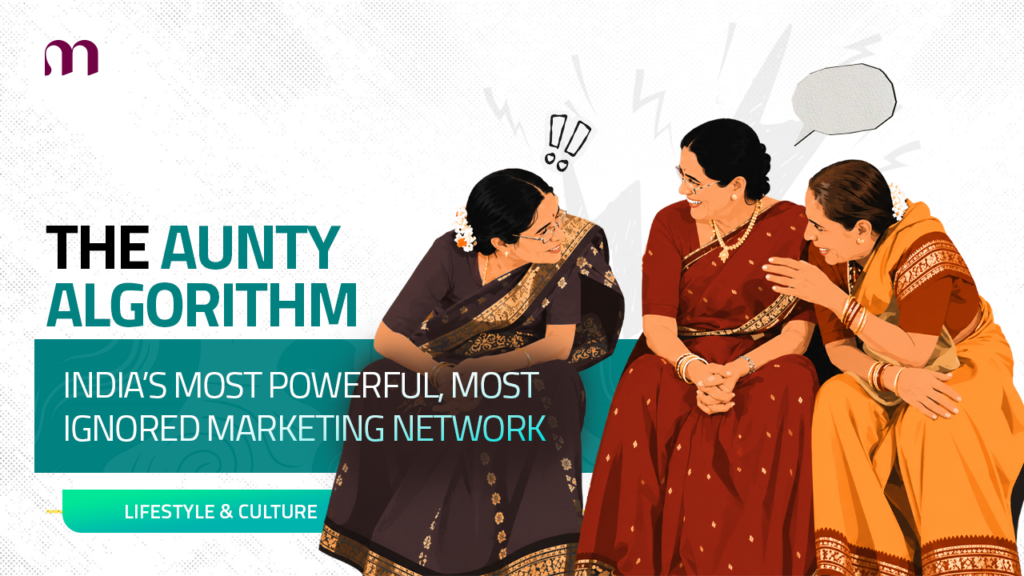
Every Indian marketing team has spent the last decade obsessing over the same questions. Meanwhile, in a Bengaluru apartment complex, a woman called Mrs. Sharma has spent the same decade running a fully functional, peer-reviewed recommendation network that has put more products into more middle-class homes than the entire Indian D2C industry combined. Just a Samsung phone 📱, three active WhatsApp groups 💬, and a working knowledge of every face within a six kilometre radius. Mrs. Sharma is not just an aunty. She is The Network. And almost every marketing team in the country has been ignoring her, which is wild, because she is the single most powerful distribution channel in India and she charges nothing. ⇥ Let’s understand what we’re dealing with. The aunty network has beats. Real ones. Each one has spent thirty years building expertise in her vertical and will tell you, unprompted, exactly which moisturiser stopped working in 2019 and why. She has sources. Each one feeds intelligence back to Mrs. Sharma, who synthesises it into recommendations. She has editorial standards. “That girl on Instagram with the lights and the music? Beta, she’s paid to say all that. Her own skin she doesn’t know what’s on it.” She has a publishing schedule. Festival season is her quarterly earnings call. Wedding season is the annual conference. She has distribution channels most CMOs would weep over. And, if the product is good enough, an active campaign inside her own household, where she will tell her husband, her son, her daughter-in-law, her grandchildren, and the cook, all within the same hour. ⇥ Brands keep getting this network wrong. Let’s discuss the specific ways. 1️⃣ Influencer Language Doesn’t Work Brands keep targeting aunties with influencer-coded language. The aunty sees this and immediately suspects she’s being overcharged. She will not buy it, and she will not let her sister-in-law buy it either. “Looks too fancy. Must be costing five times more than the actual thing inside.” 2️⃣ The Wedding Circuit Is Underestimated Brands keep underestimating the wedding circuit. A single tier-one city wedding has roughly If your product appears at one wedding, in the right hands, you’ve reached a network no Meta ad budget can buy. Boat headphones, Sleepy Owl coffee, and several skincare brands have grown to crore-level revenue mostly through wedding-circuit aunty discovery. Their CACs are a rounding error. 3️⃣ The Network Punishes Bad Products Fast Brands keep forgetting that the aunty network punishes bad products with terrifying efficiency. She does not just stop recommending. She actively warns. “Don’t buy that face wash. My friend’s daughter got rashes. Whole family avoided it. I’ll send you the better one.” One bad product enters the network and within 48 hours several hundred people have been warned away from it. No other marketing channel in India protects its audience as actively as it promotes products. Stop trying to bypass the aunty network. Build for it. Packaging should look like it costs what it actually costs. The founder, if available, should be visible, relatable, and ideally over thirty. The product needs to survive the longevity test, because the aunty will absolutely report back if it stopped working in three weeks. Price should be defensible per use. “This 1,200-rupee bottle lasts four months” is a sentence she will repeat. “This 1,200-rupee bottle” is one she will skip. At Mirra Digital, we factor the aunty network into every Indian brand strategy we write (where required, ofcourse). The aunty network is the Pretending otherwise leaves lakhs on the table. Mrs. Sharma is not going anywhere. Your aunty algorithm is running, with or without your participation. Better to be on the recommended list.