

 Back to Blogs
What Happens to Blogging When AI Can Answer Everything?

Open ChatGPT.
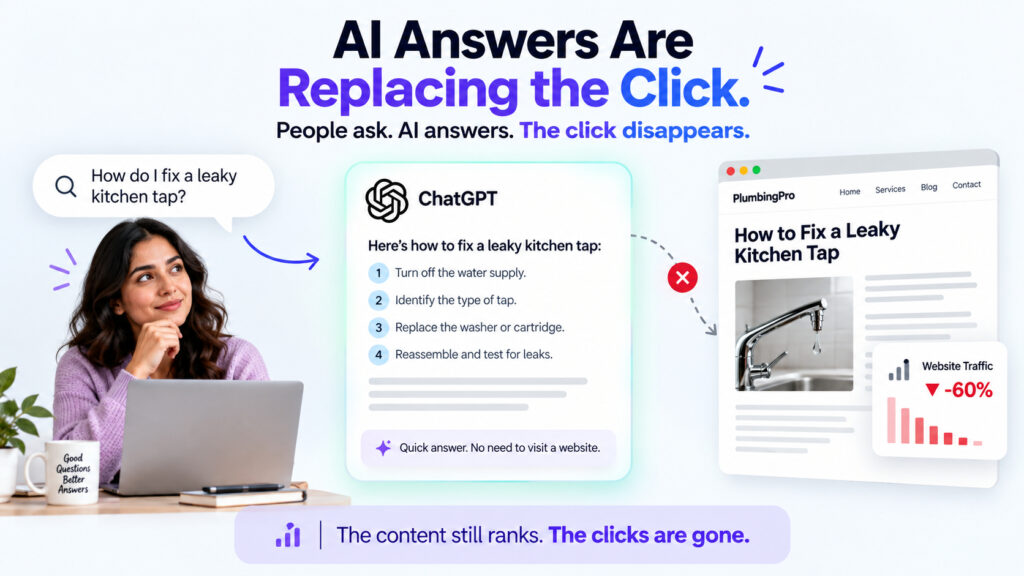
Type “how do I fix a leaky kitchen tap.“
Read the response. Notice anything?
You just did what about 60% of people used to do on Google. You asked a question, got a useful answer, and never clicked through to a single blog post written by a plumbing site optimised for that exact query. The blog post still exists. It still has 1,200 words and meta tags and internal links. It’s just nobody’s reading it anymore.
This is happening across every category right now, and the question on every content marketer’s mind is the same.
What happens to blogging when AI can answer everything? 🤔
First, what’s actually happening to traffic.
Quick informational queries that used to drive billions of clicks to blogs are now resolved inside ChatGPT, Claude, Perplexity, and Google’s own AI overviews.
- “What’s the boiling point of olive oil.” 🫒
- “How do I write a resignation email.” ✉️
- “What does R&D capitalisation mean.” 💼
These queries used to send people to a blog. Now they don’t. The answer appears inline and the user moves on.
Brands that built their entire SEO strategy on these short-tail queries are watching their traffic collapse, sometimes by 40 to 60 percent year on year.
- The content still ranks.
- The clicks are gone.
- The AI summarised the article inline, and
- The user never visited the site.
This is a real problem for the brands relying on it. But it’s also forcing a much-needed conversation about what blogging is even for.
Here’s the truth most content marketers have been avoiding.
A huge percentage of blog content was always low-value, written purely to please an algorithm, with the goal of ranking, not reading.
- The 1,500-word post explaining what “customer retention” means.
- The roundup of “10 best CRM tools in 2025” written by someone who’s never used a CRM.
- The thinly-disguised product page wearing a blog post costume.
AI is going to eat this content for breakfast, and honestly, nobody should mourn it.
What survives is the blogging that AI can’t replicate
What survives is the blogging that AI can’t replicate, and that’s where things get interesting.
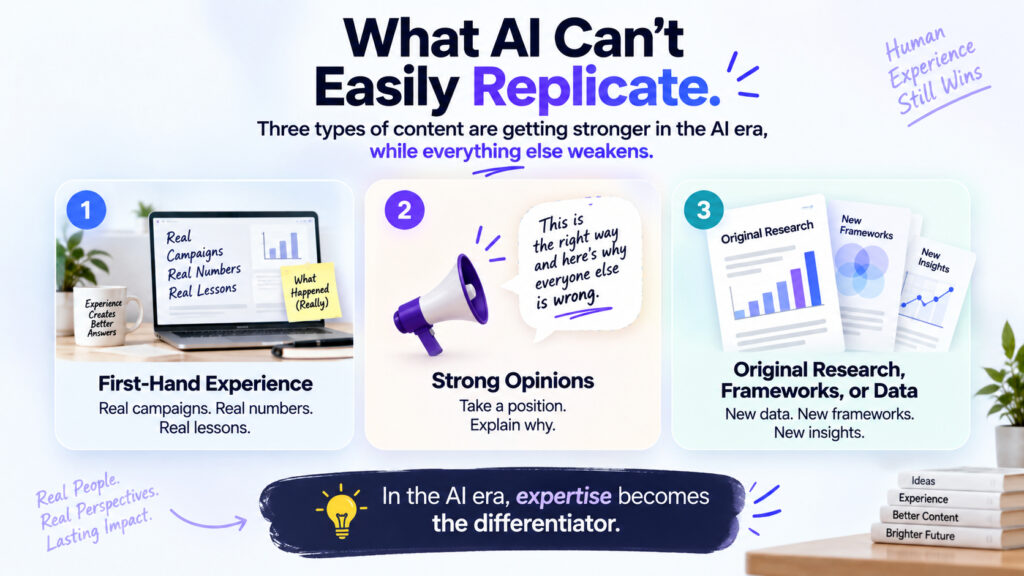
Three types of content are getting stronger in the AI era, while everything else weakens.
1️⃣ The first is content with genuine first-hand experience.
The blog post that says “we ran this campaign with this budget for these reasons and here’s what happened“ can’t be generated by an AI, because the AI doesn’t have the experience.
The actual numbers, the specific decisions, the things that went wrong in surprising ways.
This kind of content is becoming more valuable in the AI era, because it’s the only kind AI has to cite when answering questions. 🔗
2️⃣ The second is content with strong opinions.
AI is famously bad at having actual opinions.
It can present multiple perspectives, summarise debates, and offer measured analysis.
What it doesn’t do is plant a flag and say “this is the right way and here’s why everyone else is wrong.” 📌
Blogs that take real positions, especially controversial ones grounded in expertise, stand out in a feed full of AI-generated centrist takes.
3️⃣ The third is content with original research, frameworks, or data.
If your blog publishes something genuinely new, the AI has to point back to you when it gets asked about the topic.
The original source becomes the citation.
Brands that consistently produce original work are becoming the most-cited sources in AI responses, which is a new kind of distribution most teams haven’t figured out yet.
What this means in practice for any brand still publishing blogs.
Stop writing content that AI can write faster.
The generic how-to, the definitional explainer, the boring comparison post.
These were always low-value, and AI has made them economically pointless.
Free up the editorial budget for content that actually requires expertise.
Lean harder into perspective.
Your blog should sound like a person with a job and a face, working in a specific industry, with specific experiences and specific opinions.
The more clearly the blog signals “a human wrote this from inside the work,“ the more durable it will be against AI substitution.
Focus on shareability over searchability.
SEO traffic for blogs is in slow decline. Direct traffic, referral traffic, and AI citation traffic are growing.
Writing blogs that people actually want to share:
- with their team 👥
- with their boss 💼
- with their group chat 💬
is becoming a more reliable distribution strategy than chasing keywords.
Treat your blog as a portfolio of expertise, not a content factory.
Twelve excellent blogs that demonstrate genuine thinking will outperform 120 average ones in the AI era.
The math has flipped. Quality is now cheaper than volume, because volume isn’t getting read.
Bad blogging is dying.
Bad blogging is dying. The blogs that survive will be the ones that taught you something you couldn’t have learned from a chatbot, written by someone who knew what they were talking about.
At Mirra Digital, the blogs we write for our clients are increasingly the ones AI cites when asked about marketing strategy in 2026.
That’s the metric worth tracking now. The clicks come second.