
 Back to Blogs
The Language of Trust: Why the Words on Your Website Matter More Than the Design
A lot of money goes into website design.
Custom illustrations, fancy fonts, micro-animations, hover states, a homepage video that took two months and three agencies to make. Then a visitor lands on the site, reads the first three lines of copy, and bounces.
The design did its job. The words didn’t, and now the design is decoration on a building nobody walked into.
This is the part most brands underestimate.
- Design gets a visitor to look.
- Copy gets them to stay, believe, and act.
When the copy collapses, the design is just expensive wallpaper.
The language of trust on a website is built through specific choices, and most websites are getting them wrong in predictable ways.
Start with the obvious problem.
- Industry-leading solutions.
- Trusted by hundreds of clients.
- Best in the world.
- World-class quality.
- Number one in the country.
These phrases appear on roughly half of all business websites in India and they do less than nothing.
They actively damage credibility because they say everything and prove nothing.
A claim like “trusted by hundreds of clients” without naming a single client, sharing a single testimonial with a real photo, or pointing to a case study, is a sentence pretending to be evidence.
Readers can tell. They’ve seen this language a thousand times before.
Trust is built in specifics.
- “We’ve worked with 42 real estate developers across Bengaluru and Hyderabad over the last six years” is a sentence that earns belief.
- “India’s most trusted real estate marketing partner” is a sentence that loses it.
The first one can be checked. The second one can’t be anything other than a slogan.
Then there’s the jargon problem.
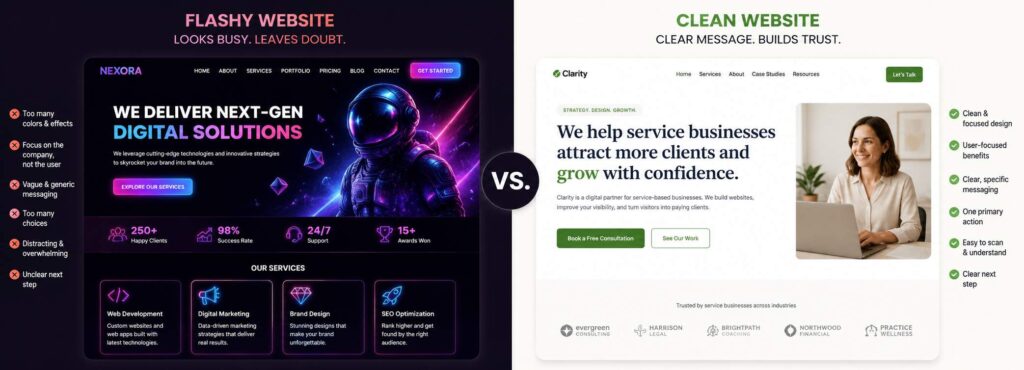
A staggering number of websites read like they were written by someone afraid to sound human.
- Robust solutions.
- Bespoke offerings.
- Synergised approaches.
- End-to-end value chains.
- Holistic ecosystems.
These words exist for one reason, which is to make a small idea sound bigger than it is.
The reader on the other end is looking for something that makes sense, and instead gets a paragraph that sounds impressive and means nothing. After three sentences of this, they leave.
The fix is plain language.
- Say what the company does.
- Say who it does it for.
- Say how it works.
If a teenager couldn’t understand the homepage, the copy is too dressed up.
Plain language sounds less prestigious in the writer’s head and reads as more credible on the page.
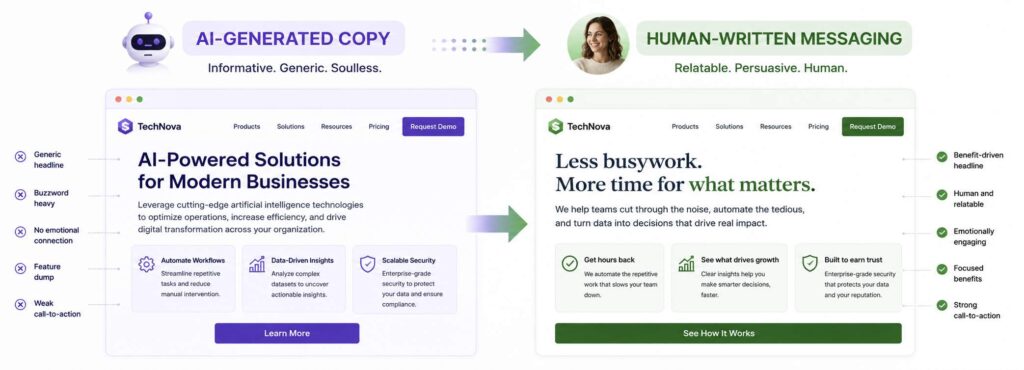
A growing problem on top of all this is AI-written copy that hasn’t been edited.
- The voice is flat,
- the rhythm is even in a way that human writing never is,
- every paragraph has the same shape, and
- every sentence ends with the same kind of phrase.
Readers can feel it within a few seconds even when they can’t say why. The brand ends up sounding like every other brand using the same tools.
AI is fine as a starting point. Publishing it as the final draft is what’s killing a lot of websites right now.
Smaller things add up too.
- Stock photography of people in headsets.
- About pages with no real names or faces.
- Testimonials that sound like the company wrote them itself, because it probably did.
Pricing pages that hide the actual price behind “contact us for a custom quote.” Each is a small trust leak. A few of them together and the visitor decides the site isn’t to be taken seriously.
⇥ Here’s what works instead, drawn from how high-trust websites actually behave.
Be specific.
- Numbers,
- names,
- dates,
- real examples.
“Founded in 2018, 12-person team based in Bengaluru, working with B2B SaaS companies on content and SEO” tells the reader who they’re dealing with. Vague does the opposite.
Sound like a human wrote it.
If the copy can be read out loud in a normal voice without sounding like a press release, it’s probably working. If it sounds like an annual report being narrated by a robot, it isn’t.
Acknowledge limits.
“We don’t do enterprise accounts under 50 employees” or “we don’t offer same-day delivery in tier-3 cities” builds more trust than “we serve everyone everywhere” ever could. Readers respect a brand that knows what it isn’t.
Lose the jargon.
If a word would feel weird in a real conversation, it shouldn’t be on the website.
Show real proof.
- Real names,
- real photos,
- real case studies with real outcomes.
If proof can’t be shown, don’t make the claim. An unsupported claim is worse than no claim at all.
Design will get someone to your site. Words decide whether they stay and whether they trust you enough to do anything once they’re there.
Spending lakhs on the first and underinvesting in the second is the most common, most expensive marketing mistake a small brand can make.