
 Back to Blogs
The Aunty Algorithm: India’s Most Powerful, Most Ignored Marketing Network
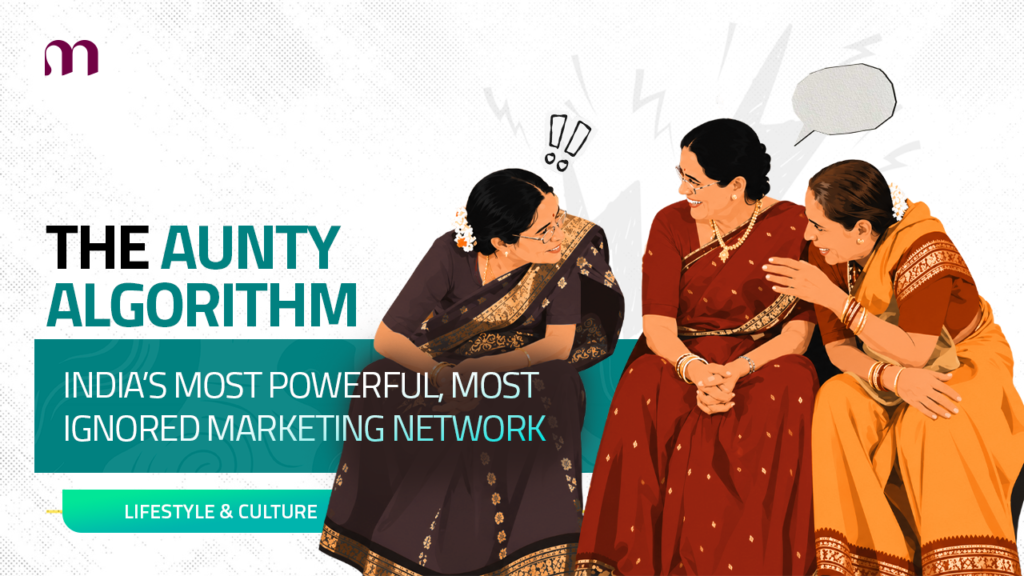
Every Indian marketing team has spent the last decade obsessing over the same questions.
- How do we crack the algorithm.
- How do we get Gen Z’s attention.
- How do we go viral on Instagram.
Meanwhile, in a Bengaluru apartment complex, a woman called Mrs. Sharma has spent the same decade running a fully functional, peer-reviewed recommendation network that has put more products into more middle-class homes than the entire Indian D2C industry combined.
- Without a budget,
- no analytics dashboard,
- no LinkedIn presence.
Just a Samsung phone 📱, three active WhatsApp groups 💬, and a working knowledge of every face within a six kilometre radius.
Mrs. Sharma is not just an aunty. She is The Network.
And almost every marketing team in the country has been ignoring her, which is wild, because she is the single most powerful distribution channel in India and she charges nothing.
⇥ Let’s understand what we’re dealing with.
The aunty network has beats. Real ones.
- A senior aunty might cover skincare and weddings.
- Another covers schools, tuitions, and children’s allergies.
- A third specialises in property, dowry-adjacent gifting, and which jeweller is currently in the doghouse for adulterating gold.
Each one has spent thirty years building expertise in her vertical and will tell you, unprompted, exactly which moisturiser stopped working in 2019 and why.
She has sources.
- Her sister-in-law’s daughter in Mumbai.
- The woman who supplies vegetables to four apartment blocks.
- The maid who works in three houses on the same floor.
- The friend whose husband travels to Dubai and brings back chocolates with names nobody can pronounce.
Each one feeds intelligence back to Mrs. Sharma, who synthesises it into recommendations.
She has editorial standards.
- She will not recommend something she has not personally vetted,
- unless her source is unimpeachable, like her own daughter or a senior aunty.
- She will not recommend something just because it’s expensive.
- She will absolutely not recommend something an influencer has been seen with.
- She does not trust people who are paid to like things.
“That girl on Instagram with the lights and the music? Beta, she’s paid to say all that. Her own skin she doesn’t know what’s on it.”
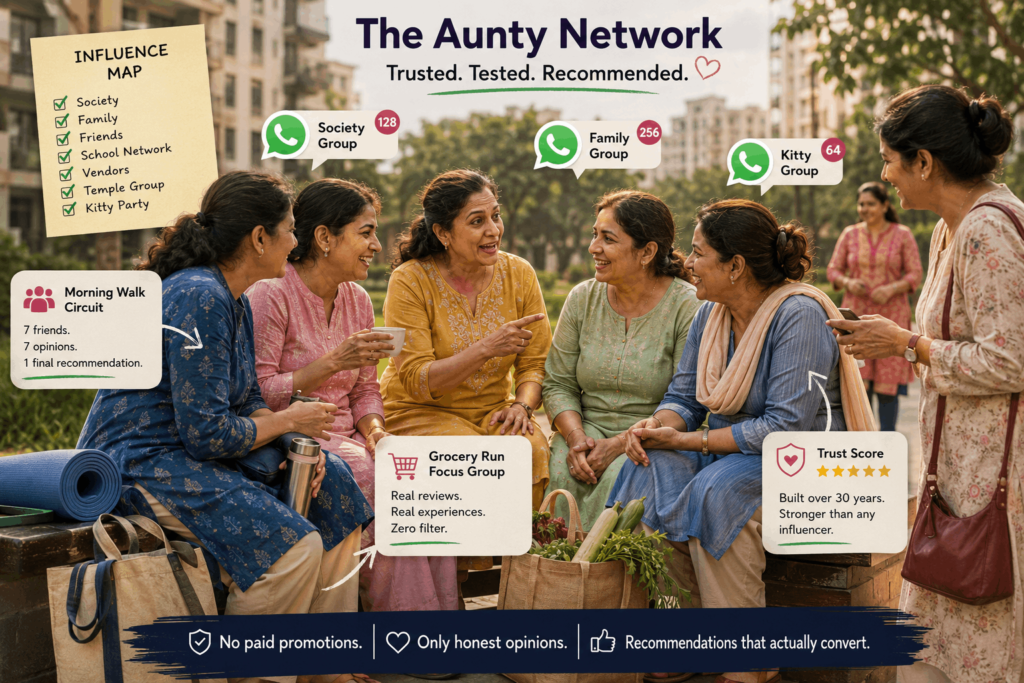
She has a publishing schedule.
- Sunday calls.
- Tuesday WhatsApp forwards.
- Wednesday society meetings.
- Saturday grocery runs with three other aunties, which doubles as a focus group with stronger sample integrity than anything Nielsen has produced.
Festival season is her quarterly earnings call. Wedding season is the annual conference.
She has distribution channels most CMOs would weep over.
- Three WhatsApp groups, two family, one society.
- A morning walk circuit of seven friends.
- A Thursday temple gathering.
- School pickup when the grandchildren visit.
- Two kitty parties a month.
- A standing tea date with the third-floor woman.
And, if the product is good enough, an active campaign inside her own household, where she will tell her husband, her son, her daughter-in-law, her grandchildren, and the cook, all within the same hour.
⇥ Brands keep getting this network wrong. Let’s discuss the specific ways.
1️⃣ Influencer Language Doesn’t Work
Brands keep targeting aunties with influencer-coded language.
- Sleek packaging.
- Aesthetic minimalism.
- Words like “curated” and “intentional.”
The aunty sees this and immediately suspects she’s being overcharged.
She will not buy it, and she will not let her sister-in-law buy it either.
“Looks too fancy. Must be costing five times more than the actual thing inside.”
2️⃣ The Wedding Circuit Is Underestimated
Brands keep underestimating the wedding circuit.
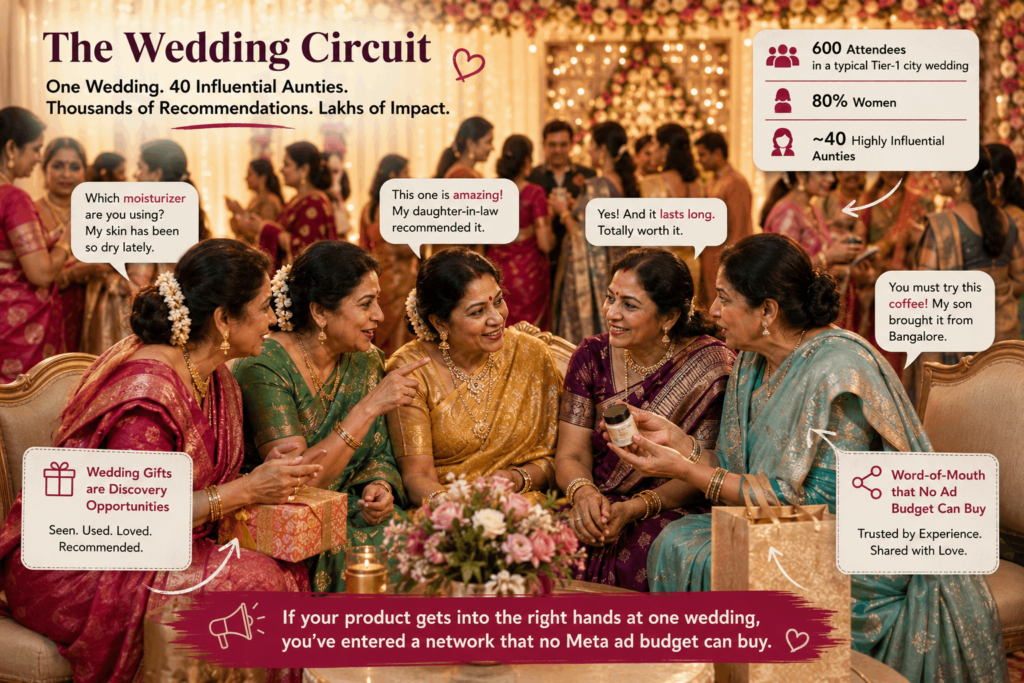
A single tier-one city wedding has roughly
- 600 attendees,
- 80% of them women,
- around 40 of whom are aunties at peak influence.
If your product appears at one wedding, in the right hands, you’ve reached a network no Meta ad budget can buy.
Boat headphones, Sleepy Owl coffee, and several skincare brands have grown to crore-level revenue mostly through wedding-circuit aunty discovery. Their CACs are a rounding error.
3️⃣ The Network Punishes Bad Products Fast
Brands keep forgetting that the aunty network punishes bad products with terrifying efficiency.
She does not just stop recommending. She actively warns.
“Don’t buy that face wash. My friend’s daughter got rashes. Whole family avoided it. I’ll send you the better one.”
One bad product enters the network and within 48 hours several hundred people have been warned away from it.
No other marketing channel in India protects its audience as actively as it promotes products.
Stop trying to bypass the aunty network. Build for it.
Packaging should look like it costs what it actually costs.
The founder, if available, should be visible, relatable, and ideally over thirty.
The product needs to survive the longevity test, because the aunty will absolutely report back if it stopped working in three weeks.
Price should be defensible per use.
“This 1,200-rupee bottle lasts four months” is a sentence she will repeat. “This 1,200-rupee bottle” is one she will skip.
At Mirra Digital, we factor the aunty network into every Indian brand strategy we write (where required, ofcourse).
The aunty network is the
- most rigorous,
- longest-running,
- highest-trust distribution layer in this country.
Pretending otherwise leaves lakhs on the table.
Mrs. Sharma is not going anywhere.
Your aunty algorithm is running, with or without your participation. Better to be on the recommended list.