How to Write a LinkedIn Post That Doesn’t Sound Like Every Other LinkedIn Post
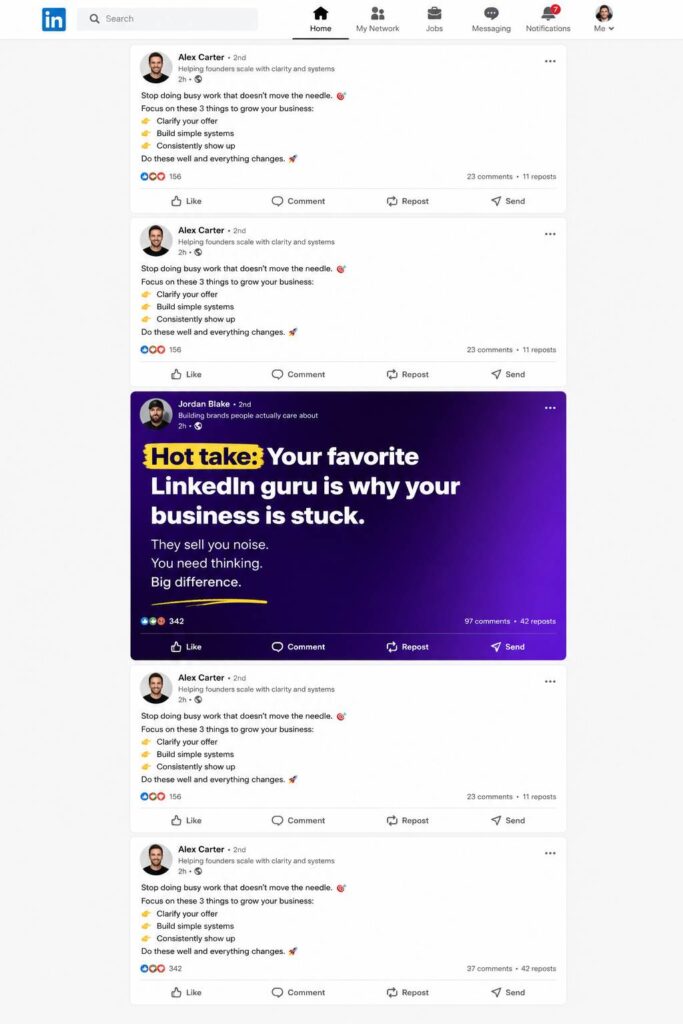
Open LinkedIn right now and scroll for sixty seconds. 📱
The posts will start blending into each other within the first three.
Same hook formulas
Same fake-humble openings
Same one-sentence-per-line layout
Same vague observation dressed up as wisdom
Everyone is performing thoughtfulness, and almost nobody is actually saying anything. 🎭
Most of this is fixable.
The problem isn’t that the writer lacks ideas, it’s that the writer is following a template that has been copied so many times the template itself has become the noise.
⇥Here’s how to write a LinkedIn post that doesn’t sound like every other LinkedIn post.
Start with the things to stop doing immediately. 🚫
There are a few formats that have collapsed under their own weight, and a post still using them will get scrolled past before the second line.
The one-sentence hook followed by “Here’s why” is dead.
So is its cousin, the hook followed by “Let me explain.“
These formats used to work three years ago when they felt fresh.
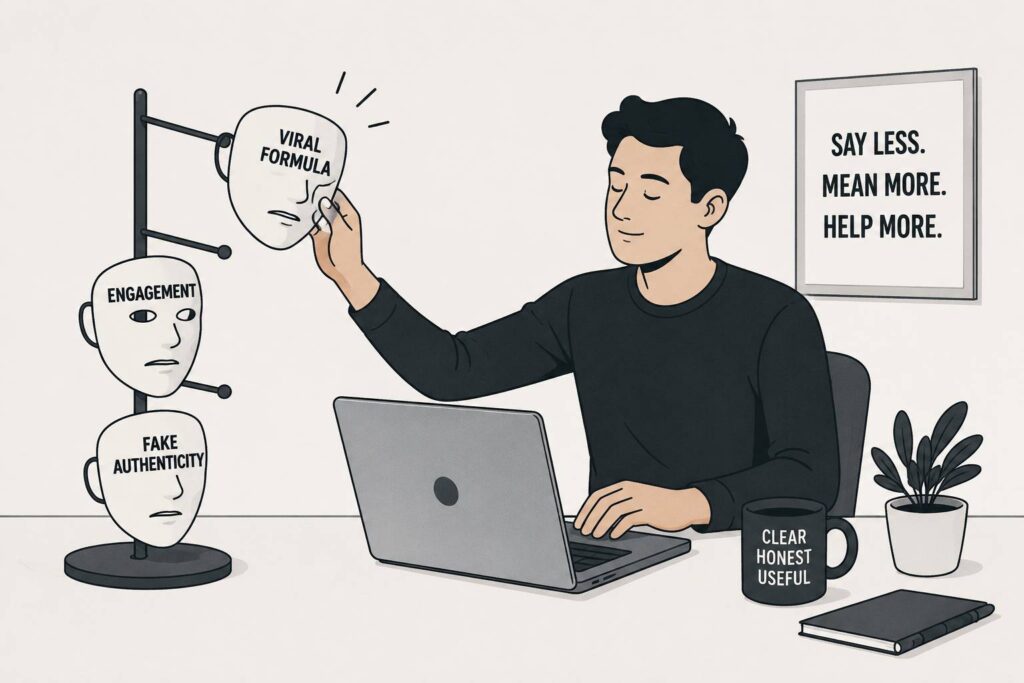
Now they read as a flashing sign that says:
“I am about to follow a viral post formula, please pretend to be interested.”
The “X taught me everything I know about leadership” framing is another one to bury.
Someone spilled their coffee on a Tuesday, and now there are 700 words about:
Resilience
Emotional intelligence
Team building ☕
Nobody believes the coffee taught you anything.
The whole structure has become a parody of itself.
Click-bait openings dressed up as “hooks” are the third repeat offender.
Something dramatic in line one
Completely unrelated payoff three lines later
A sales pitch buried in line nine
Readers caught on to this game roughly eighteen months ago and have been tuning it out ever since. 👀
With those three out of the way, here’s what to actually do instead. 👇
Write like a real person talks. 🗣️
Not like someone who is being graded.
And not like someone who has just read a productivity book.
The line-break-every-sentence thing only worked when it was new.
Now it just looks like every other post on the feed.
Use real paragraphs.They work.
Have an actual point. 🎯
This sounds painfully obvious but most LinkedIn posts don’t.
They have:
An observation
A soft anecdote
A hopeful question at the end
None of those are points.
A point is something the writer believes and is willing to argue for.
Example:
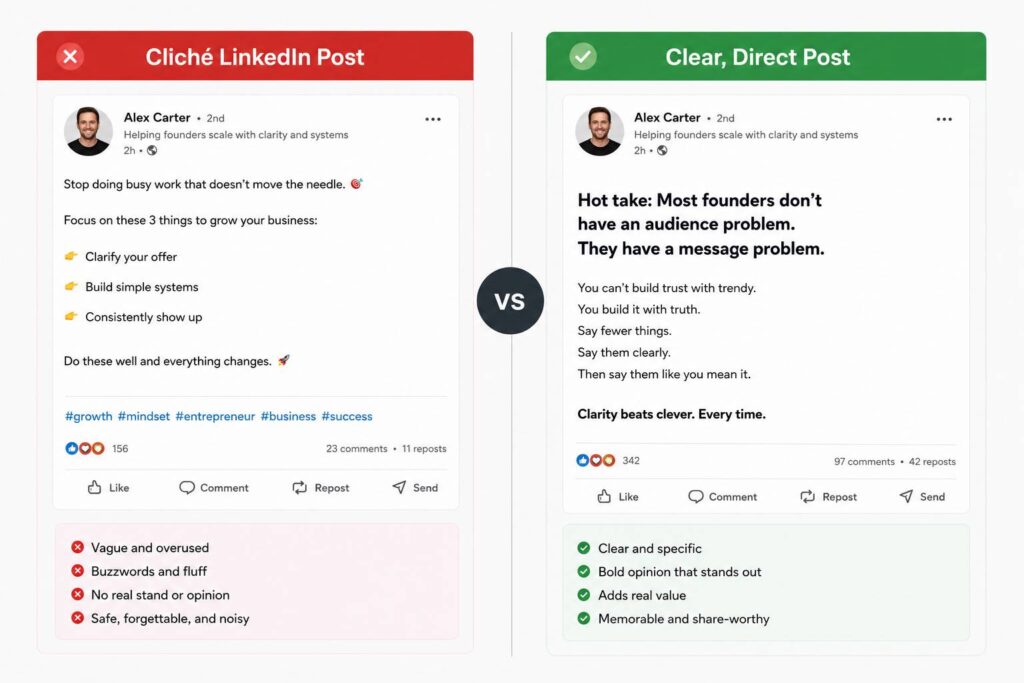
✔️ “Most onboarding programs are too long and nobody admits it” = a point.
❌ “Onboarding is a journey” = wallpaper. 🧱
The post should be able to be summarised in one sentence, and that sentence should sound like an opinion, not a horoscope.
Open with something specific.
Not a setup.
Not a flashback.
Not a:
“Three years ago I was nervously walking into my first board meeting.“
Open with the actual thing the post is about.
Specificity does the work that drama is failing to do.
Skip the fake humble-brag. 🙃
“I was humbled to be invited to speak at” is not humility.
It is the LinkedIn version of starting a sentence with:
“Not to brag, but…”
Readers can see it.
If something is worth mentioning, mention it directly.
If it isn’t, don’t dress it up in fake modesty.
Be willing to say something some readers will disagree with.
This is the most important point in the entire playbook.
The reason most LinkedIn posts feel interchangeable is that they’re optimised to never offend anyone, which means they end up saying nothing.
A post that takes a real position, even a small one, will outperform ten posts that play it safe.
Remember:
Disagreement is engagement.
Vagueness is invisibility.
End without the “thoughts?” closer. 🚫
Or the:
“Agree or disagree?”
“Comment X if you’ve experienced this”
These are engagement-bait moves that audiences now recognise instantly and ignore.
The closing line should feel like a real person finishing a thought, not a marketer setting a trap. 🎣
Here’s the uncomfortable part. 😬
Even after doing all of this, the post might not perform well, because LinkedIn rewards genuinely weird things.
A meme can outperform a thoughtful essay.
That’s the platform, and it’s frustrating.
Engagement is not the goal worth optimising for.
Positioning the writer as someone with:
A real voice
A clear perspective
Something worthwhile to say
…is.
That builds the kind of audience that actually matters in the long run.
The kind that reads the writer’s name and stops to read.
Not the kind that double-taps a viral fluke and forgets within a week.



 Back to Blogs