Back to Blogs
The Pricing Rule Every Indian Brand Should Know About
Two Indian D2C brands sell almost the same product. Same category, quality, launch year, target audience.
One prices at 749 rupees. The other at 799. The 749 brand sells three times more units.
The 799 brand has better unit economics.
One year later, the first brand has better cash flow but no margin to build brand. The second brand has margin but not enough scale. Both founders are convinced pricing broke their business.
Neither is entirely wrong. Both are missing what most Indian pricing decisions are about.
The Silent Pricing Rule
Here’s the pricing rule that governs Indian consumer behaviour, that almost no founder has explicitly named. Indian consumers do not compare prices in absolute terms. They compare prices against a mental price ceiling for the category, and they punish anything that crosses it, even by ten rupees.
This is the silent pricing rule. It’s about staying under a specific psychological threshold the Indian consumer has already decided is the maximum they’re willing to pay for this type of product. Cross it, and no amount of marketing rescues the brand. Stay under it, and the brand grows even if the product is objectively worse than a marginally-more-expensive competitor.
Let’s break down what this means in practice.

Understanding the Category Price Ceiling
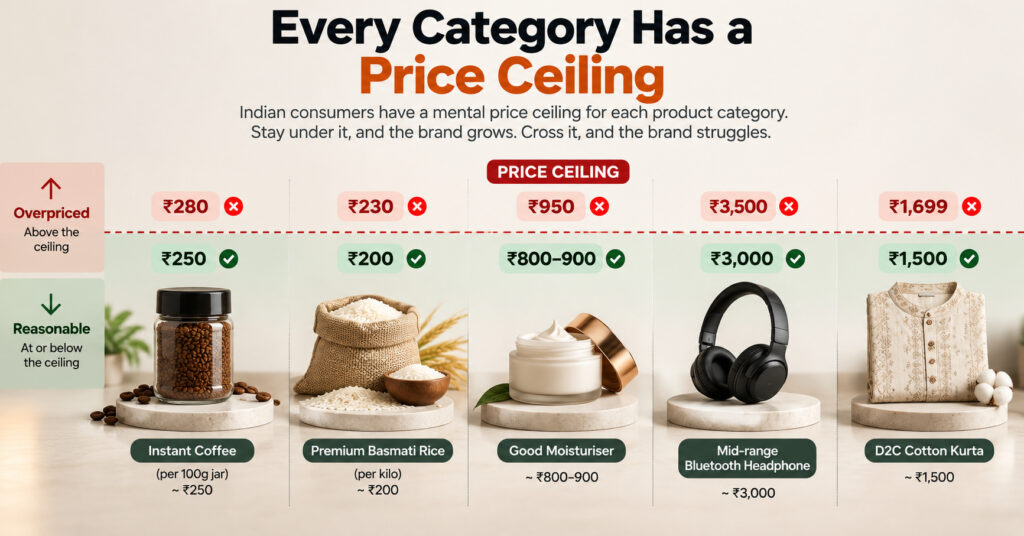
Every product category in India has an unspoken price ceiling. Not a suggested price. Not an average price. A specific number the consumer has decided is the emotional line between “reasonable” and “overpriced.” Set by what the consumer has been paying for the category for years, what competitors charge, what their peers say they paid, and what the product should cost given the category.
- For instant coffee, roughly 250 rupees per 100g jar.
- For premium basmati rice, roughly 200 per kilo.
- For a good moisturiser, 800 to 900.
- For a mid-range Bluetooth headphone, 3,000.
- For a D2C cotton kurta, 1,500.
These numbers live in the consumer’s head, never on any pricing page, and they’re surprisingly stable across cities and income levels within the middle-class band.
The brand that prices at or just below the ceiling grows. The brand that prices ten rupees above the ceiling struggles, no matter how good the product is. This is not a linear relationship. It’s a discontinuous one. There’s a cliff at the ceiling, and brands either sit on one side of the cliff or fall off it.
This is why the 749 versus 799 pricing decision in the example above matters so much. If the category ceiling in the consumer’s head is 750 rupees, the brand at 749 lives inside the perceived reasonable range. The brand at 799 has crossed the invisible line. The consumer might not consciously articulate this. They just decide the brand is overpriced and move on.
How Category Price Ceilings Shift
There’s a second layer to the rule that’s even more interesting. The ceiling can shift, but only by categories, not by brands. If Nykaa succeeds in creating a new premium moisturiser tier at 1,500 rupees, the whole moisturiser category ceiling shifts upward in the consumer’s mind, and other brands can then charge more. But no single brand can lift itself above the category ceiling by force. The whole category has to move, and only certain kinds of brands can pull the category up with them.
The brands that have successfully lifted category ceilings in India in the last decade are rare and instructive. Blue Tokai lifted the coffee ceiling. Sleepy Owl lifted the cold-brew ceiling. Zerodha, in reverse, dragged the stock brokerage ceiling down. Each of these brands did category redefinition, not brand pricing. They convinced the consumer that the category itself deserved to be priced differently. That is the only way to break the ceiling.
What Can Indian Brands Do With This Insight?
1. Find the Category Price Ceiling
First, find out what the category ceiling is in your consumer’s head. Not what your competitors charge. What consumers think the reasonable maximum is. This is a specific piece of qualitative research that most Indian brands never bother to do. You can find out by asking ten customers a very simple question.
Ask your customers:
“Before you saw this product, if I had told you it was in this category, what price would have felt reasonable to you as the maximum?”
2. Price Just Below the Ceiling
Second, price just below the ceiling, not at the average. Being ten percent below the average competitor doesn’t matter if you’re still above the ceiling. Being one rupee below the ceiling matters enormously.
3. Lift the Ceiling Through Category Redefinition
Third, don’t try to lift the ceiling as a single brand. Wait for a category leader to do it, and follow in their wake. Or become that category leader through years of category-redefining marketing. There is no shortcut.
📌 The Takeaway for Indian D2C Brands
The silent pricing rule is the most under-discussed piece of Indian consumer behaviour in modern D2C. Get this one thing right, and every other marketing decision becomes easier. Get it wrong, and no amount of Meta budget rescues you. The ceiling is real. The consumer is watching. And ten rupees over the line is the same as a hundred rupees over the line.
Price under the ceiling. Grow. Then, if you want to lift the ceiling, do it deliberately, category by category, over years. There is no other way to do this in India.