

 Back to Blogs
Why People Remember Stories but Forget Marketing Claims
Quick experiment. Can you remember the last marketing claim a brand made that genuinely stuck with you? The exact words, the exact promise, the exact stat. Probably nothing comes to mind, even though you’ve been exposed to thousands of marketing claims in the last month.
Now think about the last story a friend told you that you can still recall in some detail. The trip that went wrong. The wedding that went sideways. The small thing your colleague said that made everyone laugh in the meeting. The memories arrive vividly, almost without trying.
This is one of the oldest patterns in human cognition, and one of the most consistently ignored in marketing. Humans remember stories. Humans forget claims. The brands that figure this out build durable awareness. The brands that don’t keep producing marketing copy that nobody can recall five minutes after they’ve read it.
Why does this happen?
The answer is structural. The brain processes stories and claims completely differently.
A claim is a statement that requires the listener to evaluate, judge, and decide whether to believe.
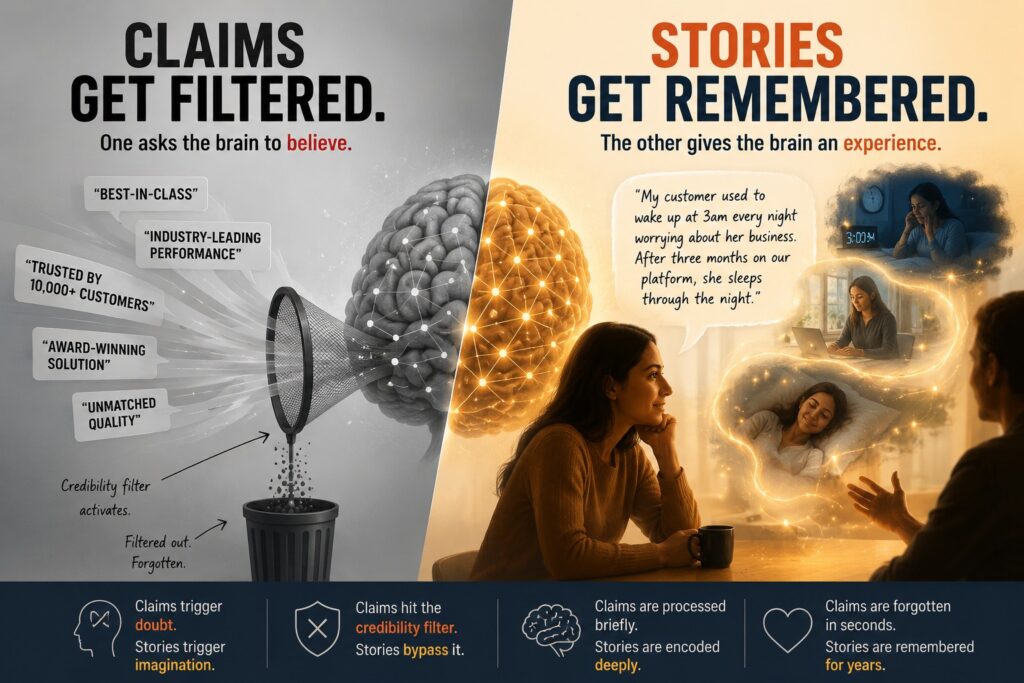
“Our product is the most effective on the market.” The brain hears the claim, runs it through a quick credibility check, and usually flags it as unreliable because almost every brand makes a similar claim. The neurons fire briefly and the information gets discarded. The brain has been trained over decades of advertising to treat marketing claims as low-priority data.
A story bypasses the credibility filter entirely.
“My customer used to wake up at 3am every night worrying about her business. After three months on our platform, she sleeps through the night.” The brain doesn’t evaluate this the way it evaluates a claim. It processes it as narrative. Narrative gets stored differently, in regions of the brain associated with autobiographical memory and emotional context. Stories enter as experiences. The brain stores them in a way that bypasses the fact-verification machinery entirely.
Neuroscientists have mapped this in detail.
When a person hears a story, multiple brain regions activate simultaneously, including motor cortex, sensory cortex, and emotional processing areas. The brain effectively simulates the experience being described. A well-told story produces a physical reaction. A well-constructed argument produces, at most, intellectual agreement.
The implications for marketing are significant.
Most brand messaging is structured as claims.
“Trusted by 10,000 customers.”
“Best-in-class support.”
“Industry-leading performance.”
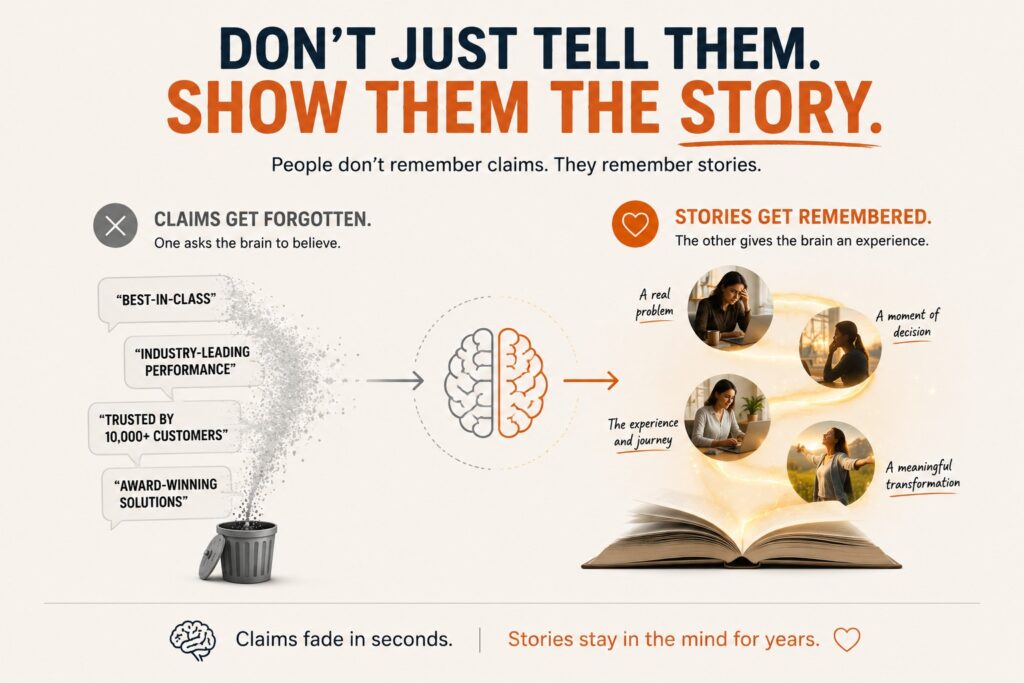
The phrases are technically true and completely forgettable. They activate the credibility filter, get discounted, and disappear from memory within seconds.
Brands that lead with stories enter the customer’s mind through a completely different door.
- A specific customer with a specific problem.
- A specific moment of decision.
- A specific outcome.
The reader doesn’t have to evaluate the truth of a generic claim. They watch a small story unfold and remember the brand by association with that story for years.
What does story-led marketing actually look like in practice?
It looks like specificity.
The skincare brand that says “Priya’s combination skin felt tight every morning. After eight weeks, the tightness was gone” is doing more work than the brand saying “effective for combination skin.” The first sentence has a name, a sensation, a timeline, a transformation. It enters the reader’s memory as a small narrative. The second sentence is a claim that gets immediately filtered out.
It looks like customer-led content.
The case study with real names, real numbers, and real problems significantly outperforms the testimonial that says “great product, highly recommend.” The former is a story. The latter is a claim wearing the costume of one.
It looks like founder narrative.
“We started this brand because the existing options frustrated me as a customer. Here’s the specific thing that went wrong, the specific decision I made about it, and what happened next.” The founder story builds brand memory in a way that no value proposition ever could.
Audiences across India, the Middle East, and Australia have different cultural expectations for stories.
Indian audiences respond to longer, more emotionally textured ones. Middle Eastern audiences respond to family and legacy narratives. Australian audiences respond to understated, slightly self-deprecating ones. The format varies. The underlying psychology stays the same.
What can a brand actually do with this?
Audit the current marketing copy for the ratio of claims to stories.
Most brands are running 90% claims and 10% stories. The story content tends to live in case studies that nobody reads, while the claim content sits on the homepage where everyone sees it. Flipping this is one of the most impactful changes a brand can make.
Collect customer stories systematically.
Real stories, with detail, arc, and specificity. Generic testimonials don’t count. Get on a call with five customers a quarter and ask them to walk you through what was happening in their life or business before they found the brand, what made them try it, and what happened after. Record the conversation. Their actual sentences are the marketing copy the brand needs.
At Mirra Digital, the campaigns we build around customer stories and founder narratives outperform the campaigns built around product claims, often by significant margins.
The story has always been the better delivery system for what a brand wants to say.
Claims wash out of the brain by the time the page closes. A good story persists for years. Choose accordingly.