

 Back to Blogs
Why Smaller Communities Are Outperforming Massive Audiences
If you’ve been on the internet long enough, you’ve noticed something happening to community.
The big platforms are getting noisier, the engagement metrics are getting weaker, and along the way, the people who actually care about specific topics walked off the main feeds and into smaller rooms.
What’s actually happening is one of the bigger shifts in how audiences gather online, and it’s worth paying attention to, because it’s changing what good marketing looks like in 2026.
Smaller communities are outperforming massive audiences across almost every meaningful metric.
- Engagement
- Trust
- Conversion
- Retention
- Word of mouth
- The lot.
A few numbers tell the story.
- A Discord server with 800 members can produce more genuine product feedback than a brand page with 80,000 followers.
- A WhatsApp community with 200 customers can drive more repeat purchases than an Instagram account with 200,000.
- A Slack group for 50 founders can generate more referrals than a year of paid LinkedIn ads.
None of this is anecdotal anymore. The brands paying attention are restructuring entire marketing teams around it.
Why is this happening?
A few overlapping reasons.
Massive audiences are mostly passive.
Most followers on a brand’s main social account aren’t real followers in any meaningful sense.
- They clicked once.
- They never followed deliberately.
- They follow for unrelated reasons.
The brand looks like it has reach, while the actual reading-and-responding audience is a tiny sliver of the total.
Smaller communities self-select.
The people who join a Discord, a Slack, or a private WhatsApp group are doing so because they actually care about the topic.
The signal-to-noise ratio is dramatically better.
Trust scales inversely with size.
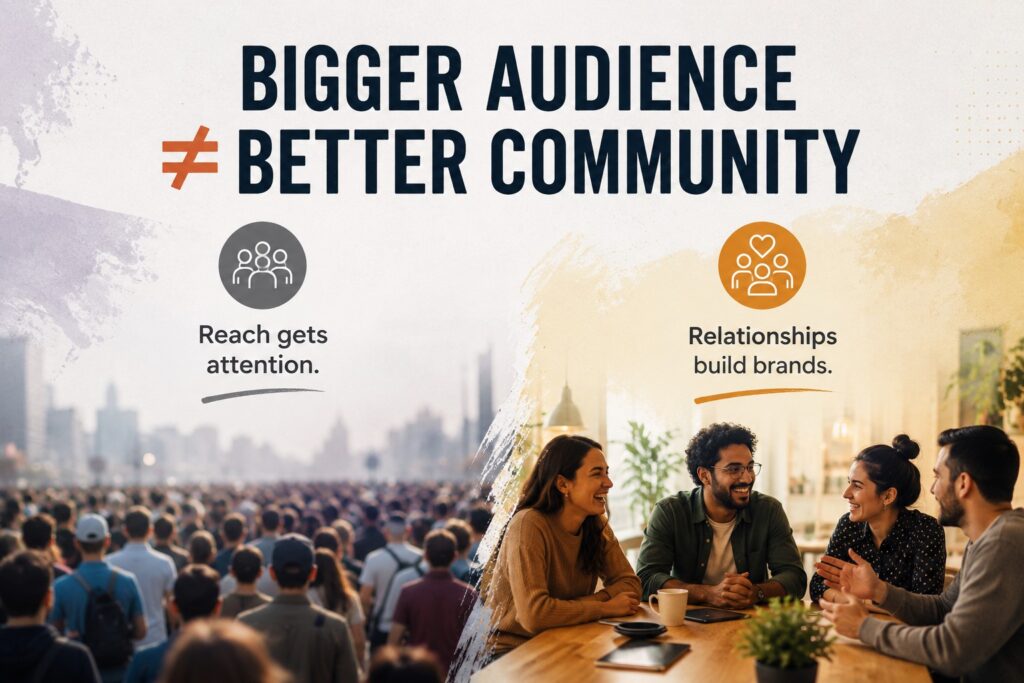
A space with 200 people feels intimate.
People:
- share real questions,
- admit confusion,
- discuss problems.
A space with 200,000 people feels like a stage.
Everyone performs.
Real conversations get crowded out by takes designed to win attention.
The smaller the room, the more honest the conversation, and honest conversations are where customers actually form opinions about brands.
Algorithms have made big platforms unreliable.
Three years ago, a brand could rely on Instagram or LinkedIn to show its content to the audience it had built.
Today, organic reach has collapsed to single digits on most platforms.
The audience exists, but the platform decides whether to show the content.
Smaller communities cut out the platform entirely.
- A WhatsApp group
- An email list
- A Discord channel
- A Geneva chat.
The brand sends, the audience receives.
No algorithmic middleman.
Then there’s the cultural shift.
People are simply tired.
- Tired of public posting.
- Tired of performing for strangers.
- Tired of having every thought judged by everyone they’ve ever met.
Smaller communities offer something the big platforms can’t, which is the experience of being part of something specific without performing for the world.
What this means for brands is significant.
The metric of “audience size” is becoming an increasingly poor proxy for brand strength.
A brand with 5,000 deeply engaged community members is in a stronger commercial position than a brand with 100,000 surface-level followers, almost without exception.
Reach without relationship is largely vanity.
The actual work has shifted from broadcasting to gathering.
Building a brand in 2026 looks more like hosting a recurring conversation than running a content calendar.
For example:
- A monthly virtual meetup.
- A WhatsApp group for early customers.
- A members-only newsletter with real replies.
- A community of practitioners discussing the topic the brand cares about.
These spaces don’t scale the way social media scales, which is the entire point.
They build a different kind of value.

Examples are everywhere if you look.
The Australian sustainability brand that built a 600-member Slack community for retailers stocking its products outperforms its peers on retention because the retailers feel like partners.
The Bengaluru SaaS startup running a private founder community converts those members into customers at five times the rate of any other channel.
The Dubai-based wellness platform with a small but obsessive WhatsApp group for early users has had to turn down acquisition offers because the community is the moat.
The trade-off is real.
Smaller communities require effort.
They require:
- showing up,
- replying,
- hosting,
- moderating.
They can’t be automated the way a content calendar can.
A founder or team has to actually be present in them, which is exactly why most brands haven’t built one.
Here’s the test.
Where are your most loyal customers actually talking about your brand right now?
If the answer is a comment section, the brand has reach.
If the answer is a Slack DM or a WhatsApp group, the brand has community.
The second one is significantly more valuable in 2026, even if it looks smaller on a spreadsheet.
Massive audiences were the goal of the last decade.
Real communities are the goal of this one.
The brands building both will do fine.
The brands chasing only size are going to find themselves with very large numbers and very small businesses.