
 Back to Blogs
Why “I Don’t Know” Is the Hardest Sentence to Write Online
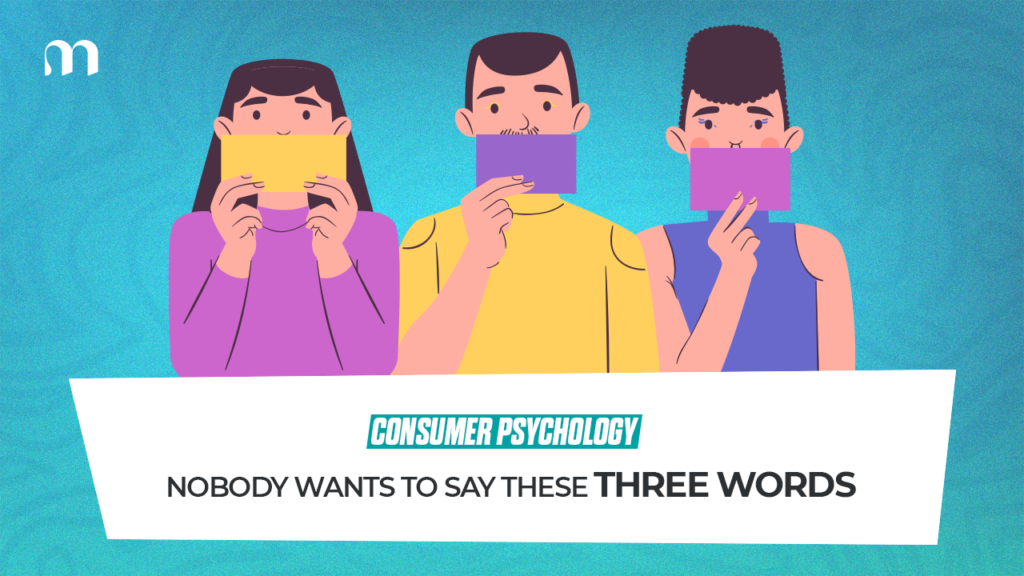
Try a small experiment. 👇
Open LinkedIn, Twitter, or Instagram right now and search for the phrase “I don’t know.” Then count how many posts you actually find from real people in real conversations, not from think-pieces written about the phrase.
It’s almost none.
Across the internet, in the spaces where people are supposedly being their authentic selves, three small words have become almost extinct.
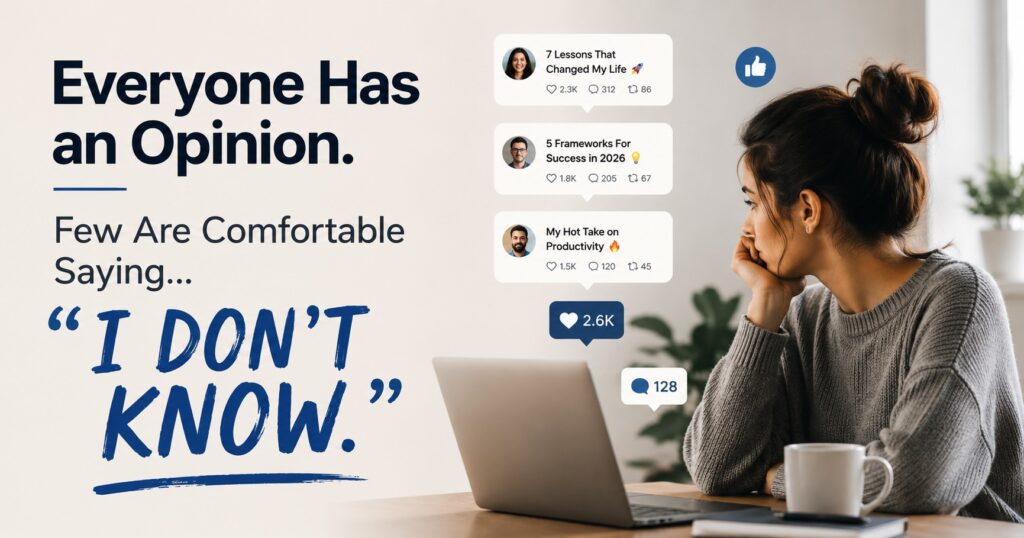
“I don’t know” has been replaced by :
- “here are seven things I learned,”
- “these are the five frameworks that changed my life,” and
- “I’ve been thinking deeply about this and here’s my hot take.”
Everyone seems to know everything.
Nobody seems to be allowed to be uncertain in public anymore.
There’s actual psychology behind why this happens, and it’s worth understanding, because the phenomenon affects :
How people make decisions,
How brands position themselves, and
How trust actually gets built online in 2026.
Start with the simple part.
Humans are wired to seek certainty.
The brain spends an enormous amount of energy trying to reduce ambiguity, because in evolutionary terms, ambiguity was dangerous.
Knowing whether the rustle in the grass was a tiger or the wind was a survival skill.
The brain that produced confident answers, even slightly wrong ones, generally lived longer than the brain that paused to wonder.
Modern humans inherited this wiring.
We feel safer when we have an opinion than when we have a question.
Now add the layer that social media adds.
Online, every statement carries a small social bet.
- Saying something confident invites engagement, likes, agreement.
- Saying “I don’t know” invites silence, or worse, the suspicion that the person doesn’t have anything worth saying.
The algorithm rewards confidence even when the confidence is misplaced.
The reward system trains everyone to perform certainty whether they have it or not.
Then add the workplace pressure.
Most professional environments treat uncertainty as weakness.
- Founders are expected to project conviction at all times.
- Marketers are expected to know which channels will work.
- Leaders are expected to have a plan.
Saying “I don’t know” in a meeting often feels like admitting incompetence, even when honest uncertainty is the most accurate position to hold.
All of this compounds.
By the time a person sits down to write a LinkedIn post or a tweet or a blog, the muscle for saying “I don’t know” has atrophied.
The default mode is to:
- Take a position
- Sound certain
- Deliver a takeaway
Even when the person doesn’t actually have one.
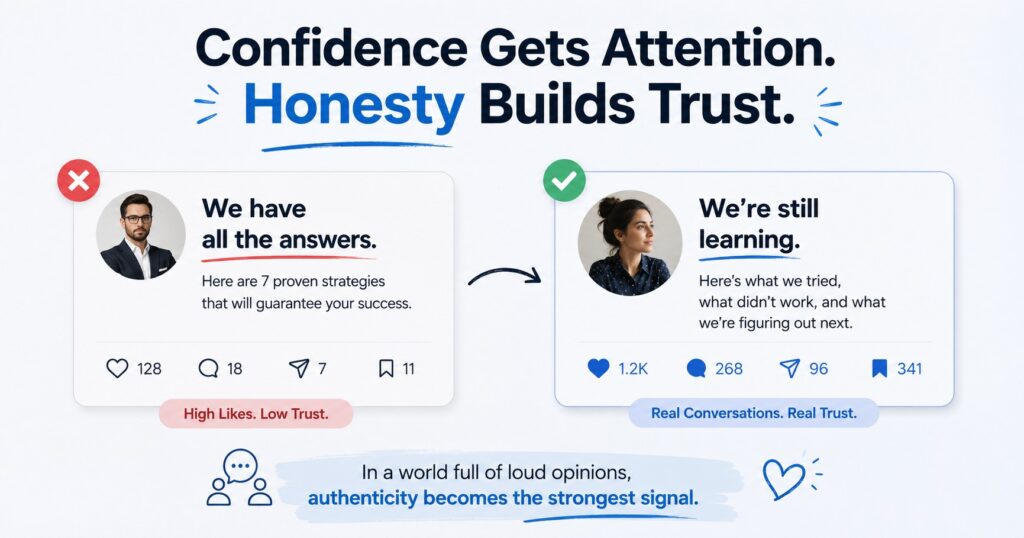
The consequences of this play out in interesting ways for consumer behaviour.
Audiences in 2026 are getting weirdly tired of confidence.
There’s so much manufactured certainty in the feed that any signal of genuine uncertainty stands out as refreshing.
Examples:
- 💬 The founder who posts “we tried this campaign, it didn’t work, we’re not sure why yet“ gets more engagement than the founder who posts “7 lessons from our latest launch.“
- 🤝 The brand that says “we don’t have a clear answer to this yet“ earns more trust than the brand that pretends to have answers to everything.
Honesty about uncertainty is becoming a competitive advantage, and most brands haven’t noticed.
Audiences are also getting better at spotting fake certainty.
The over-confident LinkedIn post about a topic the author clearly doesn’t deeply understand reads as performative now.
Readers can sense when a person is dressing up a guess as a conviction.
The performance hurts trust more than it builds it.
There’s a useful question for any brand or founder making content.
Could I write this same post and end it with:
“and honestly, I’m still figuring this out?“
If the answer is yes, the post is probably more truthful than the polished version.
If the answer is no, the post might be the kind of confident-sounding content that’s flooding the feed and contributing to the problem.
This applies to consumer-facing brands too.
Customers buy with more confidence from brands that admit:
- What their product can’t do
- What it isn’t right for
- Who shouldn’t buy it
The brand that says:
“this won’t work if your concern is X“
sells better than the one claiming to be for everyone.
The financial product that says:
“this is a long-term play, you’ll see returns over three years, not three months“
earns more deposits than the one promising instant results.
People can feel when a brand is being honest about its limitations.
The takeaway
The hardest sentence to write online is the one that admits to not knowing.
The internet has made it almost embarrassing to be uncertain.
The funny thing is that uncertainty is the most relatable emotion most readers actually feel, most of the time.
The people who give themselves permission to write it are the ones who end up sounding the most human in a feed full of false experts.
So here’s a small challenge.
Next time you sit down to post something, try ending with:
“I don’t know yet, but I’m thinking about it.“
See what happens.
It’s harder than it sounds.
💙 And more powerful than most people realise.