

 Back to Blogs
The Founder’s Framework for Creating Content in Under 2 Hours a Week

Most founders we meet say the same thing about content.
💬 “I’d love to post more. I just don’t have the time.“
This is almost always wrong.
What founders don’t have is a system.
The actual issue is scattered effort, which feels like a time issue but isn’t.
The founder who tries to write one LinkedIn post on Tuesday, film a reel on Wednesday, draft an email on Thursday, and reply to comments on Friday isn’t actually spending less time on content than the founder who batches everything.
The first founder is just spreading the work across the week in a way that makes it feel constant and exhausting.
The second founder gets two hours back and a content engine that actually runs.
Here’s the framework we use…
We’ve tested it across 50-plus founders in India, Australia, and the Middle East.
The ones who actually use it produce more content than they did before, with significantly less stress.
The framework has two parts:
- 🧠 Part 1: What to write about
- ⏰ Part 2: When to do the work
Part One: The Customer-Question Loop

Every founder has access to a goldmine of content topics they aren’t using.
💡 Look for:
- The five questions customers ask most often.
- The objections that come up in sales calls.
- The misconceptions that come up in onboarding.
- The reasons people churn.
- The things prospects almost asked but didn’t quite.
These five recurring questions are enough to generate three months of content, without ever writing about anything that isn’t directly relevant to the audience.
📌 What to do
Sit down once a quarter and list them.
- ✍️ Five questions
- 💭 Two or three sub-angles each
That’s 15 to 20 content ideas, each validated by the fact that real humans are already asking them.
Most founders try to come up with topics from scratch every week, which is exhausting and produces generic content.
Working from the customer-question list produces content that lands.
Then you loop.
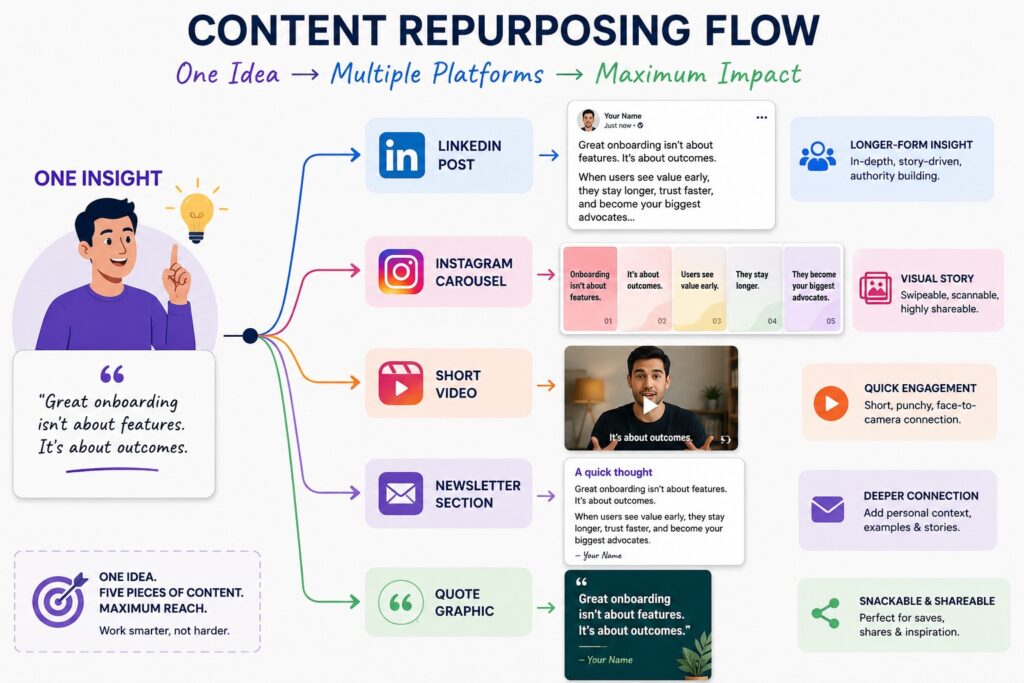
The same insight, restructured for different formats.
➡️ A LinkedIn post
➡️ becomes an Instagram carousel
➡️ becomes a short video
➡️ becomes a newsletter section
➡️ becomes a quote graphic.
One insight, five pieces of content.
Start with two or three formats and add more as the habit builds.
Part Two: The Sunday-Morning Batch
Two hours, once a week, with no phone notifications.
The founder sits down, picks two or three insights from the customer-question list, and produces all the content for the week in one sitting.
Here’s what the two hours actually looks like in practice.
First 20 minutes
Pick the insights.
- Look at the customer-question list.
- Pick two or three you have strong opinions on this week.
Don’t overthink it.
The one you almost wrote about last week but didn’t is probably the one to write about this week.
Next 40 minutes
Draft the content.
Fastest way is to record yourself talking about each insight for three to four minutes, then clean up the transcript.
Founders talk faster than they write, and the spoken version is closer to how they actually sound.
Use:
- Voice notes
- otter.ai
- Any AI transcription tool
The transcript becomes:
- The LinkedIn post
- The Instagram caption
- The newsletter section
Edit afterwards.
Don’t write from scratch.
Next 30 minutes
Format and schedule.
Take the cleaned-up transcripts and adapt them for each platform.
- LinkedIn likes longer-form.
- Instagram needs a hook.
- The newsletter can include personal context.
Schedule everything in:
- Buffer
- Notion
- Or whatever queueing tool the team uses.
Done.
💬 Final 30 minutes
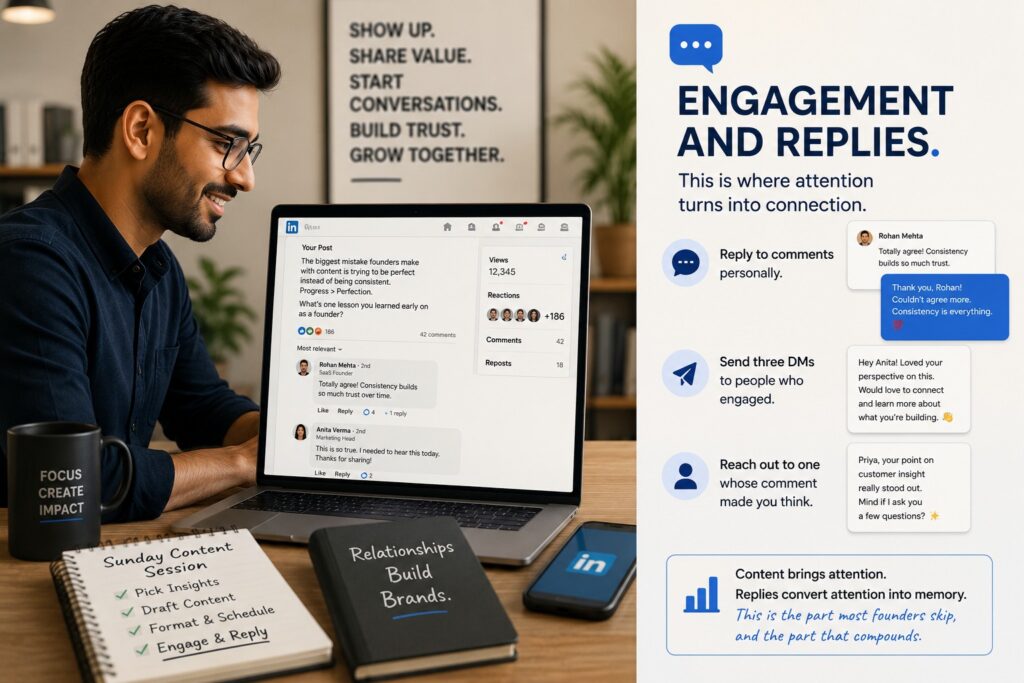
Engagement and replies.
Look at last week’s posts.
- Reply to comments personally.
- Send three DMs to people who engaged.
- Reach out to one whose comment made you think.
This is the part most founders skip, and the part that compounds.
Content brings attention.
Replies convert attention into memory.
⏳ Two hours.
That’s it.
📌 A few things to keep in mind.
Don’t worry about perfection.
The founder posts that perform best are usually the ones that sound slightly off-script.
The polished posts get fewer comments than the slightly raw ones.
Audiences in 2026 can sense over-editing, and they reward content that sounds like a real person on a real Tuesday morning.
Don’t break the Sunday session.
The discipline of having one fixed slot for content production is what makes the whole thing sustainable.
The week the founder skips it is the week the content engine starts dying.
Two hours. Every Sunday.
Treat it as a meeting with the brand itself.
At Mirra Digital…
We find that founders who stick to this for three months become unrecognisable as marketers.
- The audience builds.
- The DMs from real prospects start arriving.
- The content engine starts feeding the rest of the marketing.
Final Thought
Content production is a system problem dressed up as a time problem.
Two focused hours a week, applied with the right framework, produces more compounding presence than ten unfocused hours trying to keep up with the algorithm.
- Pick your five real customer questions.
- Batch the work.
- Show up.
- Reply.
- Repeat.
The audience is waiting.Most founders just need to figure out the time-box.