

 Back to Blogs
The 5-Step Content Audit Every Small Brand Should Do Before Spending on Ads

A founder walks into a marketing meeting and announces it’s time to run ads.
The team nods. The budget gets discussed. Within a week, money is moving on Meta. Two weeks later, the dashboard looks bleak, the cost-per-result is rising, and everyone is wondering whether ads even work anymore.
Ads work. The problem is that most small brands skip the step that makes ads work, which is auditing what they already have.
A content audit is forty-five minutes of looking honestly at the existing content surfaces of the brand.
- Website.
- Instagram.
- Past blog posts.
- Email list.
- Old videos.
Anything the brand has produced.
The audit answers one question. Is this stuff doing its job, and is it ready to receive paid traffic?
For most small brands, the honest answer is no, and that’s why their ads underperform.
⇥ Here are the five steps.
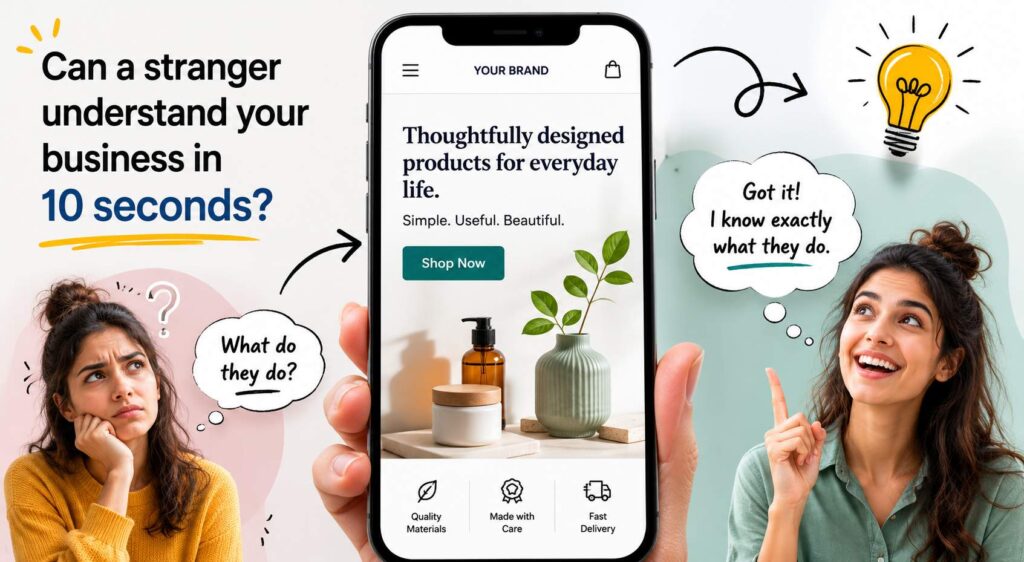
Step 1: Test Your Homepage in 10 Seconds
Look at the homepage with fresh eyes, on a phone. Read it as if landing on it for the first time, with no context.
Can a stranger figure out within ten seconds
- what the brand sells,
- who it sells to, and
- why it’s worth their attention?
Most homepages fail this test. They open with a
- vague brand statement,
- a hero image of a model looking thoughtful, and
- a value proposition borrowed from a competitor.
Before any ad campaign goes live, the homepage has to pass the ten-second test, because that’s where the paid traffic is landing.
Step 2: Audit Your Instagram Like a Stranger
Check the Instagram grid as it would look to a stranger. Existing followers have built up familiarity over months.
New visitors arriving via ads have none of that context.
Open the profile in a private window. Look at the top six posts.
- Do they explain what the brand does?
- Do they show the product or service clearly?
- Is there a pinned post that tells the story for someone who’s never heard of the brand?
If the grid only makes sense to people who already know the brand, the ads are landing visitors on a page that confuses them, and confused visitors don’t convert.
Step 3: Find What’s Already Working
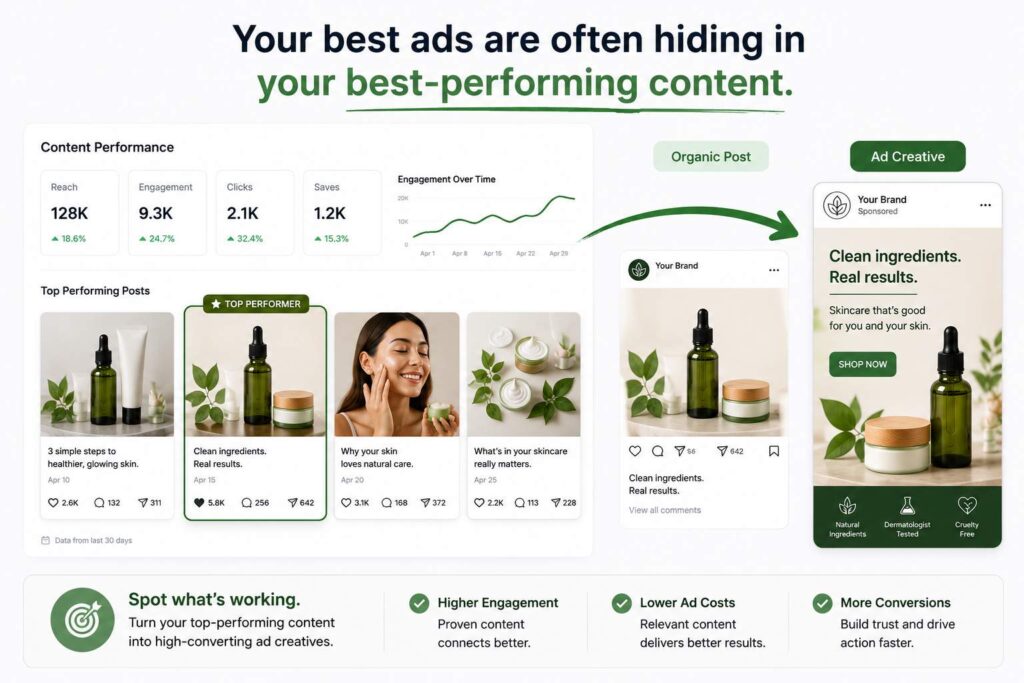
Identify the content that’s already working.
Pull up the last six months of posts.
Sort by
- engagement, ❤️
- reach, or 📈
- saves. 🔖
Find the top three to five posts that outperformed everything else.
There’s almost always a clear pattern.
- A specific topic.
- A specific format.
- A specific tone.
That pattern is the brand’s audience telling the brand what they actually want.
The smarter move is to study the winners, understand why they worked, and build more of them. This is also the content that should fuel the first round of ad creative, because it’s already proven.
Step 4: Read Every Important Page Out Loud
Read the existing copy out loud.
- Product pages,
- About page,
- service descriptions,
- captions,
- the lead magnet,
the email opt-in. Anything written.
If a sentence sounds off when spoken aloud, the visitor’s brain registers the same awkwardness when reading it, even if they can’t say why.
- Corporate language,
- vague claims, and
- AI-written paragraphs all fail this test.
Replace anything that sounds like a press release with the way a real person would say it. Plain language reads as more credible, and credibility is what converts ad traffic into customers.
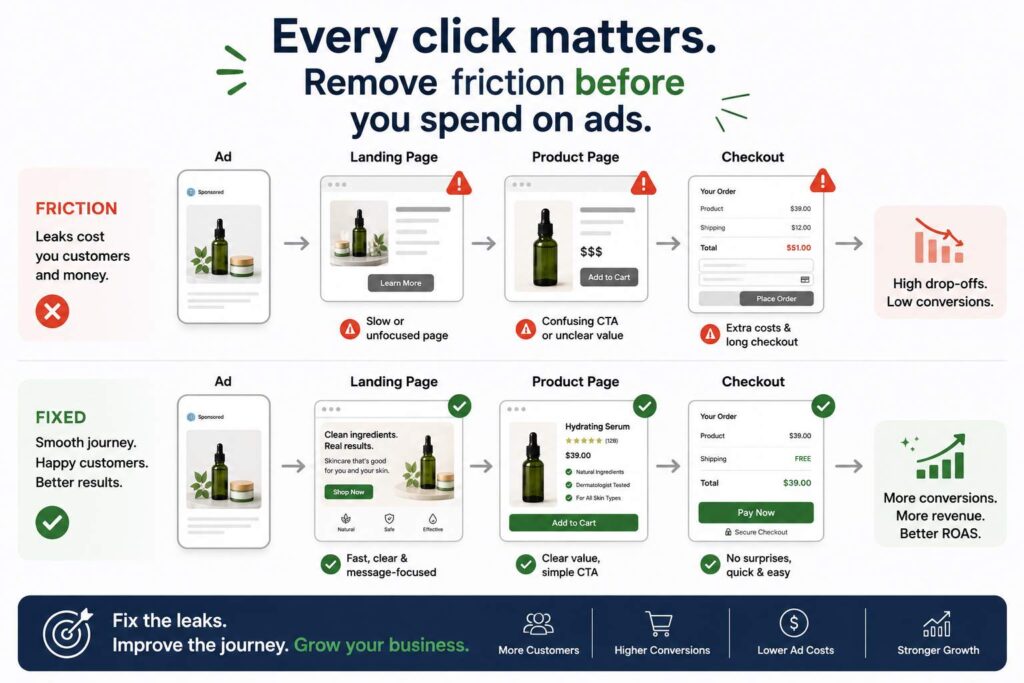
Step 5: Audit the Entire Conversion Path
Audit the conversion paths.
Where exactly does a visitor go after the ad?
Trace the journey, click by click.
Ad to landing page to product page to cart to checkout.
📢 Ad → 🌐 Landing Page → 🛒 Product Page → 💳 Checkout
Look for friction at every step.
- Is the landing page mobile-optimised?
- Does the product page have proof, specifics, and a clear call to action?
- Are there surprise costs at checkout?
Every friction point is a place where a paying customer could have been lost. Fixing these before turning on the ads costs nothing and protects the entire budget.
What Happens After the Audit?
Once these five steps are done, the brand will have a much clearer picture of what’s actually ready to convert.
- The homepage might need a rewrite.
- The Instagram grid might need three foundational posts.
- The top-performing content might be exactly what should be turned into ad creative.
- The copy might need to be stripped of jargon.
- The checkout might need a fix that recovers 15% of abandoned carts.
None of this is expensive. All of it is invisible to a brand that doesn’t look. The brands that consistently get good returns on ad spend tend to win on this unglamorous prep work, more than they win on bigger budgets or better creative.
Set aside an afternoon.
- Walk through the five steps.
- Make the fixes the audit surfaces.
- Then turn on the ads.
Every rupee will work harder, and the brand will avoid the most common reason small business ad campaigns fail, which is paying to send strangers to a place that wasn’t ready for them.
If you’d rather not send strangers to a place that isn’t ready for them, Mirra Digital can do the audit for you. One afternoon of work on our side, one clear set of fixes on yours, before any ad money get spent.