

 Back to Blogs
Stop Benchmarking Against the Big Brands. You’re Playing a Different Game.

In my opinion, one of the most common ways small brands sabotage themselves is by deciding, very early on, that they want to be measured against companies operating at a completely different scale, with a completely different budget, in a completely different stage of growth.
I’ve heard :
“I want to be the Apple of my industry” so many times now I think I should start charging extra every time someone says it in a meeting.
“I want a world-class website in India,” which is a sentence that means absolutely nothing when you actually try to unpack it.
- World-class compared to what?
- For whom?
- With what budget?
- With what content?
Nobody ever has answers to these questions. They just want the website to feel like it belongs in a category it isn’t actually in yet.
This is benchmarking against the wrong brands, and it’s costing small businesses time, money, and identity.

A small real estate company operating in two cities does not need to look like a national developer with offices in eight countries.
A boutique skincare label launching with three SKUs does not need to run a campaign modelled on a publicly traded MNC’s holiday push.
A growing café in a single neighbourhood does not need a brand book designed for franchising.
The aspirations are fine. The benchmarking is not, because aspirations and benchmarks are different things and most founders are confusing them.
- Aspiration is where you want to go.
- Benchmarks are how you measure where you are.
If your benchmarks are pulled from companies thirty stages ahead of you, all your KPIs become unachievable from day one, and the team gets demoralised before the work even has a chance to show results.
I’ve watched this play out too many times. A brand sets growth targets based on
- a competitor that has eight years of compounding ahead of them,
- fifteen times the spend, and
- a category-leading brand recall.
Then the team scrambles to hit those numbers. Then everyone wonders why nothing’s working.
Nothing’s working because the goalposts were never reasonable. They were borrowed from someone else’s life.
There’s another problem with benchmarking against big brands, which shows up most visibly on social media.
- The visual identity,
- the post formats,
- the campaign tone,
all of it starts mirroring the bigger player in the category.
The intent is to look credible. The actual effect is the opposite.
You end up looking like a cheaper version of someone else, and your audience can tell.
Whatever made you genuinely different gets sanded off in the process of trying to look like the people you admire.
Copying doesn’t make you bigger.
It makes you forgettable.
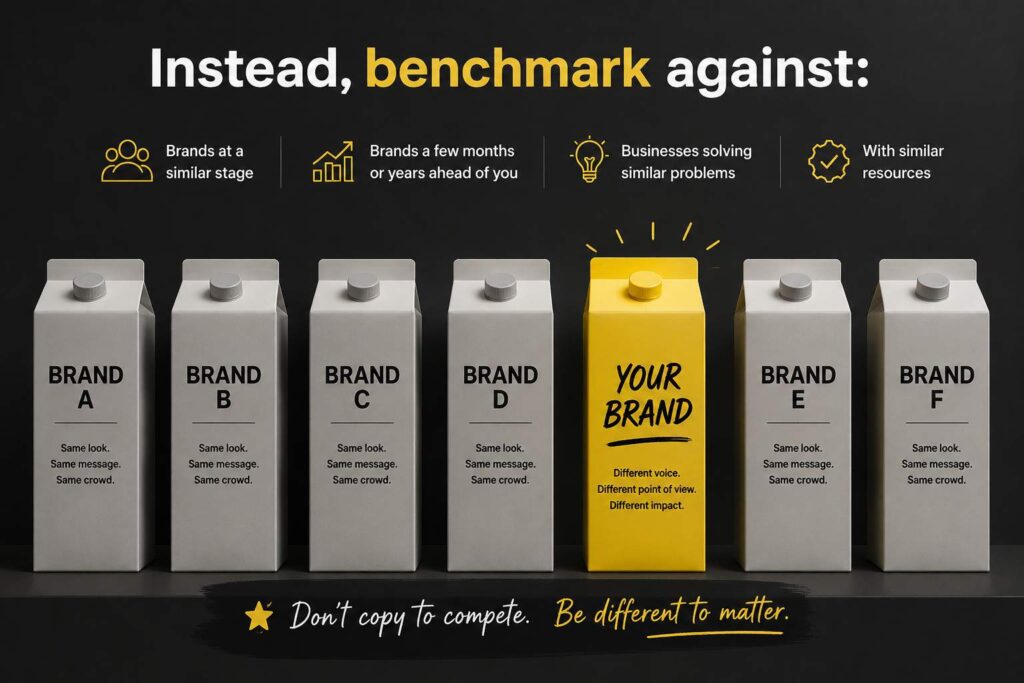
The right thing to benchmark against, if you must benchmark, is brands at your own stage.
- Brands a few months ahead of you,
- doing interesting things in your category or an adjacent one.
- Look at what they’re doing well,
- look at what’s working for them,
but more importantly,
look at what they’re doing to stand out. Then go find your own version of that.
The point of looking at peers isn’t to copy their playbook, it’s to understand what kind of distinctiveness is possible at your stage and then build your own.
Better yet, benchmark against your own previous quarter.
What were you doing three months ago, and is what you’re doing now actually better?
That’s a fairer comparison than measuring yourself against a brand whose marketing budget is larger than your entire annual revenue.
Here’s the part the big brands don’t have access to anymore.
Smaller brands have advantages that scale erases.
You have less to lose, which means you can
- experiment,
- try unexpected angles,
- change direction quickly, and
- take creative risks that no listed company would ever sign off on.
You have fewer stakeholders to convince, so a smart idea can go live in a week instead of a quarter.
- You have actual proximity to your customers,
- you can answer DMs personally,
- you can change a product based on three pieces of feedback,
- you can show up as a real human and not a brand committee.
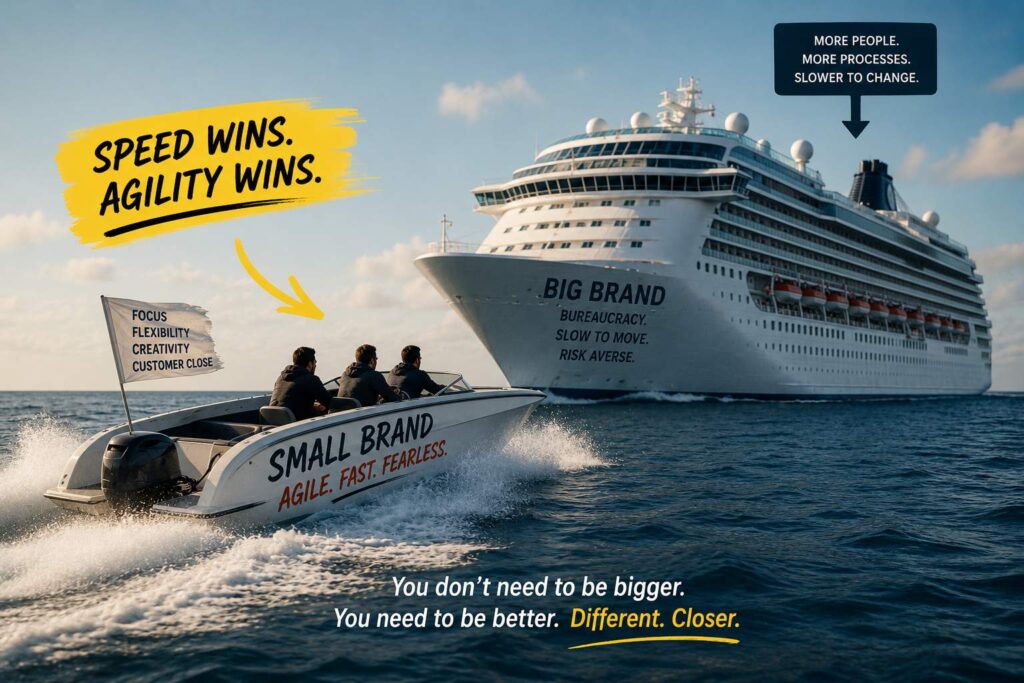
A lot of what’s interesting in marketing right now is happening at much smaller scale, with much smaller teams, doing things bigger brands literally cannot do because their structure won’t allow it.
- Benchmarks borrowed from the top of the market will tell you you’re behind.
- Benchmarks rooted in your own stage will tell you you’re moving.
The first kind kills momentum, the second kind builds it.
Have the aspiration. Keep the vision.
But please stop comparing your two-year-old brand to a forty-year-old multinational and wondering why the numbers don’t add up. They were never supposed to.