

 Back to Blogs
The “Niche Down” Advice Is Wrong for Most Small Brands

📢 There’s a piece of marketing advice that’s been circulating for the better part of a decade, sold at conferences, repeated on podcasts, and printed on the back covers of business books.
Niche down. Find a tiny audience. Speak only to them. Become the obvious choice in a small pond.
✅ It’s good advice. For about 5% of brands.
For the other 95% of small businesses, especially in early stages, niching down too aggressively is one of the fastest ways to stall growth before the business even understands what it actually is.
The advice gets parroted by people who skipped the part where it only works once a few specific conditions are in place.
Most small brands don’t have those conditions yet.
Here’s what nobody on the niche-down podcast circuit tells you.
To niche successfully, a brand needs three things.
- A clearly defined audience with proven willingness to pay.
- A product offering that’s been validated through actual sales.
- And enough cash flow to sustain the smaller-funnel revenue while it scales.
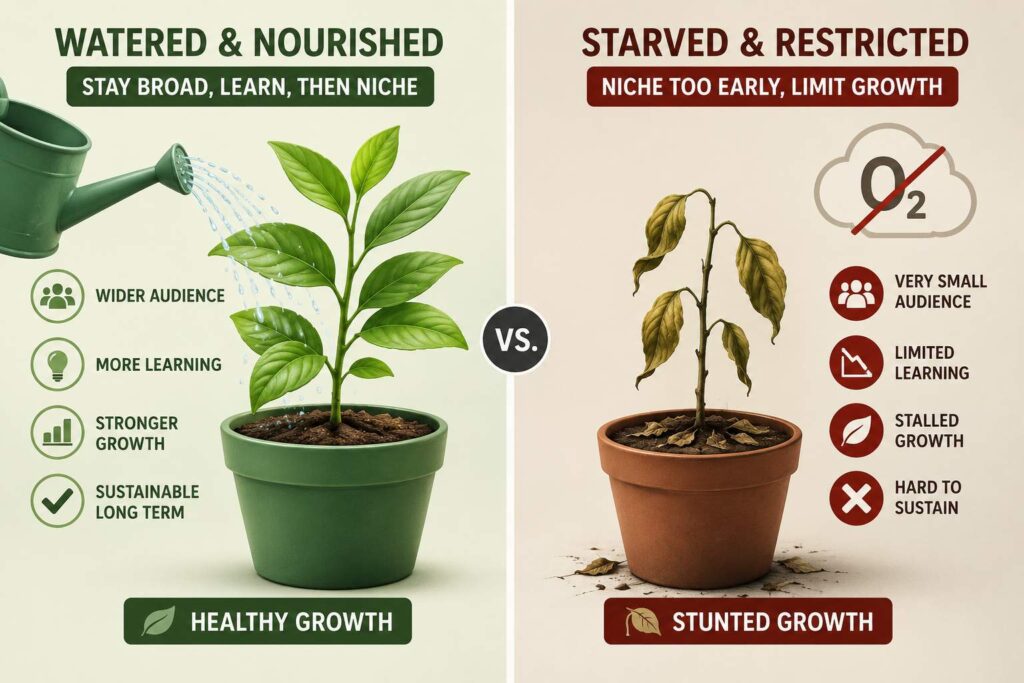
Without these three, niching doesn’t focus the business. It just cuts off the oxygen supply.
Think about what “niching down” actually demands.
📍 The skincare brand told to focus only on women aged 28 to 35 in Bengaluru with combination skin and a mid-tier income.
📍 The SaaS tool told to focus only on five-person law firms in Sydney.
📍 The consultancy told to focus only on family-run businesses in Dubai.
These are exquisitely specific audiences, and they sound smart on paper.
The problem is that when the founder hasn’t yet talked to enough customers to know whether that’s the right audience, the brand has just shrunk its own market based on a guess.
Year one and year two of a business is when the audience reveals itself,
…well before it can be prescribed.
- The skincare brand might launch thinking it’s for women aged 28 to 35, then realise its strongest customers are 45-year-old men in Melbourne with rosacea.
- The SaaS tool might assume law firms are the play and then discover that small architecture practices are the ones renewing every quarter.
- The consultancy might position itself for family businesses in the GCC and find that the founders most willing to pay are tech startups in Bangalore.
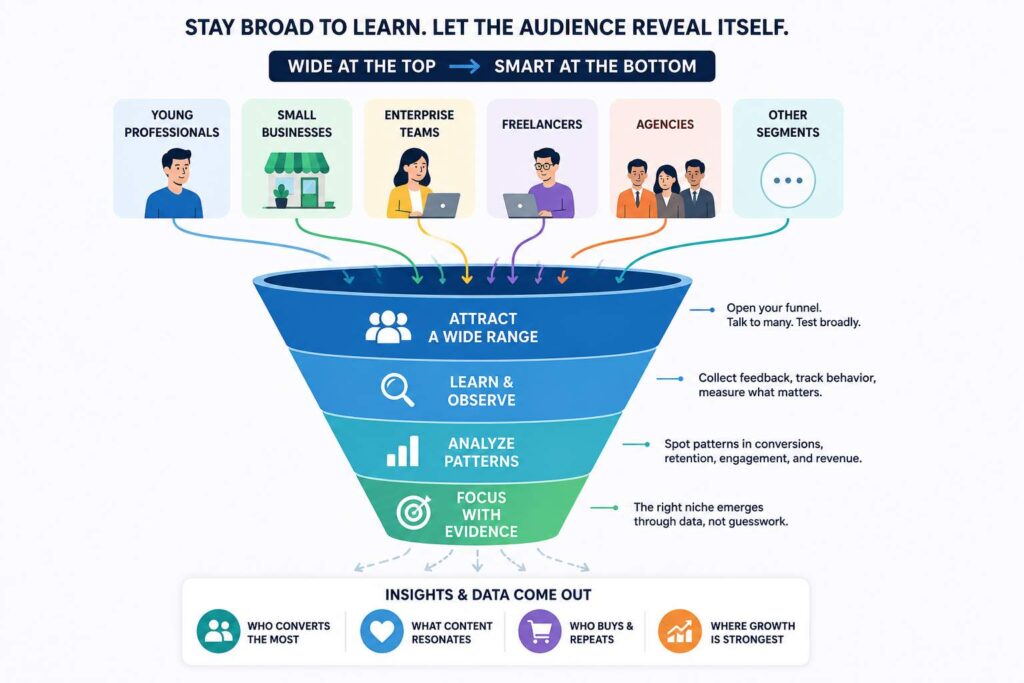
This learning only happens if the brand is open enough at the top of the funnel to attract a wide range of people.
Niching too early prevents the learning before it has a chance to happen.
There’s also an emotional weight to this advice that nobody mentions.
Founders who niche down prematurely often start to feel trapped by the audience they chose.
- The work feels narrower than the founder wants it to be.
- The content starts feeling repetitive.
- The team gets bored.
- Six months in, the founder is privately resentful of the niche they were so excited about in the first place.
So when does niching actually make sense?
A few specific situations.
1️⃣ When the data is screaming at you
First, when the brand has been operating broadly for two or three years and the data is screaming about one audience converting at three times the rate of any other.
Niching at that point is just removing distractions from what’s already working.
This is the right time, and it’s also the rarest one founders are in.
2️⃣ When the market is brutally crowded
Second, when the competitive landscape is so crowded that being a generalist is genuinely impossible.
Example:
📚 A new ed-tech platform in India can’t win by being “a learning app for everyone.”
It has to pick a wedge.
Categories saturated with hundreds of well-funded competitors require sharpness from day one.
3️⃣ When the founder already has a natural advantage
Third, when the founder has deep, lived expertise in one specific area, and the niche is the founder’s natural advantage.
A radiologist building a tool for radiology workflows doesn’t need to test other markets first.
The niche is the founder’s authority.

For everyone else, the smarter approach in year one and year two is to stay broad enough to learn.
- Define a clear category.
- Make a strong promise.
- Build a product that works.
- Talk to a lot of people.
- Let the audience tell you who they are before you tell them who they should be.
Over time, patterns emerge.
The brand notices :
- which customers stay,
- which content resonates,
- which messaging converts.
The niche reveals itself through customer behaviour, through the data, through the warm leads.
By the time the brand niches, the decision is grounded in evidence, with the data asking for it.
The niche-down advice gets repeated because it sounds smart and feels actionable. Both of those things make it dangerously easy to follow before it’s actually appropriate. Most small brands lose more by niching too early than they lose by staying broad a little longer.
Stay broad. Learn fast. Niche later, when the data is asking for it.