

 Back to Blogs
The Endowment Effect in E-Commerce: Why Free Trials Still Outperform Discounts
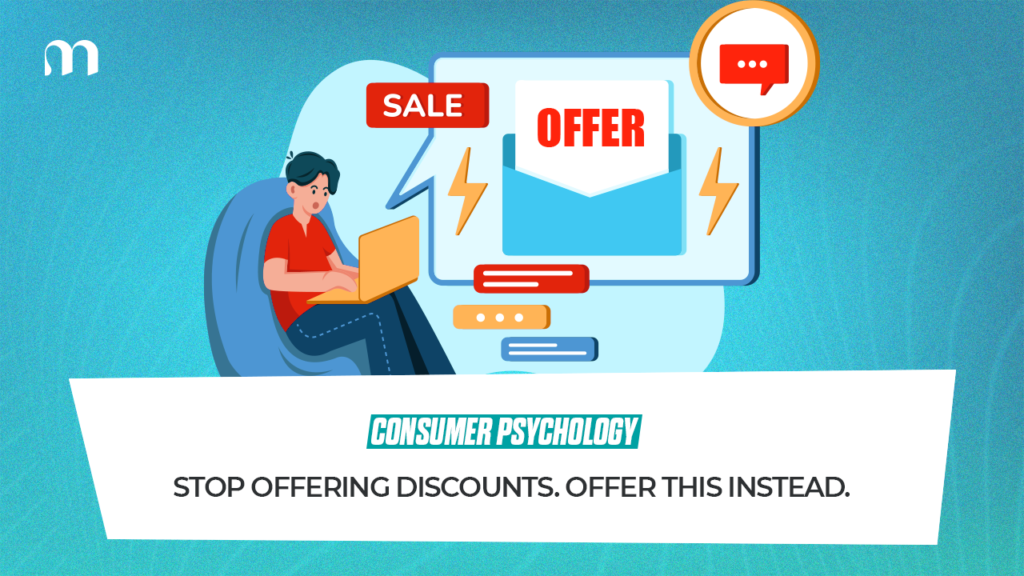
Most e-commerce brands chasing growth reach for the same lever first.
- A discount.
- 10% off,
- 20% off,
- festival sale,
- first-order discount,
- code at checkout.
It works in the short term, the dashboard lights up, and then the brand spends the next six months wondering why none of those discount-acquired customers came back at full price.
There’s an older, slightly stranger lever that consistently outperforms discounts on lifetime value, and most Indian brands aren’t using it.
The free trial.
The reason free trials work has a name in behavioural economics.
- It’s called the endowment effect, and it’s one of the most well-studied quirks in how humans value things.
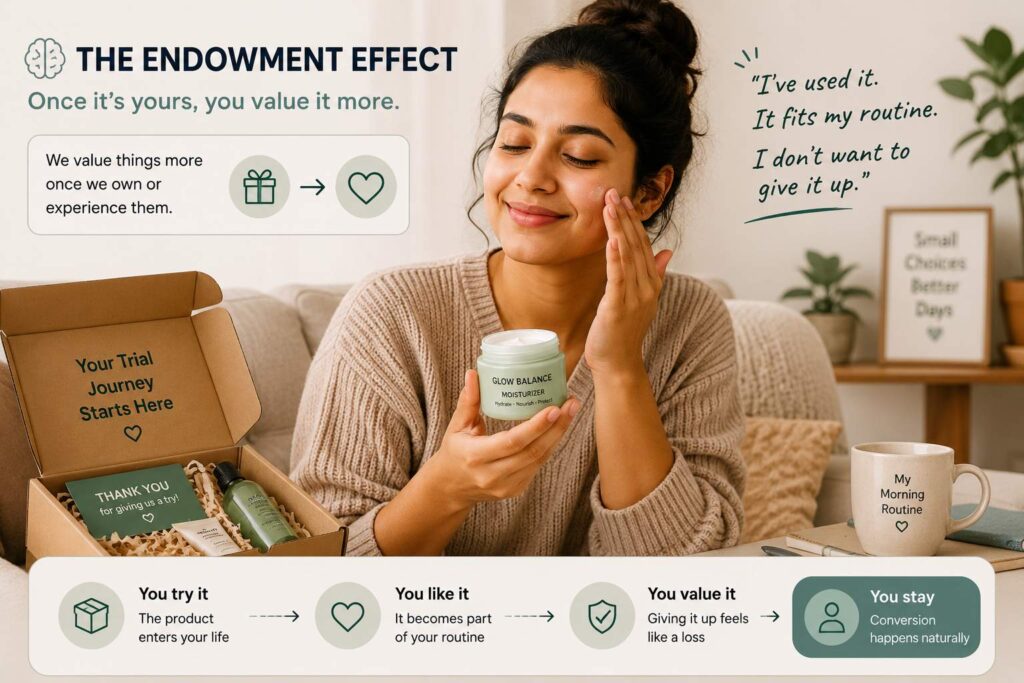
- People place a significantly higher value on something they already own, or feel they own, than on the same thing if they were buying it new.
- Once a product is in someone’s hands, parting with it feels like a loss, and humans are wired to avoid loss far more strongly than they’re wired to chase gain.
A discount asks the customer to make a decision.
- Buy now and save.
- Pay less than usual.
The customer is still being asked to spend money, and money decisions involve :
- hesitation,
- comparison, and
- the constant chance of walking away.
A free trial flips the entire dynamic.
- The customer already has the product.
- The decision now is whether to give it up.
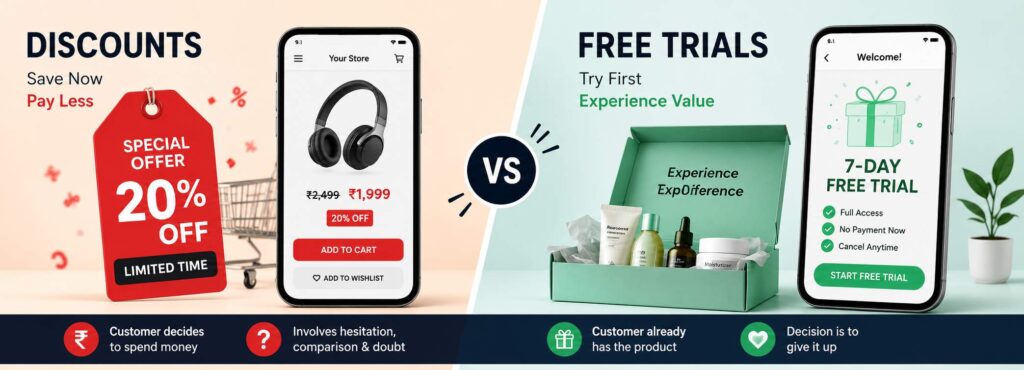
That’s a very different psychological calculation, and it heavily favours the brand.
This is why streaming services, software companies, and subscription boxes have leaned on free trials for years.
They understood early that
- getting a product into someone’s life is most of the battle, and
- once it’s in, the friction of removing it does the work that a sales page can’t.
E-commerce has been slower to catch on, partly because physical products are harder to give away than digital ones.
- Sending out free samples,
- full-size trials, or
- 30-day return offers feels expensive on a spreadsheet.
The discount looks cheaper because the loss is visible and contained.
The free trial looks risky because the cost is upfront.
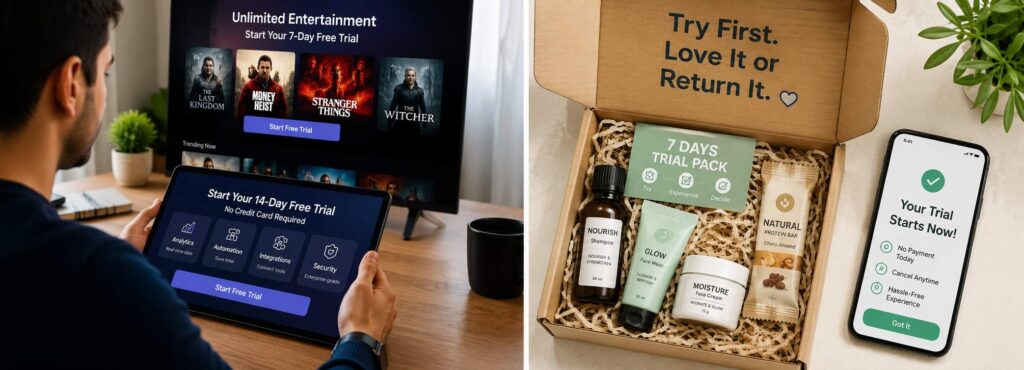
So most brands stick with the discount, even though the math on lifetime value usually favours the other approach.
⇥ Here’s what’s actually happening when a brand runs a steady discount strategy.
- The brand is training customers to wait for the next sale.
- The full-price purchase becomes the exception.
- The customer’s reference point for what the product is worth gets dragged down to the discounted price, and the perceived value drops with it.
A year of discount-led promotions and the brand has effectively repriced itself in the customer’s mind, without ever changing the MRP.
Free trials work differently.
The customer experiences the product first.
If the product is genuinely good, the endowment effect kicks in.
- The customer doesn’t want to give it up.
- Conversion to paid happens because the customer has already integrated the product into their routine, and the thought of going back feels like a loss.
The full price stays full. The brand stays positioned as premium.
Indian e-commerce has been experimenting with this slowly.
- Skincare brands offering 7-day sample kits.
- Meal subscription services giving the first week free.
- Apparel brands offering try-at-home services with no obligation.
- SaaS tools in the B2B space using free trials almost exclusively.
Each of these is using the endowment effect, whether the brand knows the term or not.
⇥ There are a few practical things worth saying about deploying free trials well.
The product has to be genuinely good.
- A free trial of a mediocre product accelerates churn rather than building any kind of attachment.
- The endowment effect only works if the product earns the customer’s attachment during the trial period.
- Sending free samples of something forgettable just costs money.
The trial length should match how the product works.
- A skincare trial of three days is too short to show results, so the customer parts with it without hesitation.
- A trial of 30 days for a snack subscription is too long, because the customer has eaten through it before the next charge hits.
The window has to be calibrated to the product.
Long enough for the customer to genuinely integrate it, and not so long that the urgency to decide disappears.
Brands also need to think about whether they’re ready ethically.
The endowment effect, like most behavioural economics, is a psychological principle that can be used to help customers or to trap them.
There’s a difference between:
- offering a free trial of something genuinely useful and
- using auto-renewal traps to lock people into subscriptions they didn’t realise they signed up for.
The former is good marketing.
The latter is the kind of dark pattern that makes regulators write new laws and customers leave one-star reviews.