

 Back to Blogs
Price Anchoring in the Age of Instant Comparison
There’s a popular theory in e-commerce circles that price anchoring stopped working the moment customers got smartphones.
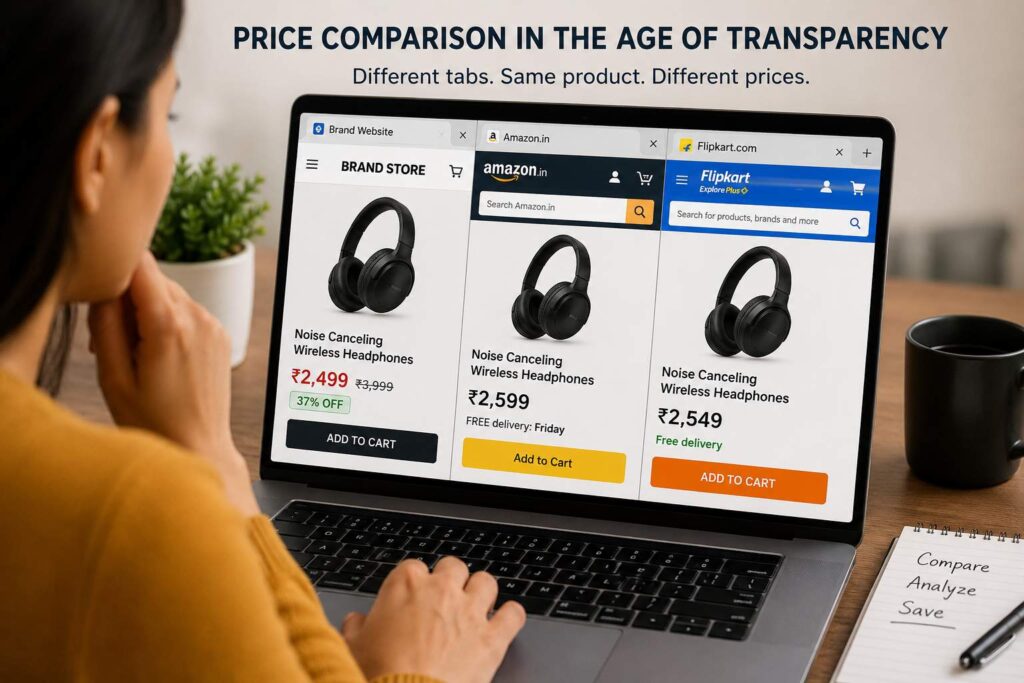
Anchoring used to work because shoppers couldn’t easily compare prices, so the first number they saw became their reference point. Now they can open three tabs in thirty seconds and check Amazon, Flipkart, and the brand’s own site before paying. The anchor, the theory says, has been broken by transparency.
It’s a tidy theory. It’s also wrong.
Anchoring is one of the most stubborn quirks in human decision-making, and it’s been studied to death by behavioural economists since the 1970s.
People judge value relatively. The first number they see becomes a reference point against which every other number gets measured, often unconsciously. Even when shoppers know the anchor is arbitrary, even when they actively check other prices, the anchor still shapes how they perceive value.
The comparison tab open in the background changes how the anchor functions, without removing it.
Walk through what actually happens when a customer browses a product on a brand’s website.
- The page loads with a hero image, a name, and a price.
- If the brand has listed the product at 2,499 with a struck-through 3,999 next to it,
- the customer is now operating in a frame where 2,499 feels like a discount,
- even though they have no way of knowing whether 3,999 was ever the real selling price.
- Then the customer opens Amazon to compare.
- They see the same product listed at 2,599. Amazon is more expensive.
- The brand’s price feels reasonable.
- The customer adds to cart and pays the 2,499 feeling like they got a deal.
- Without the original anchor, the same 2,499 might have felt expensive or fair.
With the anchor, it felt cheap.
The Amazon tab didn’t break the spell.
It reinforced it.
This is why the strike-through price hasn’t disappeared from e-commerce.
- The strike-through still works,
- even when the customer suspects the original price was inflated.
- The brain doesn’t fully separate the anchor from the new information.
The two get blended together, and the blended version still favours the seller.
The Decoy Effect: Anchoring’s Smarter Cousin
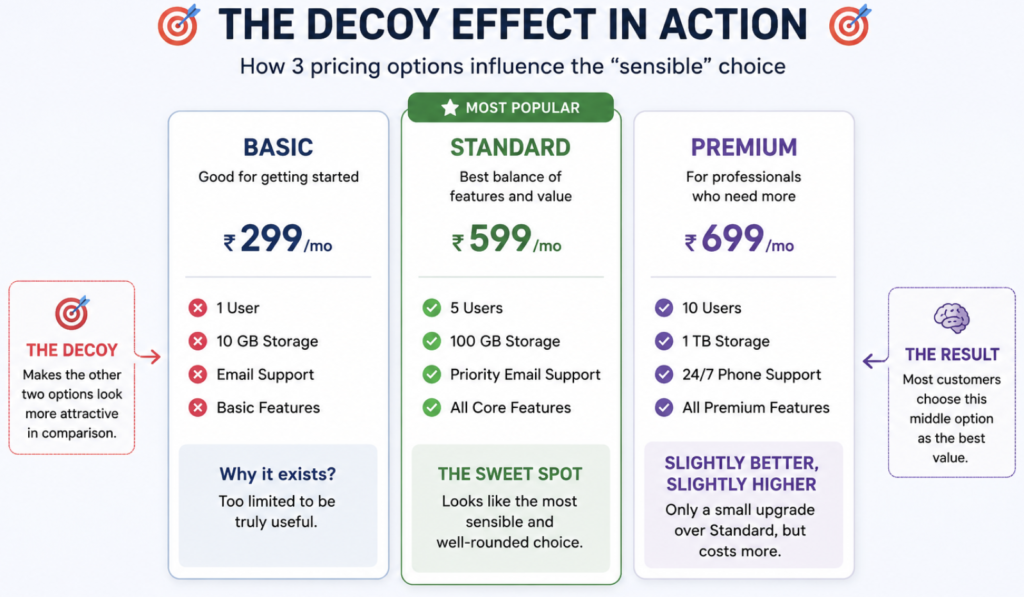
Then there’s the more sophisticated cousin of anchoring, which is the decoy effect.
A brand offers three pricing tiers.
- The cheapest is intentionally too limited to be useful.
- The most expensive is priced just slightly above the middle option, with only marginal additional benefit.
- The middle option, which the brand wanted the customer to pick all along, looks like the obvious sensible choice.
This is anchoring used architecturally.
The customer feels like they made a smart, considered decision.
The brand engineered the decision before the customer arrived.
Both of these tactics survive in the age of instant comparison because comparison doesn’t override psychology.
The extra price points the customer sees become more data filtered through the same psychological lens.
Indian E-commerce and Anchoring
Indian e-commerce has been leaning on anchoring aggressively, in ways that are sometimes useful and sometimes deeply suspect.
The MRP-vs-discount theatre that dominates fashion and FMCG, where every product is listed at 70% off a price nobody ever paid, is anchoring at its most cynical.
Customers are getting wise to this.
When everything is 70% off forever, the 70% stops feeling like a deal and starts feeling like a lie.
The anchor still works, but the trust around it erodes.
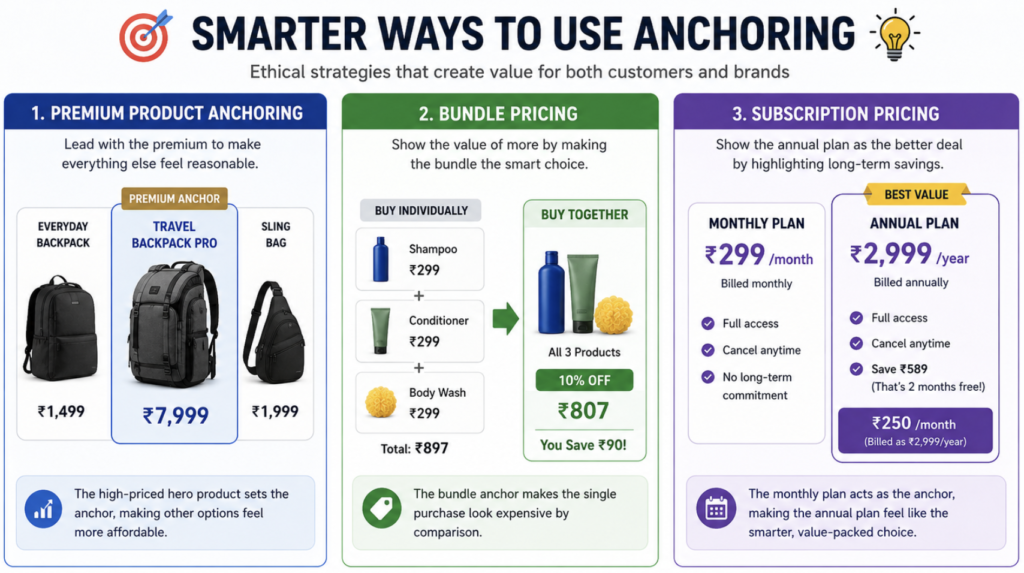
Smarter Ways to Use Anchoring
There are smarter ways to use anchoring without sliding into MRP fakery.
1. Premium Product Anchoring
Pair products at different price points so the brand can lead with the higher-priced one and let the lower one feel accessible by comparison.
A premium hero product on a homepage works as the anchor for the rest of the catalogue, making everything else feel reasonable. Many luxury brands operate this way deliberately, with a single hero product priced absurdly high to anchor the rest of the line.
2. Bundle Pricing
Bundle pricing also leans on anchoring.
A three-pack at a slight discount to three individual purchases makes the single purchase look expensive by comparison, which can shift the customer up to the bundle without feeling pressured.
3. Subscription Pricing
Subscription pricing uses anchoring constantly.
The monthly price is shown alongside the annual price, with the annual presented as the better deal because the per-month math works out lower.
- The annual commitment is the goal.
- The monthly is the anchor that makes the annual feel sensible.
Anchoring has survived every prediction of its death.
It’s a psychological principle that holds up even when the customer has every other price at their fingertips.
The real question is how it gets used.
Cynical anchoring builds short-term conversion and long-term distrust. Thoughtful anchoring helps customers make decisions they’re happy with, at prices the brand can sustainably charge.
- The first approach spikes a quarterly graph.
- The second one builds a brand that lasts beyond it.