


 Back to Blogs
The Pre-Mortem: How to Find What’s Going to Break Your Marketing Plan Before You Launch It

Most marketing teams plan a launch by listing everything that needs to happen.
- The website.
- The ads.
- The content.
- The email sequence.
- The press outreach.
- The launch-day social posts.
Boxes get checked, dates get set, the team feels organised and confident.
Three months later, the launch underperforms.
The team gathers for a post-mortem. Everyone takes turns explaining what went wrong and why nobody saw it coming.
⇥ Here’s a small idea borrowed from product management
…..that almost no marketing team uses, which is genuinely strange given how useful it is.
The pre-mortem.
The exercise is simple.
Before launching anything, the team sits down, imagines that the launch has already happened, and that it failed.
The failure should be specific, demoralising, and painful.
Then everyone in the room writes down all the reasons why.
The trick is that the failure has to be assumed.
The brain works very differently when it’s asked
“what could go wrong“
versus
“it went wrong, why did it.”
The second prompt unlocks honest analysis.
The first one usually produces a list of mild concerns.
The second one produces the actual risks the team has been avoiding.
Why It Works
It works because of how the brain handles uncertainty.
Research from psychologist Gary Klein, who pioneered this technique, found that when teams imagine failure as a completed event, they identify 30% more potential problems than when they brainstorm risks abstractly.
The grammar of the exercise matters.
“We failed”
produces a different list than
“we might fail.”
⇥ Here’s how to actually run one for a marketing plan.
Step 1: Block 90 Minutes
Get the whole team in a room or a Zoom.
No phones.
No interruptions.
Open with a clear premise.
“It’s three months from now. The campaign has launched. It has failed in a major, embarrassing way. The metrics are worse than the worst case we discussed. Write down, individually and silently, every reason you can think of for why this happened.”
Step 2: Silent Writing
Give everyone fifteen quiet minutes.
The silence matters.
Group discussions tend to converge on safe answers.
Individual writing produces the answers people are hesitant to say out loud.

Step 3: Share Everything
Then go around the room.
Each person reads their list.
- No debating,
- no defending,
- no justifying.
Just collecting. Write everything on a shared board.
What Usually Comes Out
What comes out of this exercise is usually surprising.
- The risks the team had been ignoring tend to be the ones nobody wanted to raise.
- The brand voice that hasn’t been refined enough.
- The landing page that nobody’s actually tested on mobile.
- The pricing question that’s been postponed for three meetings.
- The audience assumption nobody’s validated.
- The dependency on a third-party tool nobody fully understands.
These risks are visible to individuals on the team.
They just don’t come out in normal planning conversations because they’re awkward.
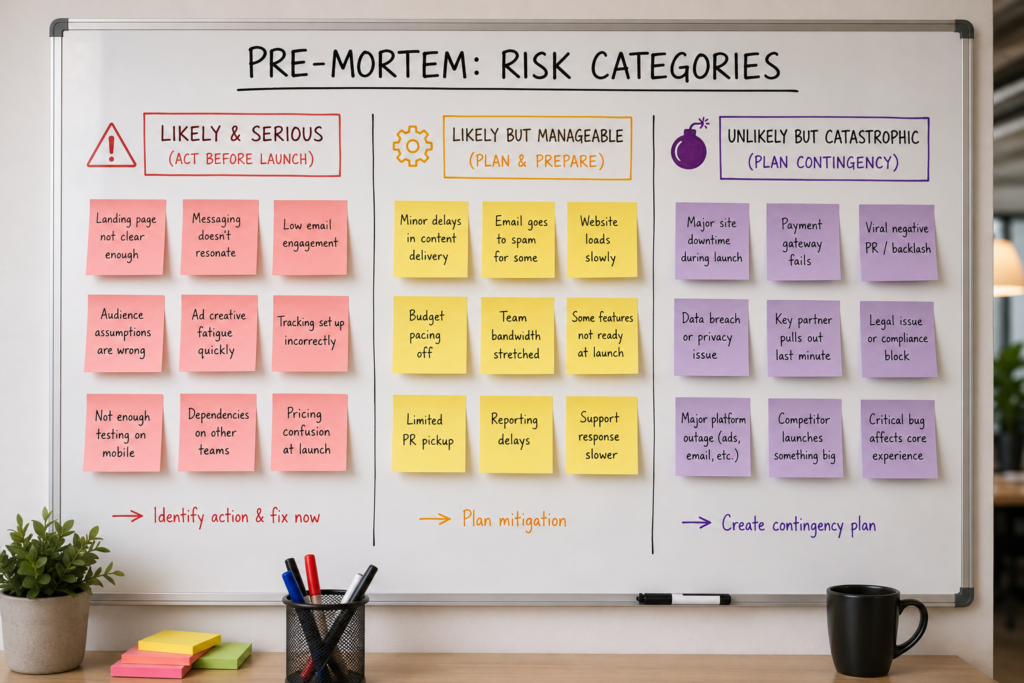
Sort the Risks
Once the risks are all on the board, sort them. Three categories work well.
🟥 Likely and serious
🟨 Likely but manageable
🟪 Unlikely but catastrophic
The first two require pre-emptive action before launch. The third one requires a contingency plan.
Turn Risks Into Actions
For each risk in the first two categories, the team identifies one specific action that reduces it.
Don’t settle for:
❌ “We should be more careful with messaging.“
Instead, choose something concrete.
Examples:
- “We will test the homepage copy on five customers in our target segment before launch.”
- “We will set up a daily monitoring routine for the first two weeks and assign one person to own it.”
- “We will write the bad-press response now, while we have time, before the scramble.”
The exercise often surfaces simple fixes that would have been obvious in hindsight.
Examples include:
- The launch needs a fallback for the payment gateway going down.
- The ad creative needs a version that doesn’t depend on a particular reference some markets won’t recognise.
- The launch date is during a regional holiday in one of the brand’s key markets, which nobody had noticed.
⇥ A Few Things to Keep in Mind
Founders should speak last.
Founders unintentionally set the ceiling for what the team feels comfortable saying.
A founder who jumps in early to defend the plan stops the exercise from working.
Junior team members usually have the best insights.
They see the campaign through fresher eyes and often spot the obvious problems that senior members have rationalised away.
Don’t skip the writing step.
The temptation to just “talk through risks” is strong.
The exercise loses 70% of its value without the silent individual writing phase.
Make it a habit.
Run a pre-mortem before every significant launch.
Not every blog post needs one, but every major campaign, product launch, rebrand, or category expansion does.
Final Thought
The pre-mortem is cheap.
⏱️ Ninety minutes.
📄 A shared document.
🤝 A willingness to be honest.
It surfaces the things that would have come up anyway in a post-mortem, with the small advantage of doing so before the money was spent.
Most marketing failures get spotted early by someone on the team, then ignored because nobody made it safe to say them out loud.
The pre-mortem makes it safe.
Try it before the next launch.
The launch will probably go better.
And if it doesn’t, at least you’ll know why earlier.