

 Back to Blogs
Search Without Search Engines: How Consumer Journeys Are Changing
📱 Pay Attention to How You Actually Look for Things Now
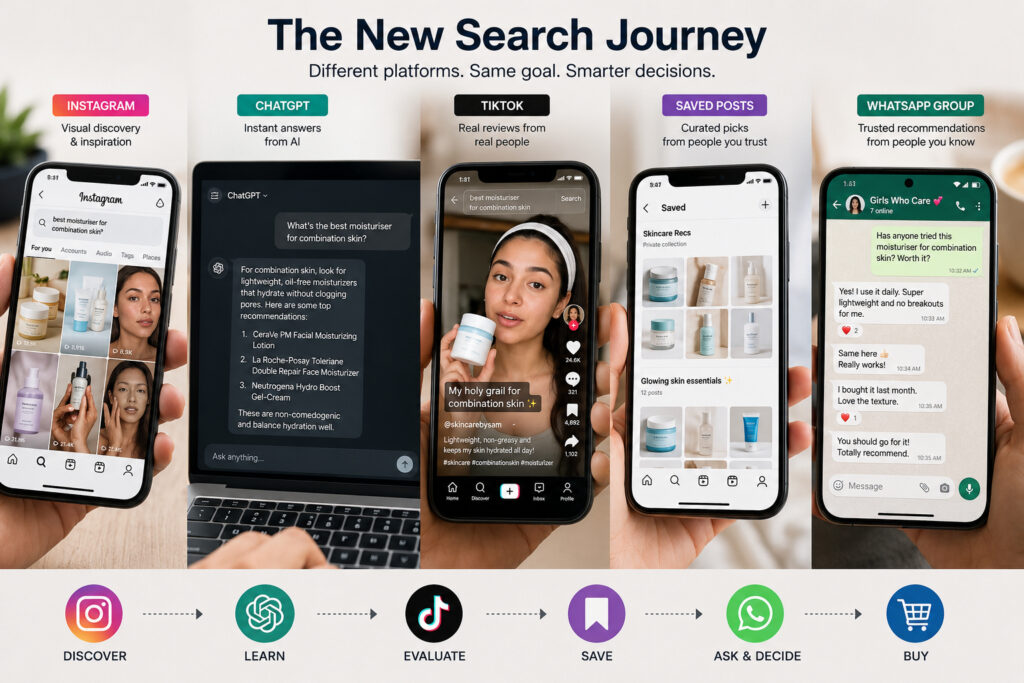
The next time you want to buy a moisturiser, watch yourself.
👉 You don’t open Google and type “best moisturiser for combination skin.”
Instead, you:
- Open Instagram
- Ask ChatGPT
- Watch three TikTok reviews
- Scroll your friend’s saved posts
- Ask the WhatsApp group
What you almost never do anymore is go to a search engine, type your query, click through the top three results, and read a blog post titled “10 best moisturisers for combination skin in 2026.”
Your customers aren’t searching the way they used to.
And most brands haven’t noticed yet, which is why their organic traffic is dropping while their competitors keep growing.
Search has fragmented into a dozen smaller behaviours that all used to live inside Google. The fragmentation is uneven, generation-specific, region-specific, and category-specific, but the overall pattern is clear.
📌 The single dominant search engine of the last two decades is being slowly replaced by a layered, scattered, more human system of discovery.
And the brands paying attention are restructuring everything about how they show up online.
Here’s how the new search actually works, broken into the main behaviours.
AI Assistants Have Become the New Information Layer
AI assistants now handle most of the questions that used to go to Google.
- ChatGPT
- Claude
- Perplexity
- Google’s AI Overviews
They answer informational queries directly.
Examples:
- “What’s the difference between niacinamide and vitamin C?”
- “What’s the best way to learn Mandarin?”
These used to drive billions of clicks.
Now they get answered inside the AI itself, and the customer never visits a brand’s website.
For brands built on top-of-funnel SEO, this is a quiet apocalypse.
Social Platforms Have Become Search Engines
Instagram and TikTok are now the default search engines for anything visual or experiential:
- 🍽️ Restaurants
- 👗 Outfits
- ✈️ Holiday destinations
- 🧴 Skincare
- 🏡 Home renovations
- 📷 Wedding photographers
The customer searches inside the app, watches a few videos, looks at saved posts, and decides without ever opening a browser.
📍 Gen Z almost never trusts a Google result over a TikTok review.
📍 The Middle East has shown some of the strongest movement, with Instagram functioning as a primary search engine for everything from cafes in Riyadh to car services in Dubai.
WhatsApp Is the New Recommendation Engine
WhatsApp and group chats have absorbed a huge slice of what used to be social search.
The recommendation from the close-friends group carries more weight than any algorithmic search.
A single:
“Has anyone tried this brand?”
message in a group of seven people produces a more trusted answer than reading 20 reviews on a website.
What Does All of This Mean for D2C and Consumer Brands?
1️⃣ Google’s Share of Attention Is Shrinking
The share of customer attention that used to flow through Google has shrunk dramatically and is still shrinking.
Brands that built their entire growth model on SEO traffic are watching that traffic decline year on year, sometimes by:
- 📉 30%
- 📉 40%
- 📉 50%
even as they keep producing content.
The content still ranks.
❌ The clicks have left.
Meanwhile, marketplaces like:
- Amazon
- Flipkart
- Noon
have absorbed much of the transactional search, with customers searching, comparing, and buying without ever visiting the brand’s own site.
2️⃣ Every Discovery Channel Has Different Rules
Each new search behaviour has its own rules.
📸 Instagram rewards:
- Visually distinctive products
- Consistent aesthetics
🎥 TikTok rewards:
- Creators above all else
🤖 AI Search rewards:
- Genuine expertise
- Original research
💬 WhatsApp and DM-based discovery rewards:
- Reputation
- Word-of-mouth trust
Each is a different discipline.
Brands need to be intentional about which ones they’re investing in.
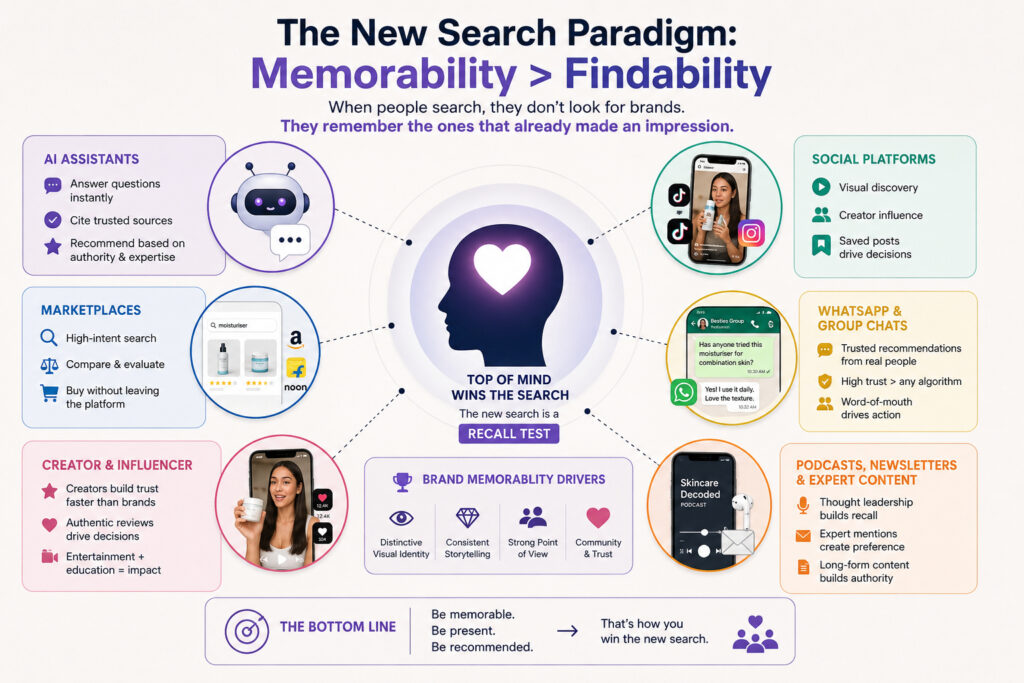
3️⃣ Memorability Is Replacing Findability
Perhaps the most important shift:
⭐ The new search system rewards brand memorability much more than findability.
When a customer searches inside ChatGPT or asks a WhatsApp group for a recommendation, the brand that comes up first is the one already in someone’s mind.
Google rankings have stopped mattering for this conversation entirely.
📌 The new search is a recall test.
What About B2B Brands and Founders?
The same shift is hitting B2B slightly later.
Today’s buyers:
- Ask ChatGPT to evaluate vendors
- Search LinkedIn for case studies
- Listen to podcasts where experts mention specific tools
The sales cycle is being shaped by content that doesn’t live on any vendor’s website.
Why Founders Should Pay Attention
The founder who shows up consistently on:
- Podcasts
- YouTube
- Newsletters
builds brand presence that survives the death of traditional search.
The founder hiding behind a corporate website that ranks well for niche keywords is building on land that gets more expensive and produces less every quarter.
What Should Brands Actually Do?
Stop Treating SEO as the Primary Distribution Channel
Treat it as one of seven or eight channels, and allocate accordingly.
The brands winning in 2026 have credible presences across:
- 🤖 AI
- 📱 Social
- 🛒 Marketplaces
- 🎥 Creators
- 👥 Communities
The brands losing are the ones still relying on Google as the main door.
A Practical Shift in Content Strategy
At Mirra Digital, we increasingly tell clients to think of content as feeding multiple discovery systems at once.
The same insight, restructured for:
- AI citation
- Social engagement
- Word-of-mouth sharing
Brands that adapt are growing.
The ones still chasing keyword rankings are running out of road.
Final Thought
Customers are still searching.
They’re doing it in places and formats most brands haven’t accounted for.
✅ The fix is to meet them where they actually look now.