


 Back to Blogs
The 30-Minute Weekly Audit That Will Save Your Social Media Strategy

Most brands have a social media strategy that worked when it was written and hasn’t been looked at since. The calendar keeps running, posts keep going up, the team keeps showing up to weekly reviews with the same colour-coded sheet, and somewhere down the line, it all becomes monotonous.
👉Posting for the sake of posting.
👉Nobody’s actually watching what’s working anymore.
This is the failure mode that kills more strategies than any algorithm change. A plan nobody updated.
The fix is shockingly simple. Thirty minutes a week 🕒, every week, looking at what’s actually happening on your accounts and deciding what, if anything, needs to shift. That’s it. Most agencies and in-house teams don’t do this consistently, and the ones who do tend to outperform the ones who don’t by a margin that’s almost embarrassing.
⇥ Here’s what those thirty minutes should actually cover.
Start with the numbers from the last seven days.
📌 Reach, 📣
📌 Engagement, ❤️
📌 Saves, 🔖
📌 Shares, 🔄
📌 Follower movement, 📈
📌 Story completion rates if your platform shows them. 📲

You’re not looking for vanity totals, you’re looking for outliers. The post that did unusually well, the post that flopped harder than expected, the format that’s quietly climbing without anyone noticing. Outliers are where micro-trends live, and micro-trends in your own data are more useful than any industry trend report you’ll read this week. Your audience is telling you something specific. The job is to listen.
Next, look at what your competitors and adjacent brands are doing. Not to copy, just to notice.
- Are they trying a format you haven’t?
- Are they leaning harder into reels while you’re still doing carousels?
- Did one of them post something that genuinely worked?
You don’t need to react every week, but you do need to know what’s happening in the neighbourhood, otherwise you’ll miss a shift until it’s six months too late.
Then check the calendar against reality. The strategy you wrote three months ago assumed certain things, and some of those assumptions have probably changed. Maybe your audience has moved more to stories. Maybe a new format is outperforming the one you’re scheduled to keep producing. Maybe a topic you used to lean on isn’t pulling its weight anymore. Adjusting doesn’t mean rewriting the whole strategy, it means tweaking the next two weeks based on what the last one actually told you. Strategies are not stone tablets. They’re working hypotheses.
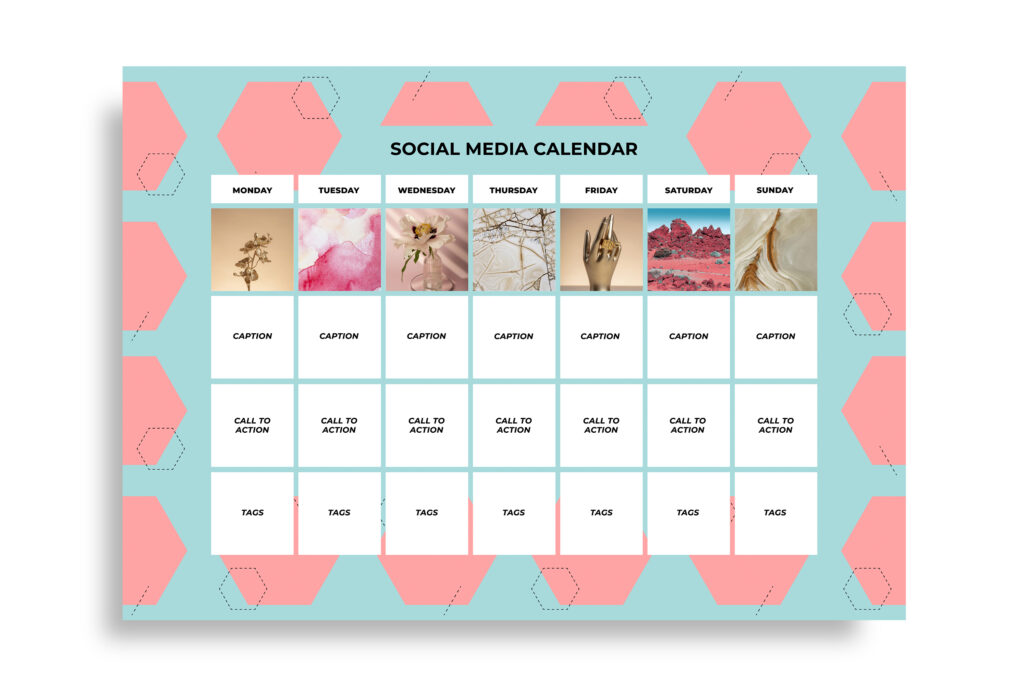
This is where most brands give up on the audit, because it requires admitting that the original plan isn’t perfect. The plan was never going to be perfect. The point is to keep adjusting it.
⇥ The experiment slot
This is the part that gets skipped most often, and it’s the one we care about most. Every weekly audit should include a small experiment for the coming week. Not a full pivot, just one thing you haven’t tried, or one thing you’ve stopped trying. A different format, a different posting time, a different hook, a different topic angle. Something.
If something is working, leave it alone. If it’s not broken, don’t fix it. But if engagement is flat or quietly declining, the worst thing you can do is keep doing the same thing harder. Experimenting is how you find what clicks, and you genuinely never know which experiment will be the one that opens up a whole new direction. We’ve had clients see real shifts from changes that looked tiny on paper. A reel format we’d dismissed. A topic we hadn’t touched in months. A posting time that turned out to actually matter.
Trial and error isn’t a sign that your strategy is weak. It’s a sign that your strategy is alive.
The biggest cost of skipping the weekly audit isn’t a bad post. It’s the slow drift into autopilot. The team keeps producing, the client keeps paying, but the question “what value are we actually bringing this month” gets harder and harder to answer with anything specific. Thirty minutes a week is the difference between a strategy that breathes and a strategy that’s quietly suffocating while everyone pretends it’s fine.
Pull up your numbers, look at your outliers, glance at the neighbourhood, tweak what isn’t working, and pick one thing to test next week. That’s the entire audit. You can do it on a Monday morning before your first meeting.
Do it every week for three months and your strategy will look almost nothing like the one you started with. That’s the goal. A plan that adapts is worth ten plans that look pretty in a deck.