

 Back to Blogs
The Agency Is Dead. Long Live the Agency.

The agency vs in-house debate is one of those conversations that gets dragged out every quarter, usually by someone who profits from one side of the answer. Founders post about how they cut their agency and built a lean in-house team. Agency owners post about why in-house always plateaus. Everyone nods along to whichever post matches what they already believed.
The whole debate is the wrong question, and it’s wasting a lot of founders’ time and money.
Here’s what’s actually happening in 2026. 👇
A lot of brands are trying to bring marketing in-house, and the version of in-house they’re building is, with respect, slightly absurd.
They’ve got a developer with spare bandwidth, so suddenly that developer is doing social media. 👨💻➡️📱They’ve got an IT person who can use ChatGPT, so now that person is writing blog posts and product captions. 🤖✍️
Then everyone wonders why the marketing isn’t working, and the founder concludes that marketing itself is broken, when actually the only thing broken is the assumption that a developer with capacity is a content team.
Marketing is a discipline. Multiple disciplines, actually.
📌 Strategy,
📌 copy,
📌 design,
📌 paid media,
📌 SEO,
📌 analytics,
📌 community,
📌 brand.
You can’t just hand it to whoever has time on their calendar and expect results.
This is the part of the in-house pitch nobody wants to admit.
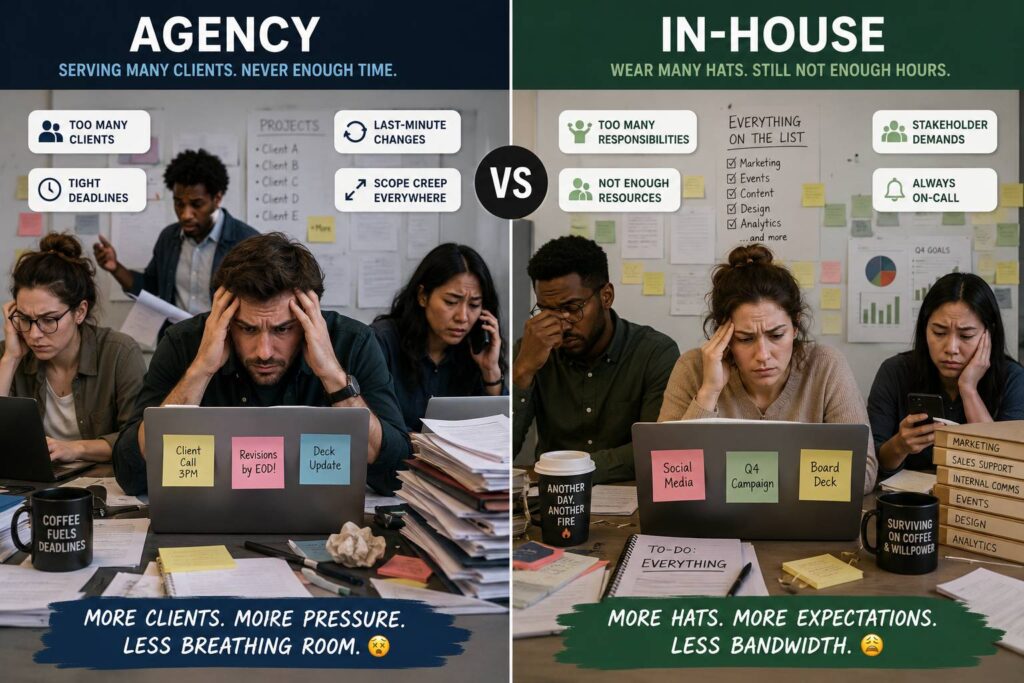
On the other side, agencies have their own version of the same problem.
A lot of agencies have stopped giving clients real attention because of how the model is structured.
📌 Twenty clients on a single team, 📞
📌 hourly billing for every meeting, 💰
📌 additional charges for anything that wasn’t in the original scope, 📋
📌 dedicated account managers who are managing eight other accounts simultaneously.
As an agency owner, I’ll say it plainly.
Some of this is fair, because clients pay for service, not for round-the-clock dedication, and a retainer is a retainer.
Some of it is genuinely not fair, because at some point “juggling fifteen clients” stops looking like a business and starts looking like a content factory pretending to be a partnership.

So when a founder asks “agency or in-house,” they’re asking the wrong question.
The right questions are different. 👇
- What kind of partner do I actually need? 🤔
- Do I need someone to execute, or someone to push back?
In-house teams are paid to execute. Agencies are paid to disagree, advise, and challenge.
That’s a real structural difference, and it shows up in the work. An in-house team will usually nod and ship what the boss wants. An agency, if it’s any good, will tell the boss when the boss is wrong.
You can’t underestimate how valuable that is until you’ve watched a brand make six avoidable mistakes in a row because nobody internally felt safe pushing back.
What’s the cost reality?
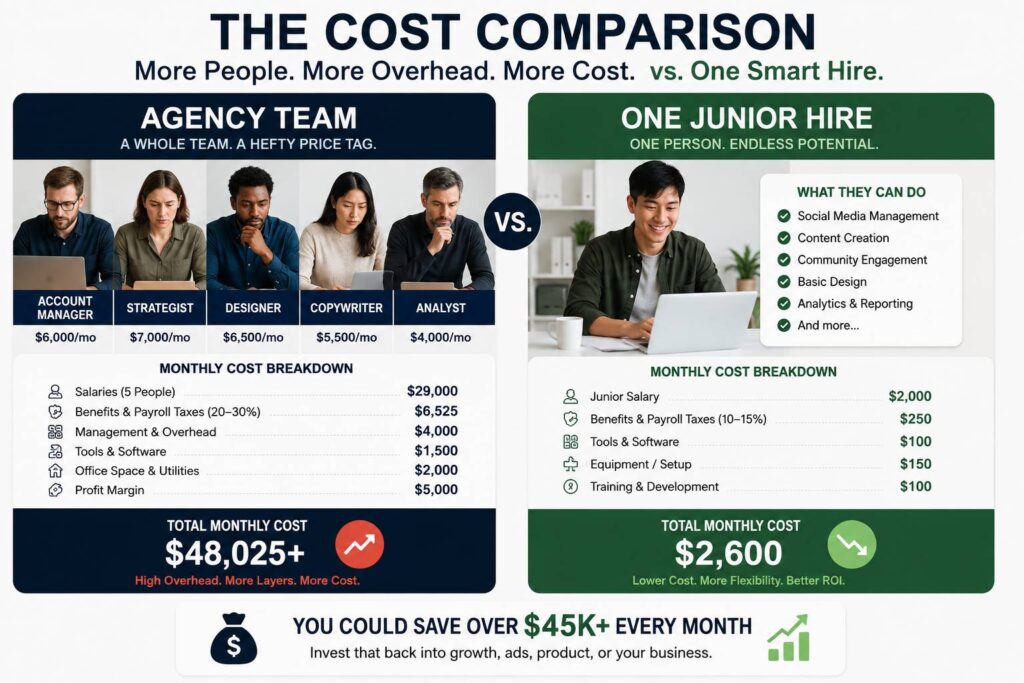
Founders love comparing agency retainers to a junior in-house salary, as if those two things are remotely the same. They’re not.
A retainer covers :
- a strategist,
- a copywriter,
- a designer,
- a social media manager,
- sometimes an SEO specialist and
- a paid media person, all working on your account.
A junior hire covers one person who is still learning.
If you genuinely need a senior strategist, a senior writer, a senior designer, and a senior SEO person in-house, you’re looking at a payroll that makes any agency retainer look generous.
Be honest about what comparison you’re actually making.
What does an agency see that in-house can’t?
Pattern recognition.
An agency working across :
- skincare, 💄
- real estate, 🏠
- B2B SaaS, 💻 and
- DTC food brands 🍔
picks up patterns nobody inside one of those companies will ever see.
In-house teams get fluent in their one brand and slowly lose the ability to look at it with fresh eyes. That outside perspective has real commercial value, and it’s hard to replicate from inside.
So where does this leave the hybrid model everyone keeps talking about?
It works, but only when the split is by function, not by task.
The failed version is in-house doing “the easy stuff” and the agency doing “the hard stuff,” because then nobody owns the whole picture.
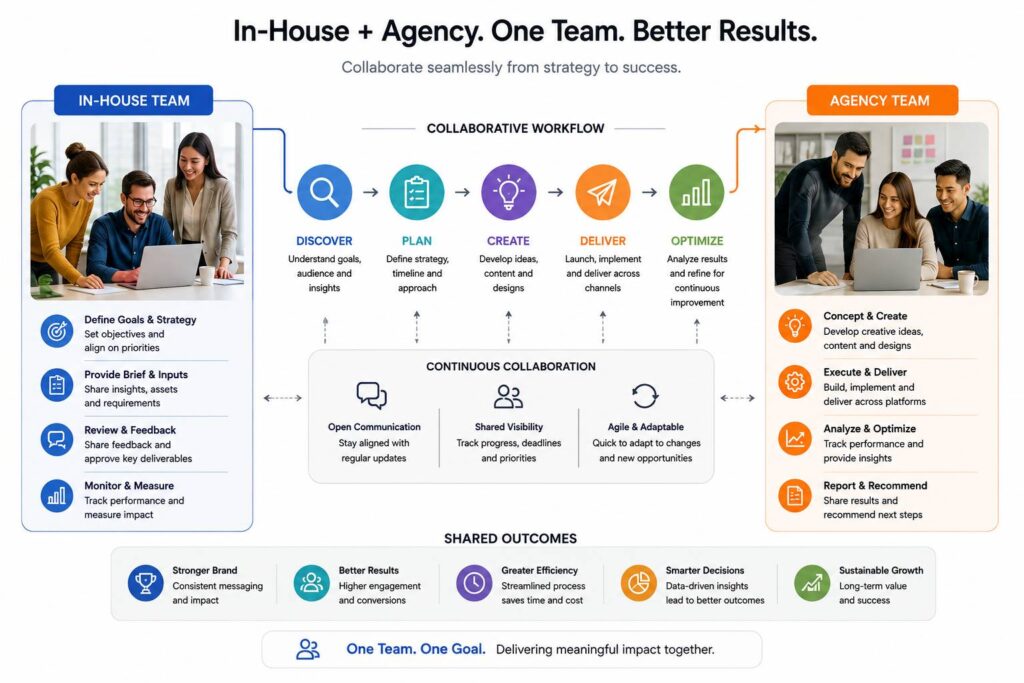
The version that works is in-house owning the things that need to live inside the business, like
- community management,
- customer-facing comms,
- anything time-sensitive, and
the agency owning the things that benefit from outside perspective, like
- strategy,
- creative direction,
- campaigns, and
- brand-level decisions.
Two different jobs, both real, both essential, neither secondary.
The agency isn’t dead. The lazy version of the agency is dying, and good. The brands winning right now aren’t picking a side in this fake debate. They’re asking better questions about who does what, and they’re spending their money on the answer.