

 Back to Blogs
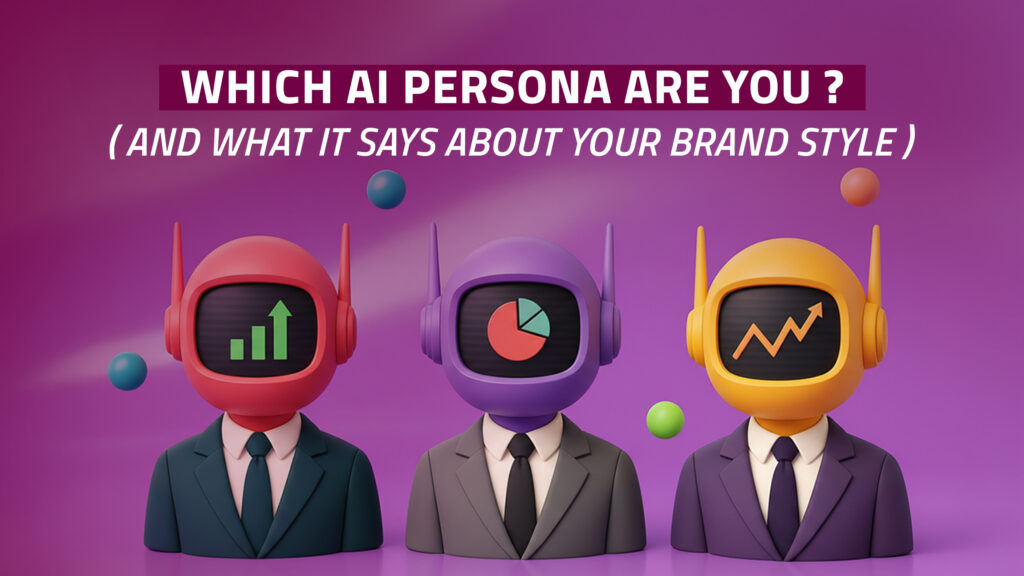
Which AI Persona Are You? (And What It Says About Your Brand Style)
Almost every brand today is using AI in some way. (Be honest!)
From writing captions to building ad copies to brainstorming campaign ideas – generative AI in marketing has quietly become everyone’s new teammate.
But the funny part is, even when brands use the same AI tools… they don’t sound the same.
That’s because your brand doesn’t just use AI. Your brand has an AI personality.
So…let’s play a fun game….shall we?
Read on and see which AI persona feels… uncomfortably familiar.
⇥ 🧠The Overachiever Strategist
You usually open AI with a plan in mind.
You ask it to build content strategies, map buyer personas, structure funnels and organise campaigns across platforms. You like clarity. You like frameworks. You like knowing exactly what goes where and why.
If someone looks at your brand from the outside, it feels well thought through. Your content marketing doesn’t exist just to fill a calendar. There’s always a purpose behind it.
The only small risk?
When AI starts doing too much of the polishing, your brand can begin to sound a little… rehearsed. Still credible. Still smart. Just slightly less you.
AI is brilliant at structure. Your job is to make sure your personality doesn’t get smoothed out along the way.
⇥ 🎨 The Creative & Slightly Cluttered Brain
You use AI more like a creative playground than a planning tool.
You throw half-formed thoughts into prompts. You ask for funnier captions. Weirder campaign ideas. Better hooks. You’re constantly chasing that one line that finally feels right.
From the outside, your brand feels warm and expressive. You care about how things look, how they feel and how people emotionally connect with your content. Storytelling matters more to you than spreadsheets.
But when ideas keep flowing faster than they get shaped, things can also start feeling scattered.
Sometimes, the most powerful way to use AI isn’t to generate more ideas, it’s to help you organise the brilliant ones you already have.
⇥ 📊 The Performance Marketer in Disguise
Your relationship with AI is refreshingly practical.
You use it to write multiple ad variations, sharpen hooks, test headlines and optimise copy for conversions. If it doesn’t move clicks, leads or enquiries, you’re not very interested.
Your brand sounds confident and clear. You speak directly to the problem and get to the benefit quickly. That’s exactly why AI works so well for you.
The catch is subtle.
When every brand in your category is using generative AI for marketing optimisation, it becomes very easy for everyone to start sounding very similar.
Your campaigns may convert beautifully, but your brand needs something deeper than performance language to stay memorable.
⇥ 🤖 The Automation Lover
You’re less obsessed with what AI writes and more excited about what it connects.
You’re building automated email journeys, CRM workflows, chat assistants and lead nurturing systems. You care about removing friction and making the customer journey smoother at every stage.
Your brand feels efficient and well-run. Nothing looks messy behind the scenes.
But when automation grows faster than tone and storytelling, brands can accidentally start feeling distant even when they’re technically doing everything right.
AI can run your workflows.
Only you can make sure your communication still feels human.
⇥ ✍️ The Reluctant AI User
You’re careful.
You still write most things yourself. You use AI mainly to tighten sentences, fix grammar, rephrase awkward lines or shorten long drafts.
Your brand often feels personal, founder-led and story-driven. You genuinely care about authenticity and you’re wary of sounding generic or “AI-ish”.
And that instinct is a good one.
The sweet spot for you isn’t letting AI create your voice. It’s letting it quietly protect your time, while you protect your tone.
So… which AI persona are you?
The part most brands overlook is that AI doesn’t shape your brand style. Your intent does.
Whether you’re using generative AI for content creation, digital marketing, campaign planning or performance advertising, the real outcome depends on how clearly you understand your brand voice before you ever open a prompt.
At Mirra Digital, we see this constantly.
Two brands can use the same AI tools, the same prompts and the same platforms, and still walk away with completely different brand identities.
Because tools don’t build brands.
People do.
AI simply exposes how well you actually know your own.