

 Back to Blogs
Digital Nostalgia Marketing: Why Brands Are Bringing Back Retro Experiences Online
Nobody Is Actually Living in the Past. They Just Feel Better When Brands Remind Them of It.
In 2019, Nike re-released the Air Max 90 in its original colourways with almost no modifications. No modern update, no reimagined silhouette, no “inspired by the classic” caveat. Just the shoe, as it was, because the shoe as it was is exactly what people wanted. It sold out. Of course it did. Because nostalgia marketing strategy, when it’s executed well, doesn’t need to try very hard. The feeling does the work.
Nostalgia is having a sustained moment in marketing right now, but understanding why it works requires going a level deeper than “people like things from their childhood”. The psychology is more specific than that, and more useful.
Nostalgic consumer psychology is rooted in something researchers call “temporal self-appraisal.” When people look back at the past, they tend to remember the emotional highlights, the summers that felt endless, the products that felt exciting, the cultural moments that felt shared. They’re not remembering the full picture. They’re remembering a feeling. And that feeling, crucially, is one of warmth, safety, and belonging. Brands that can credibly attach themselves to that feeling inherit some of it. That’s not manipulation, it’s just an understanding of how memory and emotion interact.
Coca-Cola has built an entire secondary brand identity around this principle. Their holiday campaigns consistently return to imagery and iconography from the 1930s and 40s, the contour bottle, the particular shade of red, the hand-illustrated style. None of it is accidental. It’s a vintage branding strategy designed to trigger associations with comfort and familiarity in people who weren’t even alive when those ads first ran. The feeling transfers across generations because the visual language of “classic” carries its own emotional weight.
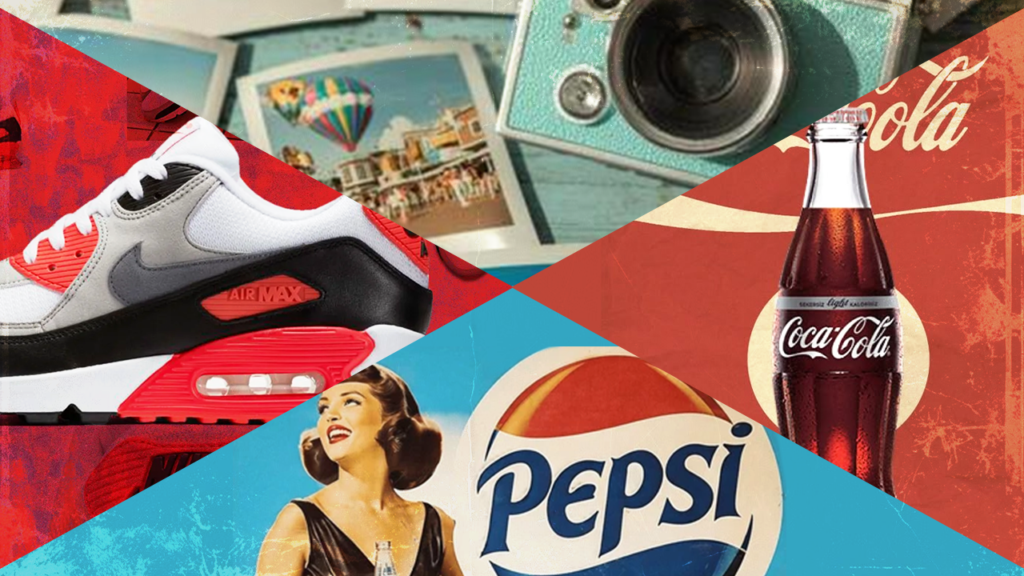
⇥ What’s changed recently is that nostalgia in advertising has found a particularly powerful home online, and the generations doing the most spending right now are the ones with the most potent digital nostalgia to mine.
⇥ Millennials and Gen Z grew up with early internet culture, Y2K aesthetics, pixel graphics, flip phones, and the particular visual texture of life before HD.
⇥ Brands paying attention to this have leaned in hard.
⇥ Pepsi’s retro logo revival, Polaroid’s sustained comeback, the wave of brands re-adopting chunky typography and washed-out colour palettes, all of it is retro digital marketing speaking directly to an audience that associates those aesthetics with a simpler, more optimistic moment in time.
The execution that tends to work best isn’t pure reproduction, it’s recontextualisation.
Stranger Things is a useful case study here, even outside of brand partnerships. The show understood that nostalgia isn’t about recreating the past accurately; it’s about recreating how the past felt. The 80s in Stranger Things is warmer, more saturated, more cinematic than the real 80s ever was. That’s the version people wanted, and that’s the version that generated one of the most effective waves of throwback marketing campaigns in recent memory, every brand that partnered with it got to borrow that feeling for their own product.
- Where nostalgia backfires is when it feels like a costume rather than a conviction.
- When a brand with no genuine history in a particular era suddenly adopts its aesthetics because the trend is moving that way, audiences, particularly younger ones, clock it immediately.
- It reads as cynical, and cynical nostalgia is worse than no nostalgia at all, because it reminds people that they’re being marketed to rather than spoken to.
- The brands that execute this well tend to have an authentic thread connecting them to the era they’re invoking, or the creative intelligence to build one that feels earned.
The other risk is over-indexing on the past at the expense of relevance. Nostalgia should be a bridge, not a destination. The most durable version of this strategy uses a retro reference point to establish emotional connection, then walks the audience forward into something current. It says: we know where you came from, and we’re still here with you. That’s a very different message from: we have nothing new to offer, so here’s something old.
At Mirra Digital, we think the best creative branding services don’t just follow cultural moments, they help brands find their own authentic place within them. Nostalgia is a powerful tool, but like most powerful tools, the results depend entirely on who’s handling it and whether they actually know what they’re building.